

Port Sudan – Sudan Now | January 18, 2026
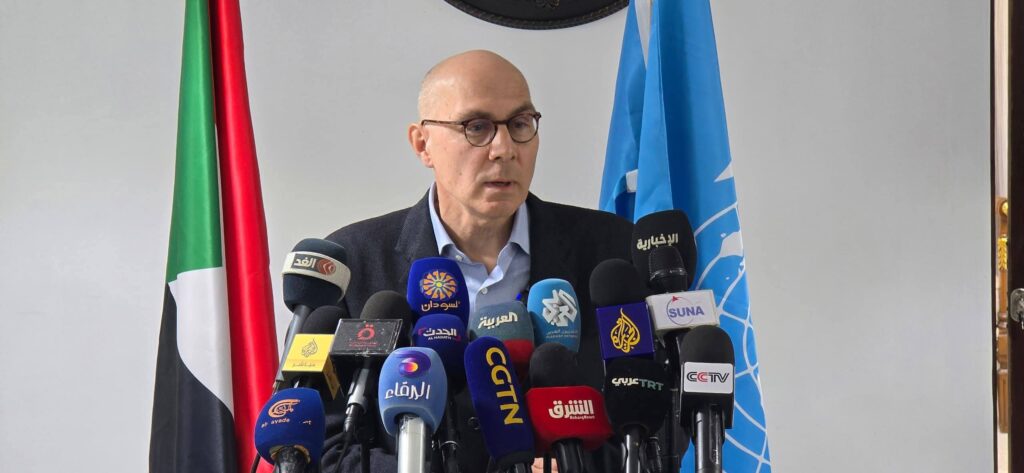
The United Nations High Commissioner for Human Rights, Volker Türk, warned that serious violations committed against civilians in Sudan and attributed to the RSF may amount to war crimes under international humanitarian law.
Türk said, during a press conference held today at Port Sudan Airport at the conclusion of a four-day visit, that testimonies he heard from residents in the cities of Port Sudan, Dongola, Al Dabbah, and Merowe revealed a widespread pattern of violations. These included attacks on civilian infrastructure, sexual violence, and extrajudicial killings. He called for an immediate end to these violations and for ensuring the protection of civilians.
The High Commissioner praised the role played by youth, volunteers, and civil society organizations in providing humanitarian services and legal support to victims of violations, stressing that the spirit of struggle for peace, justice, and freedom among the Sudanese people remains unbroken, despite nearly three years of what he described as a “brutal” war against civilians.
Türk expressed deep concern over the repeated drone attacks on Merowe Dam and the power generation station, which have caused power outages affecting hospitals and disrupted irrigation systems and clean water supplies. He warned that targeting vital civilian infrastructure constitutes a serious violation of international humanitarian law.
He also warned of the rapidly deteriorating humanitarian situation and food security, pointing to indicators of impending famine in Kadugli, and the risk of famine in other areas, including Dilling, amid the ongoing siege and lack of access to humanitarian aid.
The High Commissioner highlighted what he described as “horrifying” testimonies from war victims, including children and displaced women who were subjected to shelling, looting, and sexual violence while fleeing the city of Al Fashir, stressing that the use of sexual violence as a weapon in conflict constitutes a war crime.
He also pointed to reports of summary executions and the detention of thousands of civilians in Al Fashir, calling for the immediate release of civilian detainees, clarification of the fate of the missing, and unhindered access for humanitarian aid to all affected areas.
Türk concluded by urging all parties to prioritize the shared interests of the Sudanese people and to work seriously toward ending civilian suffering and creating the conditions for a just and lasting peace
Since the outbreak of the conflict in April 2023 between the Sudanese Armed Forces and the RSF, Sudan has been facing one of the world’s worst humanitarian crises. The fighting has resulted in the deaths of tens of thousands of people and the displacement of more than 10 million inside and outside the country, according to United Nations estimates.
The conflict has been accompanied by a widespread collapse of basic services, particularly in the health and food sectors, and repeated attacks on civilian infrastructure, amid severe difficulties faced by humanitarian organizations in accessing affected areas.


