
Port Sudan – Sudan Now | April 25, 2026
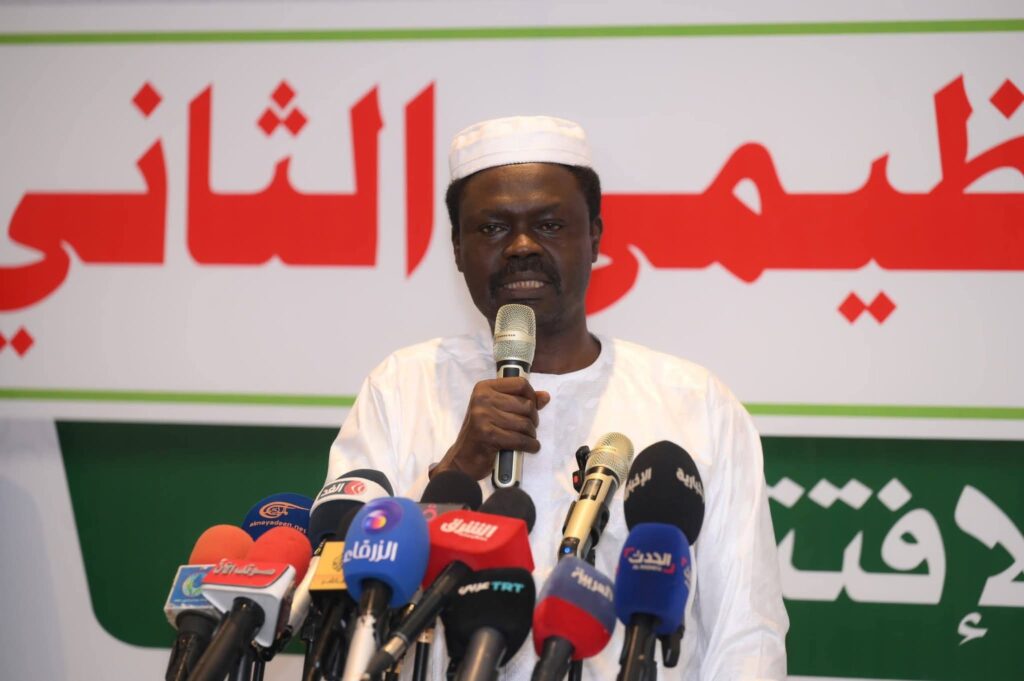
The Governor of the Darfur Region and Chairman of the Sudan Liberation Army Movement, Minni Arko Minnawi, stated that Sudan has been forced into a war it did not need, noting that expectations following the signing of the Juba Peace Agreement were that the phase of killing, displacement, forced migration, and violations -including rape- would be the last in the country’s history.
He made these remarks during a meeting of the Democratic Bloc – Forces of Freedom and Change in Port Sudan, where he explained that the current reality has created a state of political vacuum. He noted that this vacuum has been filled by certain groups, not due to their strength, but because of the absence of what he described as a “democratic bloc” capable of representing the aspirations of the Sudanese street.
Minnawi stressed that the continued presence of the Democratic Bloc is essential at this stage, alongside preserving social cohesion, underscoring that Sudan will not be allowed to be turned into an arena for chaos or narrow interests.
He added that previous experiences have revealed significant challenges in the political process, necessitating a reorganization of political action through a clear program. He emphasized the importance of the role of democratic forces in correcting the course and genuinely expressing the national position.
He noted that previous meetings of political forces had produced recommendations that were submitted to the Presidency Council, considering that the current phase requires a higher level of coordination and organization.
He said that talk of peace in Sudan still faces a gap in political representation, and that calls for the country’s unity lack genuine advocates, pointing to the absence of the Democratic Bloc from this role.
He added that the Sudanese street is ready for political engagement and that political activity is possible, stressing that the Sudanese people are waiting for the Democratic Bloc to lead the political scene and present a practical model of governance and achievement.
Minnawi underscored that the current phase requires assuming organizational responsibility and working collectively, emphasizing the importance of unity and consensus among democratic forces.
In conclusion, he affirmed that the Democratic Bloc represents the “remaining capacity” for addressing Sudan’s issues, stressing the need to harness it in order to achieve national unity and the return of refugees and detainees, and called for continued joint efforts to realize these goals.
These remarks by Minnawi come amid a political movement led by forces aligned with the Democratic Bloc – Forces of Freedom and Change, as efforts continue to reshape Sudan’s political landscape following the collapse of the transitional process and the escalation of the armed conflict since April 2023 between the army and the RSF. The situation has resulted in a political vacuum and a diminished role for civilian forces in influencing the course of events.
It also coincides with the stalled implementation of the 2020 Juba Peace Agreement, particularly regarding security arrangements and power-sharing provisions. The situation is further compounded by a deteriorating humanitarian crisis and a rising number of displaced persons and refugees, prompting some political actors to propose initiatives aimed at rebuilding a civilian bloc capable of contributing to peace and stability efforts.