
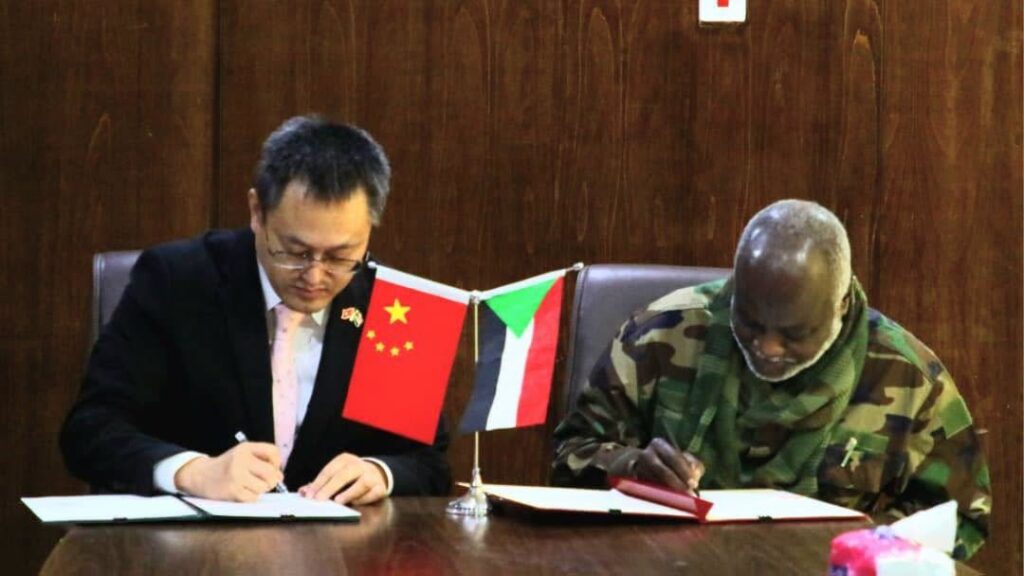
PORT SUDAN – Sudan and China on Saturday signed a protocol under which Beijing agreed to cancel part of Sudan’s debt, writing off four interest-free government loans worth 344.52 million Chinese yuan (about $50 million), as Khartoum seeks international support to ease mounting economic pressures caused by more than three years of war.
The protocol was signed in Port Sudan by Sudan’s Finance and Economic Planning Minister Jibril Ibrahim and Xu Jian, Chargé d’Affaires of the Chinese Embassy in Sudan.
The agreement takes effect immediately upon signing. Under its terms, the Central Bank of Sudan and the China Development Bank will complete the financial procedures required to finalize the debt cancellation.
Finance Minister Jibril Ibrahim welcomed the agreement, describing it as a reflection of the long-standing economic partnership between Sudan and China. He said Khartoum was committed to strengthening bilateral cooperation and praised Beijing’s continued support during what he described as a difficult period for Sudan, particularly in investment, oil production and international diplomacy.
Ibrahim said Sudan remained an important gateway for Chinese investment in Africa and welcomed China’s decision to exempt exports from 50 African countries from customs duties, describing the move as an important step toward expanding economic cooperation.
He also said China had expressed readiness to support capacity-building programs for Sudanese government officials through professional training initiatives, including courses offered by the Academy for International Business Officials (AIBO).
For his part, Xu Jian said China remained committed to supporting Sudan’s economic development, easing its debt burden and strengthening economic cooperation between the two countries.
The two sides also reviewed progress on Chinese grant-funded projects in Sudan, including the West Omdurman slaughterhouse project and a 200 million yuan grant announced by Chinese President Xi Jinping to support energy, water and agricultural projects. They also discussed removing obstacles to banking cooperation and the resumption of operations by China National Petroleum Corporation (CNPC) in Sudan.
China has remained one of Sudan’s principal economic partners for more than two decades, particularly in the energy sector, where Chinese companies have played a leading role in oil production, infrastructure development and financing.
Sudan’s economy has deteriorated sharply since the outbreak of war between the Sudanese Armed Forces (SAF) and the Rapid Support Forces (RSF) in April 2023. The conflict has disrupted trade, reduced government revenues, weakened the Sudanese pound, damaged critical infrastructure and displaced millions of people, while international financial institutions have warned of mounting fiscal pressures and growing humanitarian needs.