

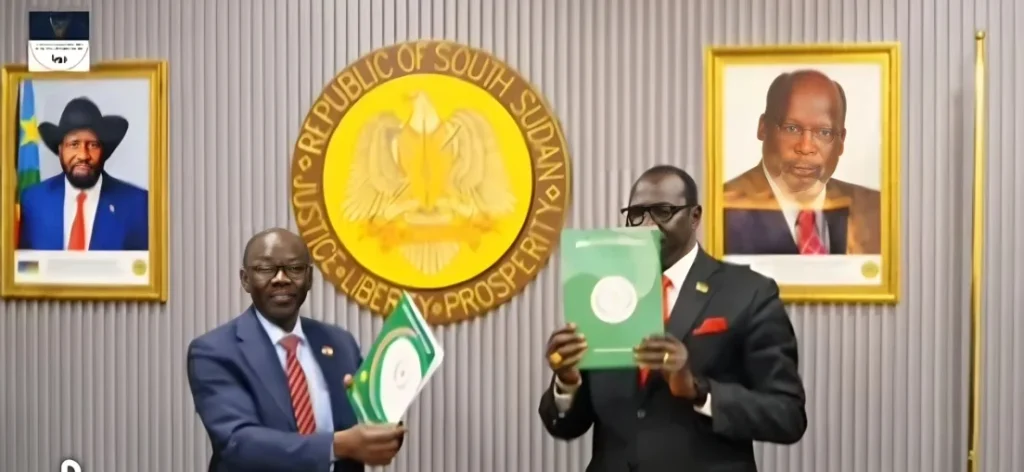
JUBA –Sudan and South Sudan signed the outcomes of a joint political and security committee meeting in Juba, but neither side immediately disclosed the details of the decisions reached during three days of talks.
The meetings of the Joint Political and Security Committee were held in the South Sudanese capital from August 9 to 11, bringing together senior defense and security officials from both countries.
Sudan’s Defense Minister Lt. Gen. Hassan Dawood Kabroun signed on behalf of Khartoum, while South Sudan’s Minister of Defense and Veterans Affairs Gen. Chol Thon signed for Juba.
The two sides said they agreed to strengthen cooperation and coordination on issues related to the committee’s mandate, in support of security and stability in both countries.
Kabroun arrived in Juba on Sunday at the head of a high-level delegation. He was received at Juba International Airport by Chol Thon, South Sudan People’s Defence Forces Chief of Staff Gen. Santino Deng, and senior military officers.
The meetings discussed political and security issues of mutual concern, including ways to improve coordination between the two countries. During the visit, the Sudanese delegation also held talks at South Sudan’s Ministry of Defense, attended by Sudan’s acting chargé d’affaires in Juba, Mubarak Mahjoub, a representative of Sudan’s army chief of staff, Maj. Gen. Al-Walid Ajabna, and Sudan’s military attaché, Brig. Gen. Mustafa Al-Mulatham.
The talks also addressed border cooperation, including procedures regulating the movement of people across the shared frontier, a long-standing security issue between the two countries.
The committee’s meeting comes as Sudan and South Sudan continue to face unresolved files dating back to South Sudan’s independence in 2011, including the disputed Abyei region, border security, oil transit, cross-border movement and refugee flows.
Abyei remains one of the most sensitive disputes between the two countries. The oil-rich region’s final status has not been resolved, while the United Nations Interim Security Force for Abyei (UNISFA) continues to support local de-escalation efforts and protect civilians amid recurring tensions between communities.
Security along the long Sudan–South Sudan border has also become more complicated since the outbreak of Sudan’s war in April 2023, with concerns over the movement of armed groups, weapons and displaced civilians across the frontier.
Oil is another central issue in relations between Khartoum and Juba. South Sudan depends heavily on oil exports, while key parts of its crude pass through Sudanese territory and infrastructure to reach Red Sea export terminals. Sudan’s war has repeatedly threatened oil facilities and transit routes, adding pressure to South Sudan’s already fragile economy.
The conflict in Sudan has also driven more than a million people into South Sudan, including refugees, asylum seekers and South Sudanese returnees, increasing pressure on limited services in border areas and displacement sites.
Despite the signing ceremony, both governments limited their public statements to general commitments on cooperation and coordination, without announcing the specific decisions or security arrangements agreed during the talks.