
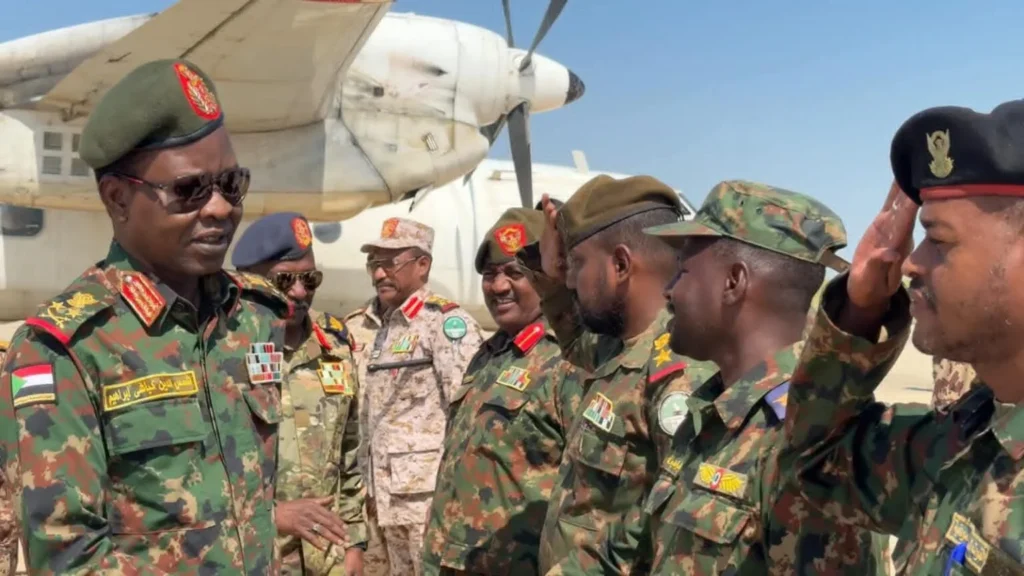
KHARTOUM – Sudan’s Sovereign Council Chairman and army chief Abdel Fattah al-Burhan has assigned senior military leaders Shams al-Din Kabbashi and Ibrahim Jaber to oversee key economic and service portfolios as the government grapples with power shortages, fuel pressures and rising living costs.
Under the decision, Kabbashi was tasked with following up and supervising the energy, oil and electricity sector, while Jaber was assigned responsibility for consumer goods and other economic files, according to reports published on Wednesday.
The assignments come as Sudan’s energy infrastructure remains under heavy strain after more than three years of war. Energy and Oil Minister Al-Mutasim Ibrahim Ahmed said earlier this month that around 60% to 65% of electricity and oil infrastructure had been damaged, affecting generation, transmission, distribution and renewable energy systems.
Government officials have been working on plans to restore electricity generation and repair transmission networks, while also seeking to attract new investment into the oil sector. The Energy Ministry said on Wednesday that it was in contact with international companies interested in petroleum investment.
Kabbashi’s new role places him at the center of efforts to stabilize sectors viewed as critical to economic recovery and the restoration of public services.
Jaber’s assignment comes amid mounting pressure on household budgets as the Sudanese pound weakens and prices of basic goods rise.
Reuters reported this week that the Sudanese pound had lost nearly half its value since the start of summer in army-controlled areas, while the rising cost of essential goods had intensified hardship for civilians.
Jaber has also been involved in wider economic measures. On Tuesday, he chaired a meeting of the higher committee overseeing plans to replace Sudan’s currency, according to reports on the government’s economic measures.
The government has separately sought to revive discounted sales centers and increase the availability of essential goods as part of efforts to ease pressure on consumers.
The assignments also come as Sudanese officials frame electricity, fuel supplies, production and market stability as central to the country’s broader recovery and reconstruction plans.
The published decisions did not specify the duration of Kabbashi and Jaber’s assignments, the full extent of their executive powers or the additional economic portfolios that will fall under Jaber’s supervision.