

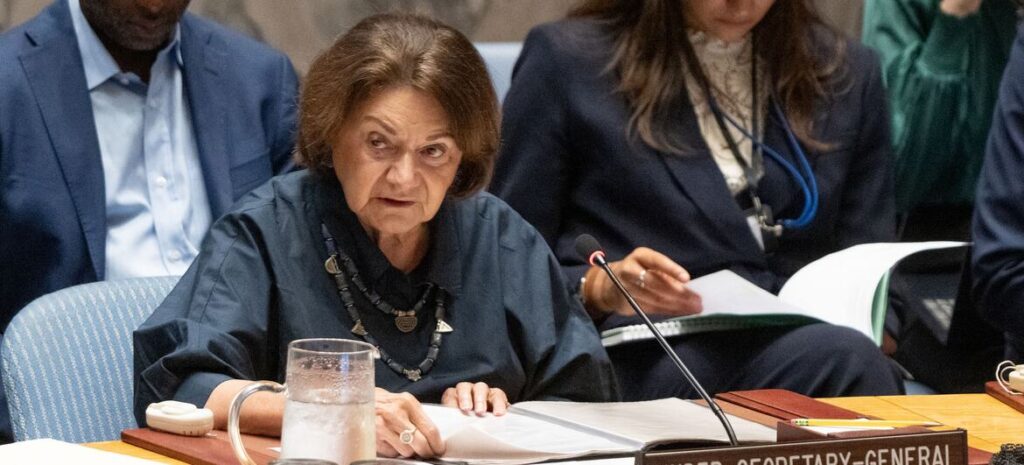
NEW YORK – Senior United Nations officials told the U.N. Security Council on Monday that Sudan’s war is escalating across multiple fronts and that the country’s worsening humanitarian crisis demands urgent international action, not further descriptions of the catastrophe.
The Security Council held an open briefing on Sudan as fighting intensified in North Kordofan, West Darfur, North Darfur and Blue Nile, with drones increasingly used in attacks and millions of civilians facing displacement, hunger and collapsing basic services. The meeting was scheduled under the council’s agenda item on reports of the secretary-general on Sudan and South Sudan.
Rosemary DiCarlo, U.N. under-secretary-general for political and peacebuilding affairs, said the consequences of Sudan’s conflict would be long-lasting and should shock the international community. She warned that the fighting was intensifying, the conflict was becoming more complex and civilian suffering was worsening.
DiCarlo said about 13 million people have fled their homes, including around 8.7 million internally displaced people across all 18 states. She said the U.N. human rights office documented the killing of about 1,400 civilians between January and June, including 1,100 people killed in drone attacks.
She said recent fighting has been marked by heavy drone use and limited ground clashes in areas less affected by the rainy season, with hostilities concentrated in North Kordofan, West Darfur, North Darfur and Blue Nile.
DiCarlo also expressed concern over fighting near the Sudan-Ethiopia border in Blue Nile, where military activity has recently intensified around border areas. Sudanese authorities have accused foreign territory of being used to support attacks, while regional tensions have grown alongside the spread of drone warfare.
The briefing comes as Sudan’s war, which erupted in April 2023 between the Sudanese Armed Forces (SAF) and the Rapid Support Forces (RSF), enters a more complex phase involving shifting front lines, wider use of drones, competing regional mediation tracks and growing evidence of external military support to the parties.
DiCarlo said the advanced weapons being used in the conflict point to continued external support for both sides. She said the U.N. continues to support efforts by the Quad — the United States, Saudi Arabia, Egypt and the United Arab Emirates — to reach a humanitarian truce.
She also said the U.N. is working with the Quint Mechanism, which includes the U.N., African Union, IGAD, Arab League and European Union, to help advance a viable political process.
DiCarlo welcomed efforts to promote civilian dialogue, saying youth, women, displaced communities, professional groups, business associations and local leaders want to take part in every stage of the peace process.
She said U.N. envoy Pekka Haavisto has continued contacts with the warring parties to press for an end to hostilities and discuss confidence-building measures. However, she warned that despite peace efforts, the parties remain committed to a military zero-sum logic.
U.N. humanitarian chief Tom Fletcher said two-thirds of Sudan’s population urgently need life-saving support. He said aid workers continue to operate across front lines, drone attacks, insecurity and bureaucratic obstacles.
Fletcher said the U.N. had reached nearly 11 million people by mid-year with at least one form of assistance, representing 52% of the priority target group. He said food assistance was on track to reach 11.4 million people, but aid delivery in education, health, shelter and water remained behind schedule.
He said Sudan’s humanitarian response remains underfunded, with just over 40% received of the $2.87 billion required for the 2026 response plan, despite pledges made at the Berlin conference in April.
Fletcher urged the Security Council not to hold another meeting that merely describes the problem, saying Sudan does not suffer from a lack of analysis but from a lack of action.
He said Sudanese civilians need food, water, medicine, peace and dignity, while external actors continue to send drones, weapons and fighters. He warned that Sudan is being used as a battleground in wider struggles over power, gold and regional influence.
The briefing underscored growing international concern that the war is becoming harder to contain as fighting spreads, humanitarian access remains restricted and the political process remains fragmented.


