
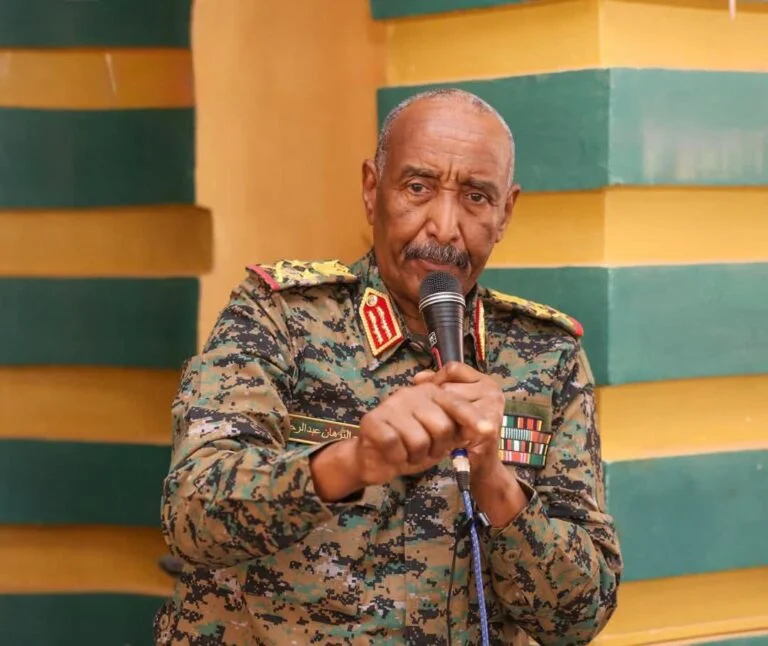
NORTHERN STATE – Sudan’s Sovereign Council Chairman and army chief Abdel Fattah al-Burhan said there were no negotiations or talks underway with any party, vowing to continue military operations against the Rapid Support Forces (RSF) and extend them into areas of Darfur, Kordofan and Blue Nile.
“We have no negotiations with anyone. We are not talking to anyone, and we have nothing going on with anyone,” Al-Burhan told a public gathering during a visit to Amri in Northern State.
He said Sudan had functioning state institutions and that the Security and Defense Council was the body responsible for decisions concerning negotiations, peace and war.
His remarks come amid regional and international efforts to push for an end to Sudan’s war, including U.S. calls for a humanitarian truce and an inclusive political dialogue leading toward a civilian-led government.
Addressing residents of areas where the RSF remains present, Al-Burhan said: “We are coming to you by force. We are not coming to persuade you or plead with you.”
He added that the army’s objective was to “uproot the enemy” and said what he described as the battle against the rebellion would continue until it was defeated.
Al-Burhan also addressed people in Darfur, Kordofan and Blue Nile, telling them that government forces would reach their areas as military operations continued.
The war between the Sudanese Armed Forces and the RSF began in April 2023 and has spread across large parts of the country, causing mass displacement and severe disruption to essential services. Repeated efforts to secure a lasting ceasefire have failed.
In the latest U.S. remarks on Sudan, Massad Boulos, U.S. Senior Adviser for Arab and African Affairs, reaffirmed Washington’s support for Sudan’s unity, sovereignty and territorial integrity and said the United States was prepared to support dialogue among Sudanese political forces toward a preliminary roadmap for the country’s future.
Boulos made the comments after attending a luncheon hosted by Egyptian President Abdel Fattah el-Sisi in New Alamein City, where Al-Burhan was also present on the sidelines of an African Union coordination meeting.
Boulos did not announce bilateral negotiations with Al-Burhan or an agreement on ending the war. He said Washington would continue working with Egypt and other regional and international partners to advance a political solution and alleviate humanitarian suffering.
The U.S. State Department had earlier called on the Sudanese army and RSF to accept an unconditional humanitarian truce and commit to an inclusive political dialogue leading toward a civilian government.
Washington said at the time that neither side had made serious commitments to an immediate truce and stated that neither the SAF nor the RSF leadership constituted Sudan’s legitimate constitutional government.
Sudanese Foreign Minister Mohieddin Salem, meanwhile, told the U.N. General Assembly that Sudan’s position centered on ending flows of weapons, ammunition and foreign fighters to the RSF, disarming the force and placing weapons under state control.
Salem said Sudan was open to efforts to end the war but rejected externally imposed solutions, calling instead for a Sudanese-owned political process and implementation of the Jeddah Declaration on civilian protection and humanitarian access.
Al-Burhan’s remarks in Amri reaffirm his position that military operations will continue while any decision to enter negotiations or make decisions on war and peace rests with the Security and Defense Council.


