

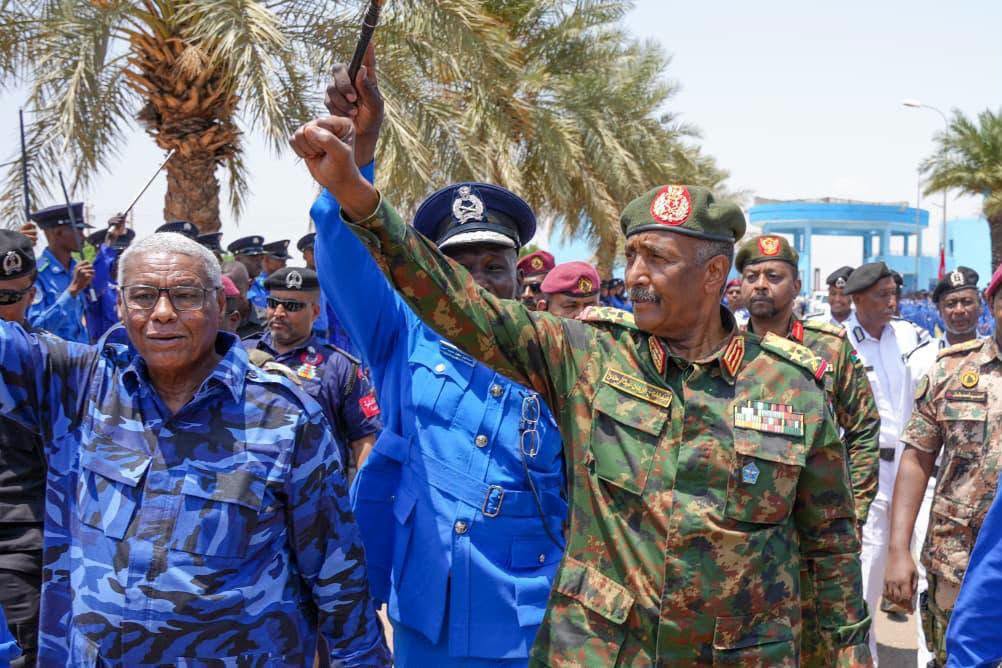
KHARTOUM – Sudan’s Sovereign Council Chairman and army chief Abdel Fattah al-Burhan dismissed talk of possible sanctions and a no-fly zone on Sudan, saying such pressure would not weaken the country or stop the army’s campaign against the Rapid Support Forces (RSF).
Speaking on Sunday at the graduation ceremony of the 22nd qualifying officers’ batch at the Police Sciences and Law College in Khartoum, Al-Burhan said the Sudanese people should not be distracted by what he described as hostile campaigns promoting sanctions or a no-fly zone.
“Talk about the possibility of imposing sanctions on the country will not affect us and will not weaken our resolve,” Al-Burhan said, according to the Sudan News Agency. “Our spirit and destiny are in God’s hands.”
He said Sudan would continue what he called the “Battle of Dignity” until every part of the country controlled by the RSF is restored.
Al-Burhan also accused unnamed Sudanese political figures abroad of welcoming sanctions in an attempt to pressure the Sudanese people, saying they would not be able to return to power through foreign pressure.
The remarks come as Sudan faces growing international concern over the continuation of the war, the expansion of drone warfare and reports of foreign support to the warring parties. The conflict between the Sudanese Armed Forces (SAF) and the RSF, which began in April 2023, has created one of the world’s largest displacement and humanitarian crises.
During the ceremony, Al-Burhan praised the police, describing the force as an institution with long-standing traditions, discipline and a record of service to the public. He said police officers, non-commissioned officers and soldiers had remained a source of trust for the Sudanese people and had played a role in protecting security, stability and citizens’ rights.
He also said police forces had fought alongside the army during the war and supported military operations against the RSF.
Al-Burhan said the SAF, backed by other regular forces, would continue working to restore security and stability across Sudan. He said civilians displaced by the war would return to their areas and villages to resume normal life.
The army chief also used the speech to address the future of armed movements under the Juba Peace Agreement, saying the SPLM-N faction led by Malik Agar, the deputy chairman of the Sovereign Council, had joined the armed forces with all its fighters. He called on other movements to follow the same model.
The issue of integrating armed formations into a unified national army has become increasingly central to Sudan’s post-war debate, especially as the army fights alongside regular forces, former rebel movements, popular resistance groups and other allied formations.
Al-Burhan praised what he described as the sacrifices of the Sudanese people during the war, saying they did not want to see the RSF or the Forces of Freedom and Change return to the political scene.


