

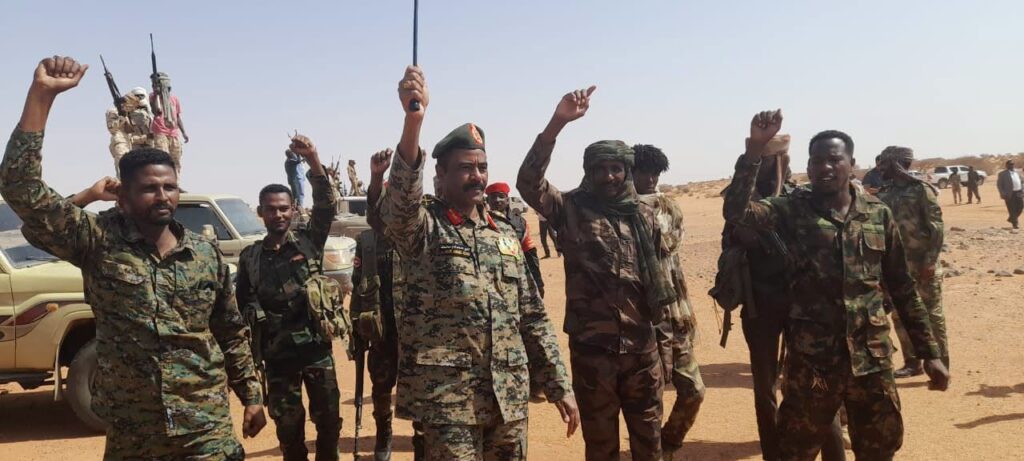
KHARTOUM – A group of 318 fighters led by Maj. Gen. Musa Ali Ahmed, known as Musa Khamsin, has defected from the Rapid Support Forces (RSF) and joined the Sudanese Armed Forces (SAF) in Northern State, according to army-aligned officials.
The group reportedly arrived with about 50 combat vehicles, along with its weapons and military equipment. Musa Khamsin said the decision to join the army was driven by what he described as the absence of institutional discipline inside the RSF, adding that his forces were committed to defending Sudan’s stability and unity.
The announcement comes amid a wider wave of reported defections from the RSF since early 2026, including field commanders, fighters and units said to have crossed over to the army with vehicles and weapons.
Maj. Gen. Al-Nour Al-Qubba, another former RSF commander who previously joined the army, said more RSF columns were expected to defect in the coming days. He urged young people in RSF-held areas not to join the fighting against the army.
Sudan Now could not independently verify the number of fighters, vehicles or the circumstances of the reported defection. The RSF did not immediately comment.
The defections come as Sudan’s war, which erupted in April 2023, enters a more fluid phase marked by shifting front lines, intensified fighting in Kordofan, Darfur and Blue Nile, and growing pressure on armed formations to maintain supply lines, pay fighters and preserve internal cohesion.
Since the beginning of 2026, several RSF-linked commanders and groups have reportedly defected to the army. Among the most prominent were Al-Nour Ahmed Adam, known as Al-Nour Al-Qubba, who joined the army in April, and Brig. Gen. Ali Rizgallah, known as Al-Savana, who announced his defection in May. Earlier, Abu Aqla Keikel, commander of the Sudan Shield Forces, defected in October 2024 before aligning with the army.
The reasons behind the defections appear to be varied. Analysts and local accounts have pointed to leadership disputes, tribal tensions, reduced resources, problems over salaries and welfare, and battlefield losses as possible factors weakening parts of the RSF’s internal structure.
The RSF has long relied on a network of decentralized alliances, tribal mobilization and field commanders operating across different regions. That structure gave the force battlefield flexibility, but it also created vulnerabilities as control over territory, resources and supply routes shifted during the war.
In August, Northern State authorities announced that 21 commanders and 270 fighters had joined the army with 37 combat vehicles, before another group was reported to have defected later in the month.
For the SAF, such defections may offer gains beyond manpower. Former RSF fighters and commanders could provide operational knowledge, battlefield experience and information about command networks, supply routes and deployment patterns.
However, the military impact remains uncertain and depends on whether the defections continue at scale, whether the army can integrate the fighters effectively, and whether the RSF can replace commanders and units lost through defections.
The reception and reintegration of former RSF commanders has also raised questions about accountability. Human rights groups have warned that commanders who switch sides should not be granted protection from investigation or accountability for alleged abuses committed during the war.
The defection of Musa Khamsin’s group therefore appears to be part of a broader and increasingly organized pattern of RSF defections, rather than an isolated incident, at a time when both sides are seeking to strengthen their battlefield position and political legitimacy.


