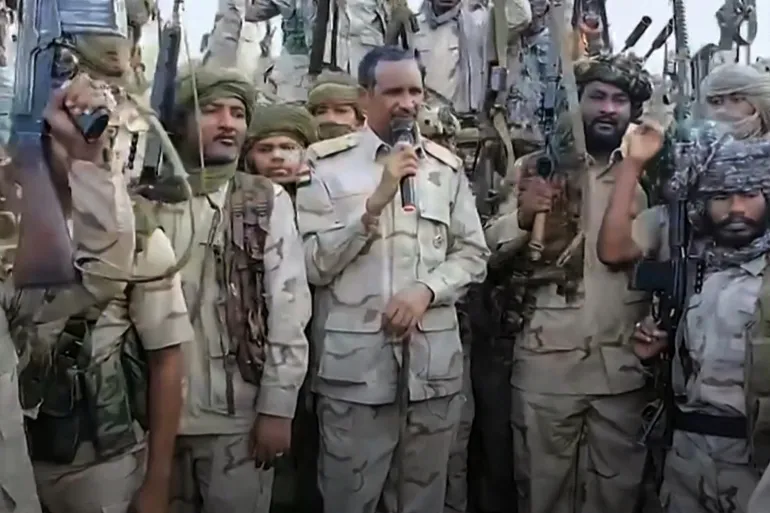
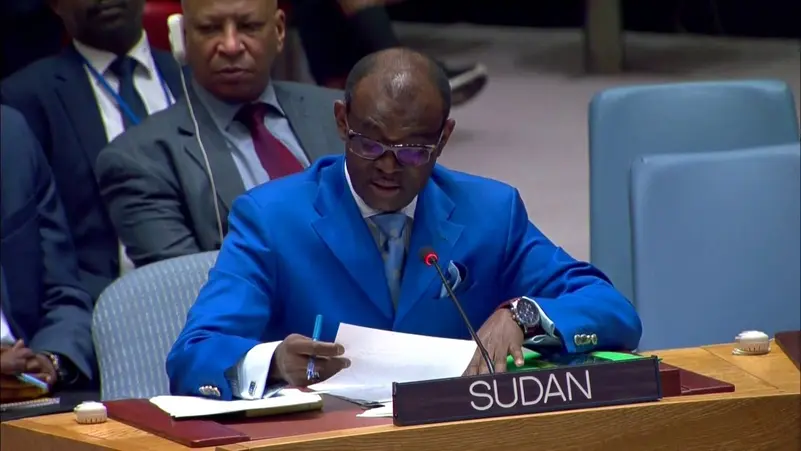
NEW YORK – Sudan told the U.N. Security Council on Friday that any humanitarian truce must include the withdrawal of the Rapid Support Forces (RSF) from civilian homes and public facilities, the departure of foreign fighters and an end to arms and financing flows to the paramilitary group.
Sudan’s U.N. ambassador, Al-Harith Idriss Al-Harith, said the measures should form part of clear and binding arrangements designed to protect civilians and pave the way for a permanent ceasefire.
The position comes as international efforts intensify to halt a war between the Sudanese Armed Forces (SAF) and RSF that began in April 2023 and has displaced millions of people while devastating cities, infrastructure and basic services.
Idriss said RSF forces should withdraw to agreed assembly points under international monitoring and that foreign mercenaries should leave Sudan.
He said Sudan also wanted arms and financial flows to the RSF halted, arguing that without such measures a truce could be used to regroup and rearm.
The Sudanese government has repeatedly tied ceasefire proposals to implementation of commitments under the May 2023 Jeddah Declaration, brokered by the United States and Saudi Arabia, which included commitments to protect civilians and vacate civilian facilities.
Idriss said army chief and Transitional Sovereignty Council chairman Abdel Fattah al-Burhan had sent U.S. President Donald Trump a message on Oct. 1 expressing Sudan’s appreciation for U.S. efforts to end the war and reiterating Khartoum’s willingness to pursue peace.
The statement comes amid renewed U.S. diplomatic efforts aimed at securing a humanitarian truce and creating conditions for negotiations.
Sudan said it had submitted technical observations on civilian protection and implementation mechanisms, seeking arrangements that could be monitored and verified before moving toward a permanent ceasefire.
The government also argued that any peace process should preserve Sudan’s sovereignty and territorial integrity and ultimately bring armed formations under a single national military structure.
Sudan cited Security Council Resolution 2736 in support of what it described as national ownership of the peace process. The resolution, adopted in June 2024, called for protection of civilians, humanitarian access and the withdrawal of fighters threatening civilians around El Fasher.
Idriss also urged international action against parties supplying weapons, money and foreign fighters to forces involved in the conflict, saying external support was prolonging the war and contributing to the spread of weapons across the region.
The issue of foreign military support has become increasingly prominent as the conflict has expanded. U.N. officials and Security Council members have repeatedly warned that flows of weapons, foreign fighters and other military assistance are worsening the fighting.
Sudan also called for state institutions to be preserved, arguing that weakening them could create a security vacuum and undermine civilian protection and law enforcement.
The government reiterated its commitment to what it described as a civilian democratic transition through an inclusive national dialogue, while rejecting any political settlement that grants governing authority on the basis of military control.
It also said accountability for crimes committed during the war should form part of a future political settlement and that Sudan should ultimately have one national army.