
Khartoum – Sudan Now
Drone attacks have killed and injured dozens of civilians across Sudan in recent days, highlighting the growing role of unmanned aircraft in a conflict that has entered its third year and continues to exact a heavy toll on the civilian population.
In one of the latest incidents, the National Umma Party accused the Sudanese army of carrying out a drone strike on two civilian vehicles along the Abu Zabad–Al-Fula road in West Kordofan, killing 10 people, including eight children, and injuring others.
The party described the attack as a serious violation of international humanitarian law and warned that repeated drone strikes in populated areas and on public roads are posing an increasing threat to civilian lives.
The incident comes amid escalating military operations across Kordofan, where fighting between the Sudanese army and the Rapid Support Forces (RSF) has expanded into areas that were previously removed from the main frontlines of the war.
Days earlier, the Sudan Doctors Network reported that 27 people, including elderly civilians, were killed when RSF-affiliated forces attacked villages in the Al-Marra area west of Bara in North Kordofan during the Eid al-Adha holiday.
Sudan’s Foreign Ministry condemned what it described as a “massacre” in the Umm Saadoun and Al-Marra areas, saying dozens of civilians had been killed or wounded. The ministry blamed the RSF and its alleged backers for the attack and renewed calls for the group to be designated a terrorist organization.
The RSF denied responsibility, describing the accusations as part of a political and military campaign against the group. It also accused army-aligned actors of supporting tribal militias in Kordofan and warned against attempts to turn the conflict into a broader communal war.
The conflicting accounts underscore the growing difficulty of independently verifying incidents in Sudan’s conflict zones, where access remains limited and fighting continues across vast areas of the country.
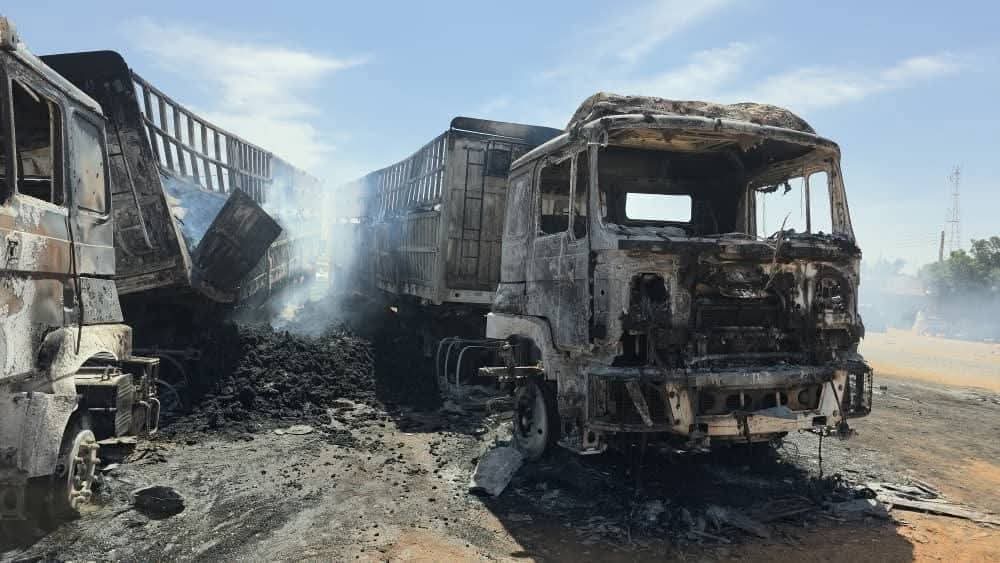
In North Darfur, at least nine people, including two women, were killed and 55 others injured when a drone strike hit the market in the border town of Al-Tina, according to a medical source who spoke to Sudan Now.
The attack occurred during peak trading hours, causing significant civilian casualties and raising fears that the death toll could increase due to the severity of some injuries. Health facilities in Darfur continue to struggle with shortages of medicines, equipment and medical personnel after more than two years of war.
The incidents reflect a broader shift in the nature of Sudan’s conflict. While the war initially centered on ground battles and artillery exchanges, drones have increasingly become a key tool for reconnaissance, long-range strikes and attacks on strategic targets.
In recent months, the Sudanese army has repeatedly announced the interception of drones in several states, including Khartoum, Blue Nile and White Nile. Most recently, the military said it had shot down a strategic drone over the city of Kenana in White Nile State.
Military analysts say the growing use of drones demonstrates an evolution in the capabilities of the warring parties but also increases the risk to civilians, particularly where military objectives are located near markets, residential neighborhoods and transportation routes.
The escalation comes as diplomatic efforts to end the war remain stalled. Despite multiple regional and international initiatives, attempts to secure a lasting ceasefire have made little progress amid deep divisions between the rival sides.
With drone attacks becoming more frequent and the conflict showing no signs of ending, humanitarian and rights organizations continue to warn that civilians are bearing an ever-greater share of the cost of a war that has produced one of the world’s largest humanitarian crises.