
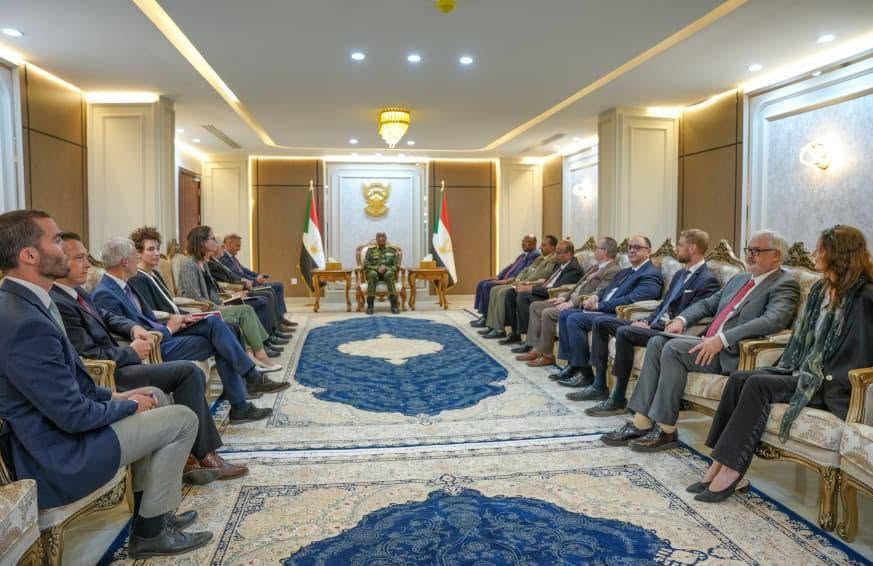
Khartoum – European Union ambassadors concluded their first joint visit to Sudan since the outbreak of the war in April 2023, calling for a ceasefire, expanded humanitarian access and an end to external support fueling the conflict.
The delegation, led by EU Ambassador to Sudan Wolfram Vetter, held meetings in Khartoum and Port Sudan with senior Sudanese officials, including Sovereign Council Chairman Abdel Fattah al-Burhan, Prime Minister Kamil Idris, Foreign Minister Mohyeldin Salim and intelligence chief Ahmed Ibrahim Mufaddal.
The diplomats called on all parties to the conflict to de-escalate as a first step toward a comprehensive ceasefire and stressed the need to establish humanitarian corridors and safe areas to facilitate aid delivery and protect civilians.
The conflict between the Sudanese Armed Forces (SAF) and the Rapid Support Forces (RSF), which erupted in April 2023, has displaced millions of people inside and outside Sudan and created one of the world’s largest humanitarian crises, with aid agencies warning of worsening food insecurity, displacement and protection risks across the country.
The EU delegation said massacres and serious human rights violations reported in areas including El Fasher and Al Jazirah State must not be repeated and called for an immediate end to sieges affecting civilians and population centers.
The ambassadors reaffirmed their support for Sudan’s unity, sovereignty and territorial integrity and rejected efforts to establish parallel governing structures in the country.
The issue of parallel governance has become increasingly prominent in recent months amid political initiatives and arrangements proposed by Sudanese actors, while Sudanese authorities and several international partners have continued to emphasize the importance of preserving national institutions and maintaining the country’s unity.
The delegation also criticized what it described as external support fueling the conflict, including the flow of weapons, mercenaries and foreign fighters into Sudan, warning that such support is prolonging the war and worsening humanitarian suffering.
The European Union reiterated its support for international peace initiatives led by the Quad and the Quintet grouping, which includes the African Union, United Nations, Intergovernmental Authority on Development (IGAD), League of Arab States and the European Union.
The diplomats encouraged Sudanese authorities to engage constructively with those initiatives, saying they could complement national efforts aimed at resolving the conflict and advancing a civilian-led political process toward democratic and inclusive governance.
They also stressed the importance of accountability for serious human rights violations committed during the conflict and called for efforts to combat impunity.
Regional security was another focus of the discussions, with the ambassadors expressing concern that continued fighting in Sudan could destabilize neighboring countries and contribute to increased displacement, terrorism, trafficking networks and the growth of armed groups across the region.
Sudan occupies a strategic position linking North Africa, the Horn of Africa and the Sahel region. International organizations have repeatedly warned that a prolonged conflict could have wider repercussions beyond Sudan’s borders, including increased migration pressures and cross-border insecurity.
The delegation said it would remain engaged with Sudanese authorities and continue visits and dialogue aimed at strengthening relations between Sudan and the European Union.