

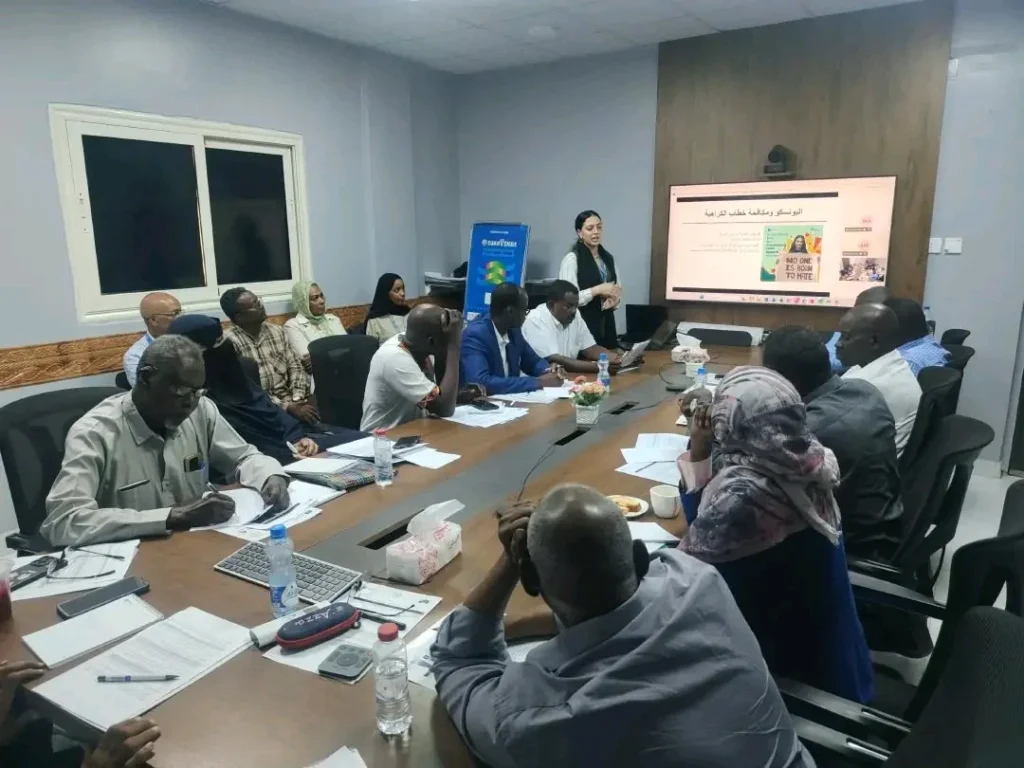
PORT SUDAN – The United Nations Educational, Scientific and Cultural Organization (UNESCO) brought together education, media, cultural and peacebuilding actors in Port Sudan to discuss joint efforts to counter hate speech and strengthen peace and social cohesion in Sudan.
Participants included Kassala State Minister of Education and Guidance Osman Omar Osman, the Sudanese National Commission for Education, Science and Culture, radio and television institutions from Kassala and Red Sea states, community radio representatives, Red Sea University, the Peace Studies Center and other partners.
The discussions focused on the role of education, culture, media and community leaders in preventing hate speech, limiting its spread and promoting peaceful coexistence and social cohesion amid Sudan’s ongoing conflict.
UNESCO said the priorities, challenges and recommendations identified during the meetings would help guide project activities and contribute to efforts to develop a national action plan to combat hate speech in Sudan.
The initiative comes as inflammatory rhetoric has grown alongside the war, political polarization and widening social divisions, with digital platforms and social media increasingly used to circulate content that incites violence, discrimination and hostility between communities.
The problem has been compounded by limited institutional capacity to monitor and respond to inflammatory content, as well as the absence of a clear and comprehensive legal framework defining hate speech and establishing mechanisms for accountability.
Hate speech poses particular risks in Sudan when it is linked to ethnic, tribal, regional or political identity, potentially deepening social divisions and creating an environment in which violence against civilians can be normalized or justified.
The spread of incitement and misinformation can also undermine reconciliation and peace efforts by transforming political and military disputes into broader hostility between communities.
Sudan’s war, which began in April 2023, has intensified polarization across the country and damaged institutions that previously played a role in education, media regulation, cultural exchange and community dialogue.
UNESCO and its partners are seeking to strengthen cooperation across those sectors in an effort to reduce inflammatory discourse and support longer-term social cohesion.


