

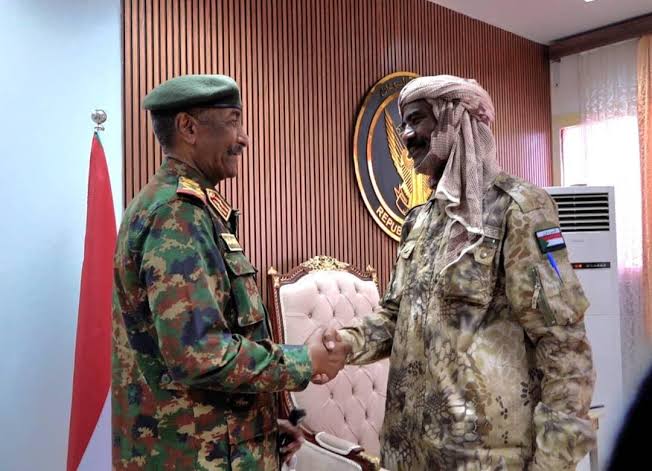
PORT SUDAN – Sudan’s Public Prosecution has issued a legal memorandum clarifying the scope of the presidential amnesty granted to members of the Rapid Support Forces (RSF) who voluntarily surrender, saying the measure bars criminal prosecution under specified conditions but does not affect victims’ private rights.
The memorandum, published by Sudan’s Public Prosecution and authored by Senior Public Prosecutor Awad Hamida Abdallah, says the amnesty is intended to encourage combatants to lay down their arms, promote national reconciliation, facilitate the reintegration of those who voluntarily abandon fighting, and help restore stability, while preserving victims’ rights under Sudanese law and Islamic jurisprudence.
According to the memorandum, the amnesty applies only to individuals who voluntarily abandon armed activity, surrender themselves to the Sudanese Armed Forces (SAF) of their own free will, and renounce participation in the conflict. It says those captured during military operations or forced to surrender are not covered by the decision.
The legal memorandum cites Article 211 of Sudan’s 1991 Criminal Procedure Act, which authorizes the head of state, after consultation with the Attorney General, to issue a general amnesty—excluding hudud offences under Islamic law—at any stage before a final judgment is issued. It says criminal proceedings may not be initiated or continued once an offence falls within the scope of the amnesty.
The memorandum states that the amnesty does not automatically extend to civilians or other individuals accused of assisting the RSF unless they are explicitly included in a separate decision. It adds that prosecutors and courts are legally required to terminate criminal proceedings once an individual is found to meet the conditions of the amnesty.
The memorandum stresses that the amnesty applies only to the state’s criminal claim and does not extinguish victims’ private rights. It says victims retain the right to recover property, seek compensation, pursue civil claims, and demand other remedies available under Sudanese law and Islamic jurisprudence unless those rights are voluntarily waived or otherwise settled.
The memorandum also cites Quranic verses and Prophetic traditions encouraging forgiveness and reconciliation when they serve the public interest, while emphasizing that private rights remain protected and cannot be extinguished solely through a general amnesty.
The clarification comes amid growing debate in Sudan over the legal status of former RSF members who have defected or surrendered to the SAF under the presidential amnesty announced by Transitional Sovereignty Council Chairman and SAF Commander Abdel Fattah al-Burhan.
The issue has also drawn international attention as human rights organizations continue to stress that defections or amnesties should not shield individuals suspected of war crimes, crimes against humanity, or other serious violations from accountability.
In recent weeks, Human Rights Watch has argued that individuals suspected of war crimes or crimes against humanity should remain subject to investigation and prosecution regardless of any change in affiliation. International organizations have likewise continued to call for accountability for violations committed by all parties to Sudan’s conflict.
The war between the SAF and the RSF, which erupted in April 2023, has triggered one of the world’s largest humanitarian crises, displaced millions of people, and prompted repeated international calls for accountability alongside efforts to end the conflict through negotiations.