

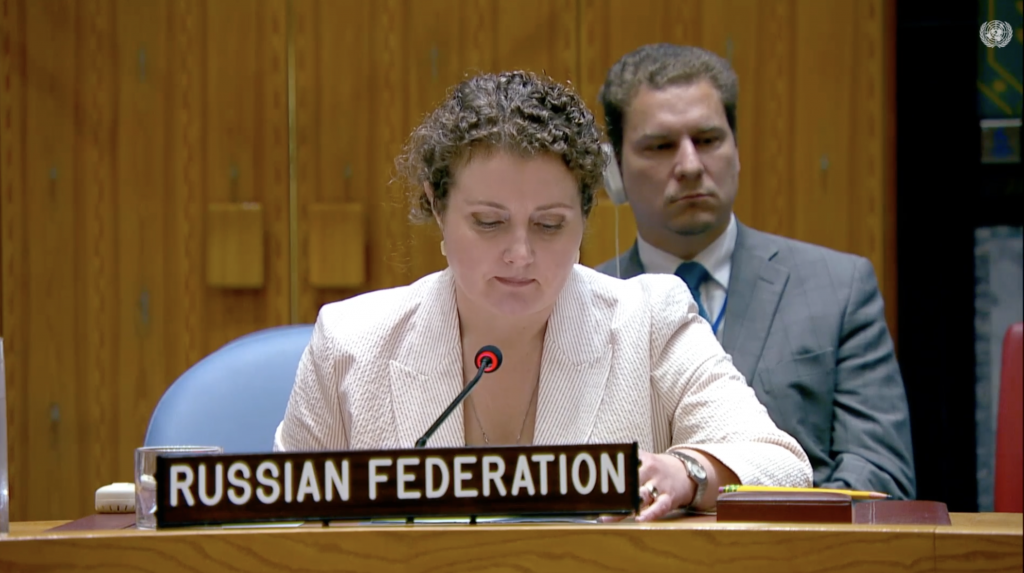
NEW YORK – Russia said on Friday that any international political arrangements or initiatives concerning Sudan must be coordinated with the Sudanese government, describing any agreements reached without its participation—including those concerning the country’s political future—as “unacceptable.” Moscow also called for a review of the U.N. Security Council’s approach to the crisis and rejected expanding U.N. sanctions beyond the Darfur region.
The remarks were made during a U.N. Security Council meeting on developments in Sudan, as fighting continues in parts of Darfur and Kordofan amid U.N. warnings of a worsening humanitarian crisis.
Anna Evstigneeva, Russia’s Chargé d’Affaires ad interim to the United Nations, said the situation in Sudan remained “far from stable,” adding that the Sudanese government and the Sudanese Armed Forces (SAF) continued to confront what she described as “destructive elements” targeting the country’s security and the legitimacy of its current leadership.
Evstigneeva said recent developments around El Obeid, which were recently addressed by the Security Council in a press statement, showed that “enemies of peace” were seeking to spread instability and create conditions for Sudan’s disintegration. She urged the Council to focus on addressing the root causes of the conflict rather than dealing only with its consequences.
Her remarks come as El Obeid has witnessed an escalation in drone attacks in recent weeks, while the United Nations and the United States have warned of growing risks to civilians and the possibility of further atrocities if violence around the city intensifies.
Evstigneeva said the path toward ending the most acute phase of the conflict required “honest and constructive” cooperation with the Sudanese government, arguing that it remained the “only guarantor” of preserving Sudan’s state institutions. She added that it would be wrong to expect a repeat of the political circumstances that emerged in 2019 given the current developments in El Fasher, El Obeid and Al Dilling.
She also welcomed the return of most Sudanese state institutions and several international organizations to Khartoum, expressing confidence that the Sudanese authorities would be able to create conditions allowing foreign diplomatic missions to resume operations in the capital.
Evstigneeva said attempts to establish parallel authorities in Darfur and Kordofan amounted to an effort to partition Sudan. She added that any mediation initiative or political arrangement should take into account the position of the Sudanese government, while an eventual Sudanese-Sudanese dialogue after the restoration of stability should include political, military and religious groups with genuine public support, with the United Nations maintaining its central role in supporting the peace process.
Russia’s position comes as Security Council members remain divided over how to address the conflict in Sudan. While some countries have called for increased pressure and tougher sanctions, Moscow has insisted that priority should be given to engagement with the Sudanese government and addressing the underlying causes of the conflict.
Concluding her remarks, Evstigneeva rejected using the Sudan crisis as grounds for expanding the U.N. sanctions regime beyond Darfur, arguing that the sanctions imposed over the years had failed to halt the illicit flow of weapons into the region. She reaffirmed Russia’s support for Sudan’s sovereignty, territorial integrity and state institutions.


