

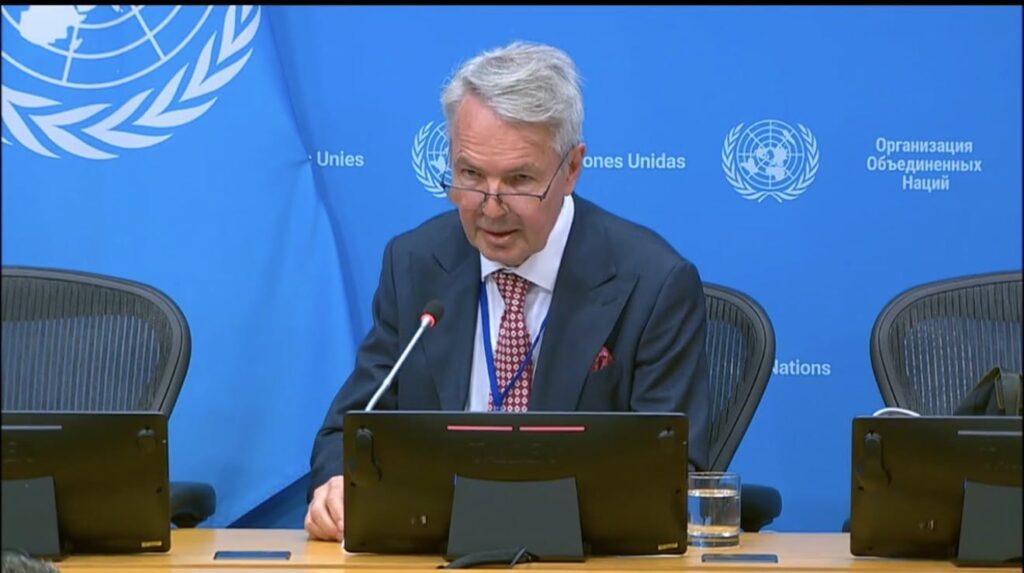
NEW YORK – U.N. Secretary-General’s Personal Envoy for Sudan Pekka Haavisto warned on Wednesday that escalating violence in and around El Obeid risked endangering thousands of civilians and worsening Sudan’s humanitarian crisis.
Speaking at a press conference at U.N. headquarters in New York, Haavisto said the situation in El Obeid had become increasingly alarming in recent days amid continuing hostilities and repeated drone attacks, which he said were affecting civilians and disrupting humanitarian access.
He compared the risks facing El Obeid to those previously seen in El Fasher, warning that further military escalation could have immediate consequences for the city’s civilian population.
Haavisto said he had spoken by telephone with Rapid Support Forces (RSF) commander Mohamed Hamdan Dagalo, who, according to the envoy, said his forces had no intention of targeting civilians and remained committed to protecting humanitarian corridors leading to the city.
The envoy warned that the growing use of drones had introduced a dangerous new dimension to the conflict, with attacks increasingly affecting civilians and civilian infrastructure while worsening humanitarian conditions.
El Obeid has come under repeated drone attacks in recent weeks that have struck civilian infrastructure, including power facilities, fuel stations and other essential services. International officials have also warned of an RSF military build-up around the city, raising fears of a wider assault and increased risks to civilians.
On the political front, Haavisto described recent meetings of the Quintet—comprising the African Union, the Intergovernmental Authority on Development (IGAD), the League of Arab States, the European Union and the United Nations—as the first gathering bringing together Sudanese political actors in three years, calling it a positive step toward reviving peace efforts.
He added that the United Nations continues to support the Quad—comprising the United States, Saudi Arabia, the United Arab Emirates and Egypt—in efforts to secure a humanitarian truce, saying regional actors increasingly recognize that the conflict cannot be resolved through military means and that a negotiated political settlement remains the only viable path to ending the war.
Haavisto’s warning comes amid growing international concern over developments around El Obeid. Germany, France, Ireland, Italy, the Netherlands, Norway and the United Kingdom have jointly called on the RSF to halt its offensive, warning against a repeat of the violence seen in El Fasher.
Japan’s embassy in Sudan and British Foreign Secretary Yvette Cooper have also expressed concern over the military build-up around El Obeid, urging the protection of civilians, unhindered humanitarian access and warning that the city must not become “another El Fasher.”


