

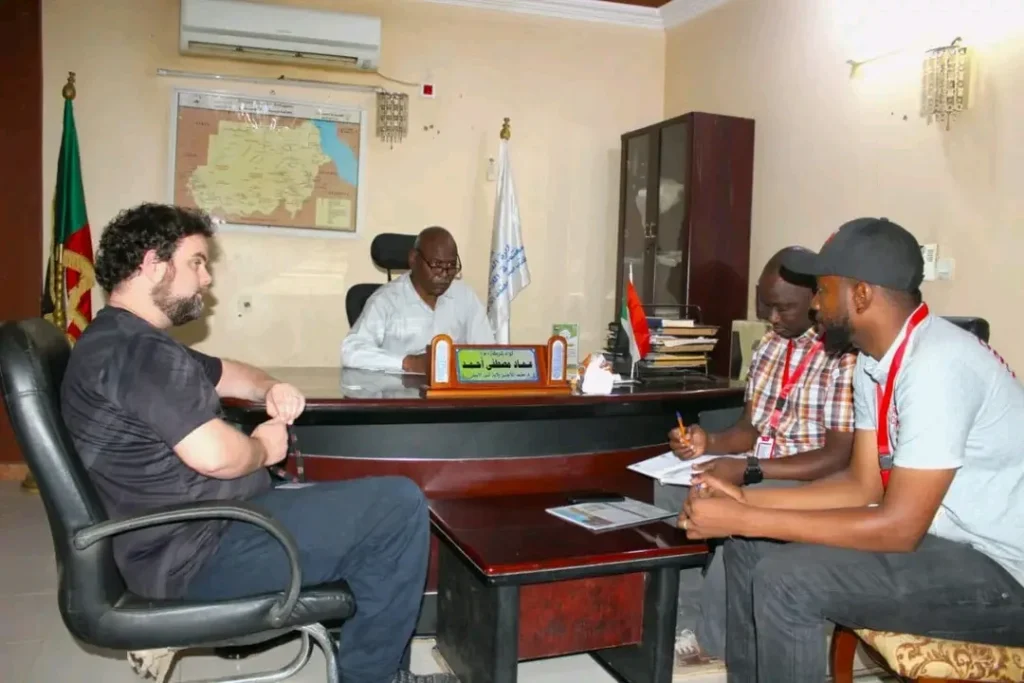
KOSTI – Sudanese authorities and humanitarian agencies warned of mounting pressure on refugee camps in White Nile State, calling for increased international support as growing refugee and displacement numbers strain essential services.
During a meeting in Kosti with Norwegian Refugee Council (NRC) Country Director Paul Byers, the White Nile State Commission for Refugees said camps in Al Salam and El Jebelein localities are facing increasing challenges in delivering basic services, urging humanitarian partners to expand assistance and strengthen coordination to support both refugees and host communities.
Assistant Commissioner for Refugees in White Nile State, Maj. Gen. (Ret.) Imad Mustafa Ahmed, said the commission remains committed to coordinating and facilitating humanitarian operations across the state. He said the continued arrival of refugees, internally displaced people (IDPs), returnees and deportees, combined with funding shortages, has placed severe pressure on services in camps and surrounding communities.
For his part, Paul Byers said the growing refugee population is placing increasing strain on healthcare, education, shelter and water services, stressing that humanitarian assistance should also target host communities, which are facing many of the same challenges.
He also praised the cooperation provided by the Office of the Assistant Commissioner for Refugees, saying continued coordination is essential to strengthening the humanitarian response and improving services for refugees and displaced people.
White Nile State hosts one of Sudan’s largest refugee populations, particularly refugees from South Sudan, who have fled conflict since the outbreak of South Sudan’s civil war in 2013. The state’s camps in Al Salam and El Jebelein have become major reception sites alongside surrounding host communities.
According to the U.N. Refugee Agency (UNHCR), Sudan was hosting approximately 885,000 registered refugees and asylum seekers as of June 2026, including around 664,000 South Sudanese refugees, making them the country’s largest refugee population.
The humanitarian burden has intensified since the outbreak of fighting between the Sudanese Armed Forces (SAF) and the Rapid Support Forces (RSF) in April 2023. Refugee-hosting areas have also absorbed large numbers of internally displaced people and returnees while facing declining humanitarian funding, prompting aid agencies to warn that support for both refugees and host communities must be expanded.


