
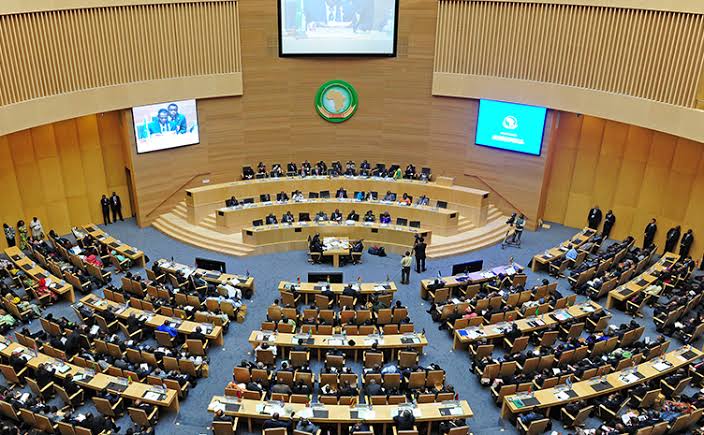
KHARTOUM – Sudanese political and civil forces filed a formal complaint with the African Union Peace and Security Council and the AU’s political affairs, peace and security body, objecting to an African Union Commission statement welcoming an internal Sudanese dialogue initiative.
In a press statement issued on Tuesday, September 2, the groups said their memorandum rejected and condemned the commission’s August 31 statement, which welcomed a dialogue initiative announced after a call by army chief and Sovereign Council Chairman Abdel Fattah al-Burhan.
The signatories include the Sudanese Declaration of Principles, the Umma Party, the Popular Congress Party, civil society organizations, women’s and youth networks, and a number of intellectuals, academics, writers and public figures.
The groups said the AU Commission’s statement had bypassed the position of the African Union Peace and Security Council and failed to mention a humanitarian truce or ceasefire.
They said a humanitarian truce and a ceasefire must remain the top priority and should not be delayed, arguing that welcoming a political initiative while the war continues risks weakening efforts to stop the fighting.
The complaint comes amid widening divisions among Sudanese political forces over Al-Burhan’s proposed Sudanese-Sudanese dialogue inside Sudan. Supporters say the initiative could provide a Sudanese-owned path to end the war, while opponents argue that any dialogue held under the authority of one side of the conflict could lack credibility unless preceded by a ceasefire, humanitarian access and clear guarantees.
The groups criticized the AU Commission for welcoming an initiative they said was under the control of a single military commander. They argued that such a position contradicts the African Union’s decision to suspend Sudan’s participation after the October 2021 military takeover, which linked Sudan’s return to the establishment of a legitimate civilian authority.
The memorandum said the groups had already presented their principles during direct consultations with the African Union and the Quint Mechanism, as well as in a joint position document signed in Addis Ababa on August 22 and 23.
They said those principles include full Sudanese ownership of decision-making, prioritizing an end to the war and addressing the humanitarian catastrophe, and excluding the dissolved National Congress Party, the Islamist movement and their fronts from the political process.
The groups warned that holding a partial dialogue in an area controlled by one party to the war, without broad participation by Sudanese people and without a commitment to halt hostilities, could entrench political division.
“A partial dialogue managed from an area controlled by one of the warring parties, without the participation of most Sudanese and without a commitment to stop hostilities, entrenches the political division of Sudan,” the memorandum said.
They called on the African Union Peace and Security Council to ask the AU Commission to provide an official clarification on the reasons behind its statement and to reaffirm the priority of a humanitarian truce and a comprehensive ceasefire.
The groups also urged the African Union to remain a neutral and trusted actor and to work on unifying mediation tracks, including regional and international mechanisms dealing with Sudan’s crisis, within a coordinated framework.
Sudan’s war, which erupted in April 2023 between the Sudanese Armed Forces and the Rapid Support Forces, has fragmented the political landscape and produced competing peace initiatives. Some political forces have aligned with the army, others with RSF-linked structures, while a third current presents itself as anti-war and independent from both sides.
The AU Commission said in its August 31 statement that it welcomed the launch of an initiative to facilitate a Sudanese-Sudanese dialogue inside Sudan under the supervision of an independent committee of Sudanese figures. It called for consultations to include civil, political and community forces based on inclusivity, Sudanese ownership and Sudanese leadership of the political process.
The commission said the initiative was part of its efforts since the outbreak of the war to bridge gaps between Sudanese parties, create conditions to end the armed conflict and support peace and stability. It said the political process should aim for a united, sovereign and peaceful Sudan governed by legitimate civilian institutions, with one national security system and peaceful mechanisms for resolving political and social disputes.
The signatory groups said they remain ready to continue cooperation and consultations with African Union institutions, but stressed that a just and sustainable peace must end the war, preserve Sudan’s unity and protect the dignity of its people.