

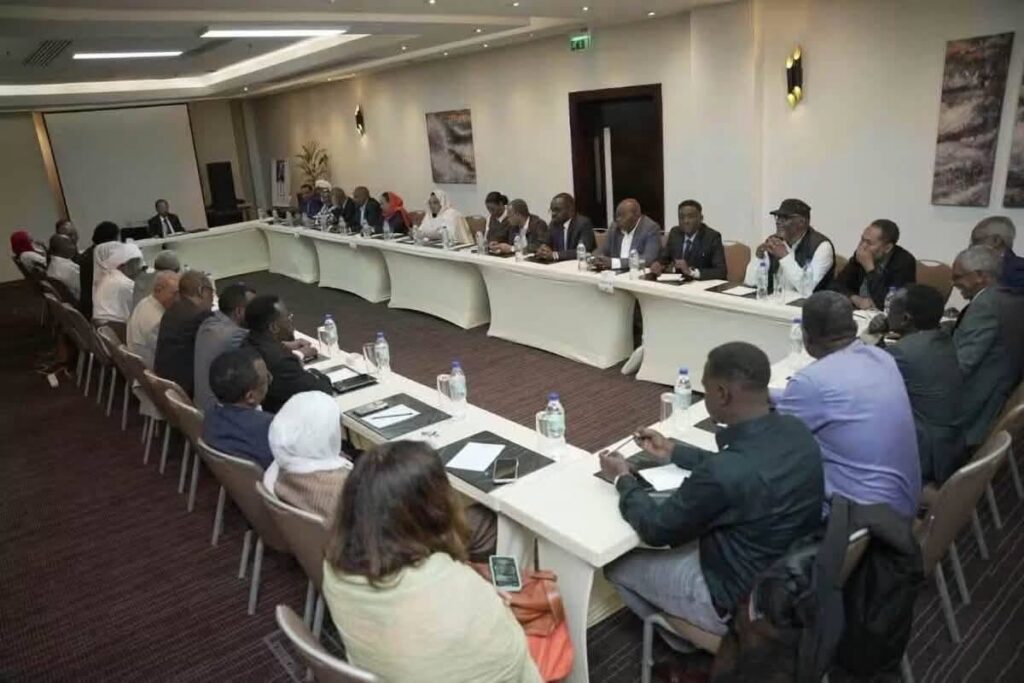
ADDIS ABABA – Sudanese political and civil forces opposed to the war opened consultations in Addis Ababa to discuss army chief Abdel Fattah al-Burhan’s call for an internal Sudanese dialogue, alongside broader efforts to shape a common position on ending the war, according to a statement by the Umma Party.
The two-day meeting, which began on August 22, brings together forces described as opposed to the war and not aligned with its warring parties, including groups affiliated with the Sudanese Declaration of Principles, the Popular Congress Party, the Umma Party led by Mubarak al-Fadil, civil society organizations, women’s and youth networks, academics, writers and public figures.
According to the statement, the consultations will discuss developments in the war, national visions for a comprehensive peace process, the roadmap of the Sudanese Declaration of Principles and participating political and civil groups, as well as the role of external mediation efforts.
The meeting also aims to coordinate positions on Al-Burhan’s proposed “Sudanese dialogue” and develop a shared approach toward what participants describe as a genuine and integrated peace process.
Al-Burhan recently said the state was ready to provide political, legal and security guarantees for participants in a proposed Sudanese-owned dialogue. He said the state could offer logistical support and protections, while insisting it would not organize the dialogue, determine its agenda or control its outcomes.
His proposal has opened a new debate among Sudanese political forces. Supporters view it as a possible internal opening after more than three years of war, while critics say any dialogue held under wartime conditions and inside areas controlled by one side risks lacking credibility unless preceded by a ceasefire, humanitarian guarantees and a more inclusive political environment.
Sudan’s war, which erupted in April 2023 between the Sudanese Armed Forces (SAF) and the Rapid Support Forces (RSF), has fragmented the political landscape and deepened divisions among civilian forces. Some groups have aligned with the army, others with the RSF-linked political camp, while a third current presents itself as opposed to the war and independent of both sides.
The Addis Ababa consultations come amid renewed regional and international attempts to revive mediation efforts. The African Union, IGAD, the Arab League, the European Union and other actors have supported different tracks aimed at ending the conflict, but previous efforts have failed to secure a lasting ceasefire or unify civilian forces around a single political process.
For anti-war forces, the central challenge is how to build a credible process that can stop the fighting, address the humanitarian crisis and prevent Sudan’s de facto division, while also dealing with accountability, security arrangements and the future of armed formations.
The consultations are expected to focus on whether Al-Burhan’s internal dialogue initiative can be engaged with, rejected or reshaped, and how political and civil forces can coordinate their position before any wider Sudanese peace process begins.


