
Khartoum – Sudan Now
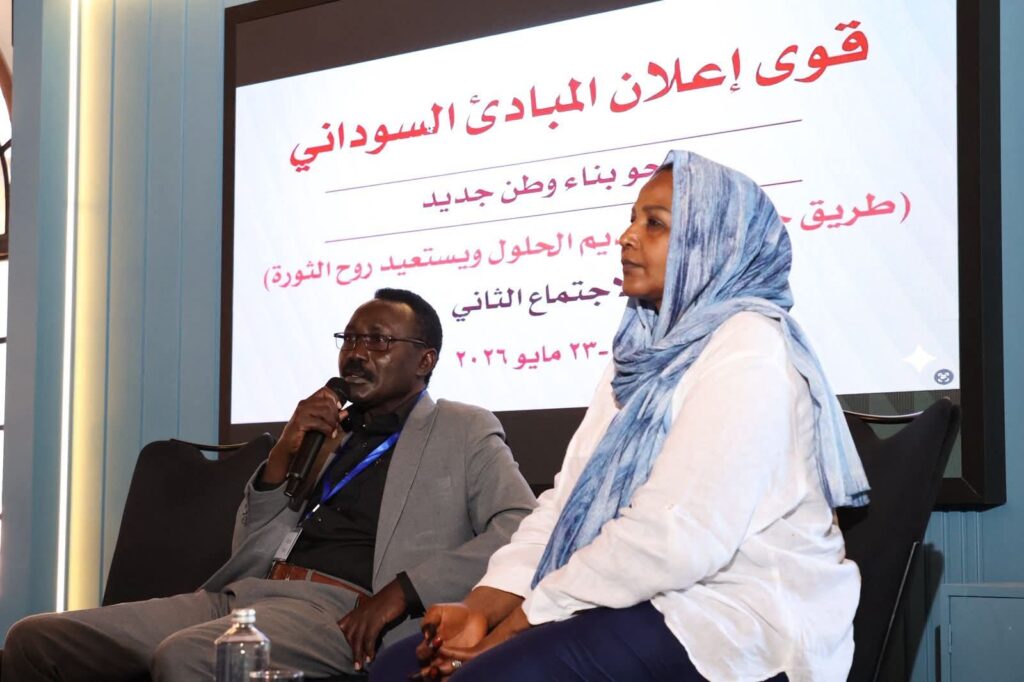
The Sudanese Declaration of Principles Forces unveiled a comprehensive political roadmap aimed at ending the war in Sudan and launching what it described as a new civilian democratic transition rooted in the principles of the December revolution.
The document, titled “A New Path for Sustainable Solutions and Restoring the Spirit of the Revolution,” was approved during meetings held on May 22–23 under the slogan “Towards Building a New Homeland.”
The alliance said the roadmap was designed to avoid what it described as the “fragile settlements” and partial political deals that contributed to the outbreak of war in April 2023 between the Sudanese army and the Rapid Support Forces.
The document proposes a Sudanese-led political process built around three parallel tracks: a humanitarian track focused on civilian protection and aid delivery, a temporary ceasefire leading to a permanent cessation of hostilities, and a political process addressing the roots of Sudan’s crisis.
The alliance said the proposed political process should not be limited to negotiations between the warring parties, but should instead address structural issues related to governance, citizenship, justice, identity, wealth distribution and the relationship between religion and the state.
It also called for the creation of a single national military institution under civilian authority and the dismantling of militias and parallel armed formations.
The roadmap rejects what it described as rewarding parties responsible for the war and specifically excludes figures linked to the former ruling National Congress Party and the Islamist movement from the proposed political process.
The document further calls for accountability for war crimes and human rights violations, warning against impunity and the continuation of armed and ideological control over state institutions.
On the humanitarian side, the alliance proposed a temporary humanitarian truce involving the Sudanese army, the RSF and the Sudan Liberation Movement led by Abdel Wahid al-Nur.
The proposed truce would include the suspension of offensive operations, protection of civilians, reopening humanitarian corridors, restoration of basic services and international monitoring mechanisms involving regional and international actors.
The roadmap also called for civilian participation in monitoring ceasefire arrangements and humanitarian operations, while emphasizing the role of women, youth and civil society groups in any future political settlement.
The alliance warned against the fragmentation of Sudan and rejected calls for partition, describing the country’s unity as a fundamental principle that should not be compromised.
The document comes amid mounting international pressure for a negotiated settlement as Sudan faces one of the world’s largest humanitarian crises, with millions displaced and famine risks expanding in parts of Darfur and Kordofan.
Participants in the meetings included former Prime Minister Abdalla Hamdok, Abdel Wahid al-Nur, Omar al-Digair, Yasser Arman and senior figures from several civilian and political groups.
Separately, the National Umma Party expressed reservations over clauses related to the separation of religion and state, saying such issues should be addressed through a national constitutional conference after the war rather than through political charters.