

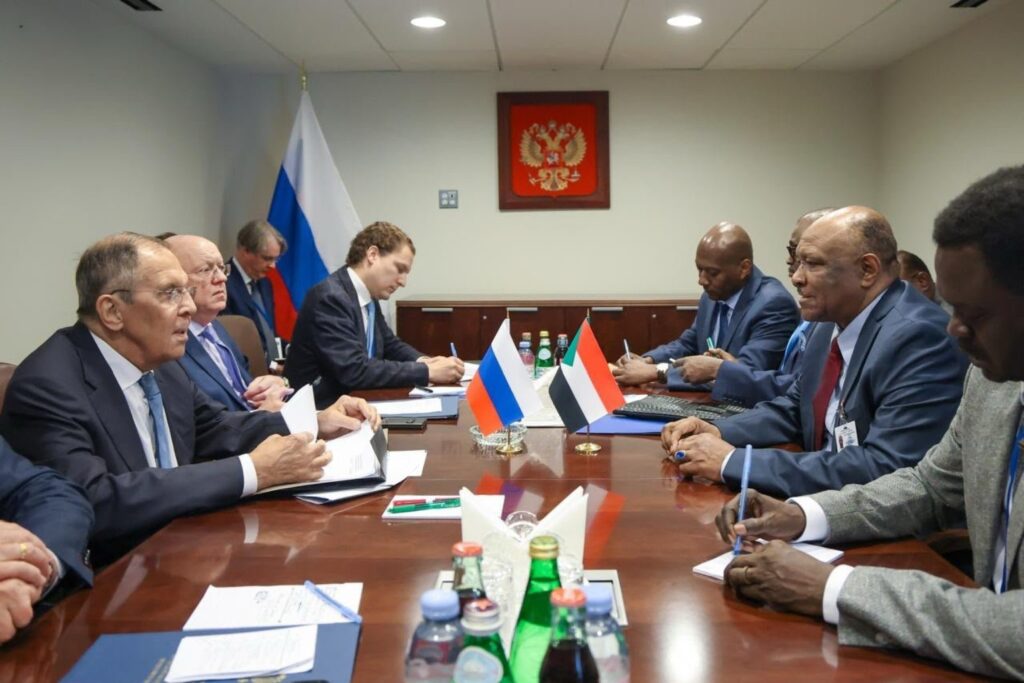
NEW YORK – Russian Foreign Minister Sergei Lavrov reaffirmed Moscow’s support for Sudan’s government and state institutions during talks with Sudanese Foreign Minister Mohieddin Salem in New York, according to Sudan’s Foreign Ministry.
The meeting took place on Sept. 25 on the sidelines of the 81st session of the U.N. General Assembly and focused on bilateral relations, cooperation and the political, security and humanitarian situation in Sudan.
Salem briefed Lavrov on developments in Sudan and on government efforts to pursue peace and stability while preserving the country’s sovereignty, unity and territorial integrity.
He also praised Russia’s positions toward Sudan and said Khartoum wanted to continue political consultation and expand cooperation with Moscow in areas of mutual interest.
Lavrov, according to the Sudanese statement, described bilateral relations as strong and reiterated Russia’s support for Sudan’s government and what Moscow regards as its legitimate institutions.
He also reaffirmed support for Sudan’s sovereignty, unity and territorial integrity and expressed hope for peace across the country.
The Russian foreign minister said Moscow supported efforts by the Sudanese government to bring national forces together and pursue what he described as a Sudanese-Sudanese solution to the conflict.
The meeting came as Sudanese officials held a series of diplomatic talks in New York focused on ceasefire proposals, humanitarian access and competing visions for a political settlement.
Sudan’s government has repeatedly stressed that any peace process should preserve state institutions and national sovereignty, while rejecting political arrangements it says are imposed from outside the country.
The war between the Sudanese Armed Forces (SAF) and the Rapid Support Forces (RSF) began in April 2023 and has displaced millions of people while severely damaging infrastructure and public services.
Russia has maintained diplomatic engagement with Sudan throughout the conflict and has repeatedly emphasized state sovereignty and a political process led by Sudanese actors.


