Introduction
Darfur is a vast region in western Sudan known for its rich cultural diversity, strategic location and complex history. Covering an area roughly the size of France, Darfur has long served as a crossroads for trade, migration and cultural exchange across North and Central Africa.
In recent decades, Darfur has attracted international attention because of armed conflict, humanitarian crises and large-scale population displacement. However, the region is also home to millions of people from diverse ethnic communities, with economies based on agriculture, livestock and trade.
This guide explains Darfur’s geography, history, people, economy and its role in Sudan’s modern political and humanitarian landscape.
Overview
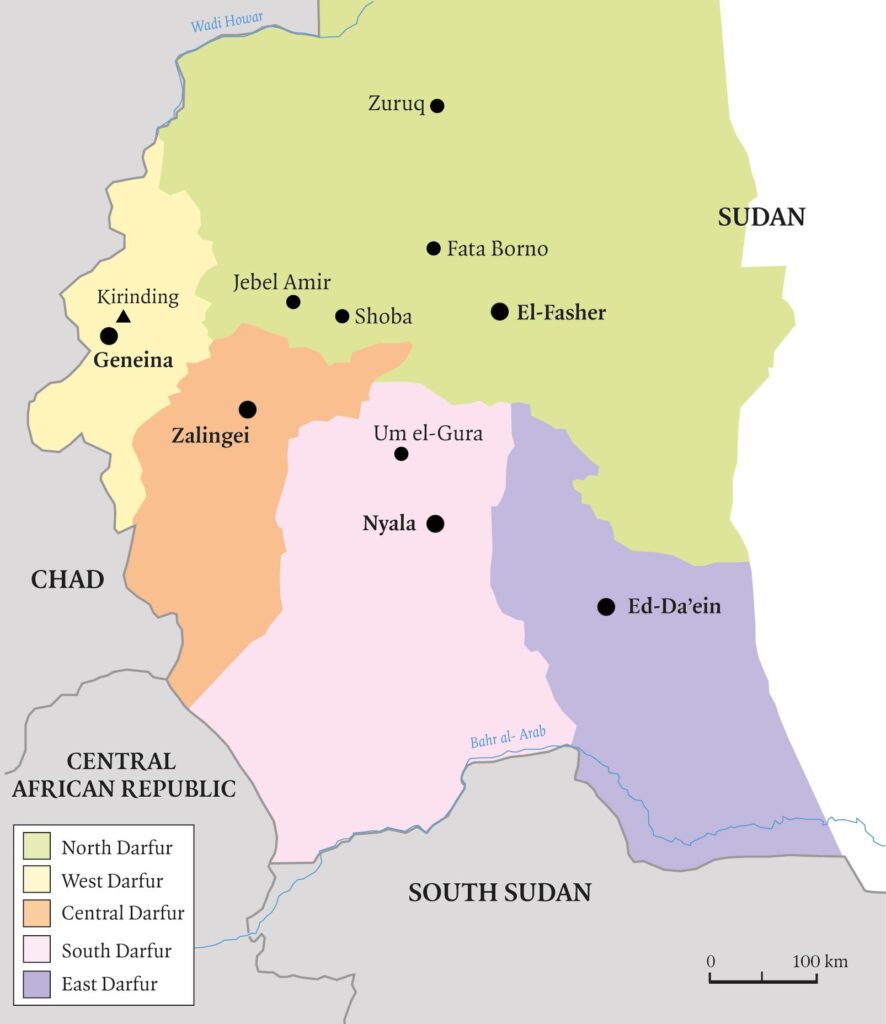
Darfur is located in western Sudan and borders Chad, the Central African Republic and Libya. Administratively, the region is divided into five states: North Darfur, South Darfur, Central Darfur, West Darfur and East Darfur.
The region covers approximately 493,000 square kilometres and is home to millions of people representing numerous ethnic groups and languages. Agriculture, livestock herding and cross-border trade have traditionally formed the backbone of Darfur’s economy.
Today, Darfur remains one of Sudan’s most strategically important regions because of its population, natural resources and geographic position.
Geography
Darfur occupies western Sudan and stretches from the Sahara Desert in the north to more fertile savannah areas in the south. The region shares international borders with Chad, Libya and the Central African Republic, making it an important gateway for regional trade and migration.
Darfur’s landscape includes mountains, plains, seasonal rivers (wadis) and volcanic highlands. Jebel Marra, an extinct volcanic massif located in central Darfur, is the region’s highest mountain range and an important source of water and agricultural land.
Rainfall varies significantly across the region, with northern areas characterized by arid desert conditions and southern areas supporting agriculture and livestock production.
Administrative Divisions
Darfur is divided into five states:
• North Darfur
• South Darfur
• Central Darfur
• West Darfur
• East Darfur
Major cities include El Fasher, Nyala, El Geneina, Zalingei and El Daein. El Fasher serves as the capital of North Darfur and has historically been one of the region’s principal political and commercial centres.
History
Darfur has a long and distinguished history that predates the modern state of Sudan. The region was home to the independent Sultanate of Darfur, which emerged in the seventeenth century and became one of the most influential kingdoms in the central Sahel.
The sultanate developed strong political institutions, regional trade networks and diplomatic relations with neighbouring states. Its economy was supported by agriculture, livestock, trans-Saharan trade and local craftsmanship. El Fasher served as the capital and an important centre of administration, commerce and Islamic scholarship.
In 1916, during the First World War, the Sultanate of Darfur was incorporated into Anglo-Egyptian Sudan. The region subsequently became part of the modern Sudanese state while retaining its distinct historical and cultural identity.
People and Ethnic Diversity
Darfur is one of Sudan’s most ethnically and culturally diverse regions. It is home to numerous communities with different languages, traditions and historical backgrounds.
Major ethnic groups include the Fur, Zaghawa, Masalit, Berti, Daju, Tunjur, Tama, Birgid and several Arab communities. Many communities have traditionally depended on farming, while others have followed pastoral or mixed agricultural livelihoods.
For centuries, interaction through trade, migration and shared natural resources contributed to Darfur’s cultural diversity. The region’s population continues to reflect this rich mixture of ethnic, linguistic and cultural traditions.
Economy
Darfur’s economy has historically been based on agriculture, livestock and regional trade. Farmers cultivate crops such as millet, sorghum, groundnuts and sesame, while pastoral communities raise cattle, camels, sheep and goats.
Cross-border trade with Chad, Libya and the Central African Republic has long contributed to local economic activity. Livestock markets, agricultural products and small-scale commerce remain important sources of income for many households.
Years of conflict, displacement and insecurity have disrupted economic activity across parts of Darfur. Nevertheless, agriculture and livestock continue to support the livelihoods of millions of people throughout the region.
Culture and Languages
Darfur’s cultural heritage reflects centuries of interaction between African and Arab civilizations. The region is known for its rich oral traditions, music, traditional crafts, religious scholarship and community leadership structures.
Arabic is widely spoken throughout Darfur, alongside several indigenous languages belonging to different ethnic communities. Traditional customs, local festivals and Islamic cultural practices continue to play an important role in community life.
Despite decades of conflict, Darfur remains one of Sudan’s most culturally diverse regions, preserving traditions that have developed over hundreds of years.
The Darfur Conflict
Armed conflict erupted in Darfur in 2003 after rebel movements accused the Sudanese government of political and economic marginalization. The conflict involved government forces, allied militia groups and several armed movements, leading to widespread violence and large-scale displacement.
The situation attracted significant international attention because of reports of attacks on civilians, humanitarian needs and allegations of serious violations of international humanitarian and human rights law. International organizations, including the United Nations and the African Union, became involved in peacekeeping, mediation and humanitarian assistance.
Although the intensity of the conflict has varied over time, insecurity has continued to affect parts of Darfur. The outbreak of the Sudan war in April 2023 further intensified violence in several areas, particularly around major population centres, resulting in renewed displacement and humanitarian challenges.
Humanitarian Situation
Darfur has experienced repeated humanitarian emergencies over the past two decades. Millions of people have been displaced by conflict, while many communities continue to face limited access to healthcare, education, clean water and other essential services.
Humanitarian organizations provide emergency assistance, including food, shelter, medical care and protection services. However, insecurity, damaged infrastructure and logistical challenges often restrict humanitarian access to affected communities.
Despite these challenges, local communities, humanitarian agencies and international organizations continue to support relief and recovery efforts across the region.
Darfur Today
Today, Darfur remains one of Sudan’s most strategically important regions because of its population, natural resources and geographic position. The region continues to play a significant role in Sudan’s political, humanitarian and economic landscape.
Agriculture, livestock and cross-border trade remain important sources of livelihood for millions of residents, while reconstruction and development efforts face ongoing challenges linked to insecurity and displacement.
Darfur’s future is closely connected to broader efforts to achieve peace, improve governance, strengthen public services and support long-term economic recovery throughout Sudan.
Frequently Asked Questions
Where is Darfur?
Darfur is located in western Sudan and borders Chad, Libya and the Central African Republic.
How many states are in Darfur?
Darfur consists of five states: North Darfur, South Darfur, Central Darfur, West Darfur and East Darfur.
What is Darfur known for?
Darfur is known for its historic sultanate, cultural diversity, agriculture, livestock production and, in recent decades, the armed conflict and humanitarian crisis that have drawn international attention.
What is the capital of Darfur?
Darfur does not have a single regional capital. The historical capital of the former Sultanate of Darfur was El Fasher, which is now the capital of North Darfur.
Why is Darfur important?
Darfur is important because of its strategic location, rich history, cultural diversity, agricultural resources and its role in Sudan’s political and humanitarian developments.
Related Guides
– Sudan War Explained
– Who are the Rapid Support Forces (RSF)?
– Who is Abdel Fattah al-Burhan?
– Who is Mohamed Hamdan Dagalo (Hemedti)?
– Sudan Conflict Timeline
– Sudan Humanitarian Crisis
– Sudan Economy
– History of Sudan
Sources
This guide is based on publicly available information from:
• Encyclopaedia Britannica
• United Nations Office for the Coordination of Humanitarian Affairs (OCHA)
• United Nations High Commissioner for Refugees (UNHCR)
• United Nations Integrated Transition Assistance Mission in Sudan (UNITAMS) archives
• African Union (AU)
• International Crisis Group (ICG)
• Human Rights Watch (HRW)
• Amnesty International
• Library of Congress – Country Studies
• Sudan National Records and historical publications
• Academic research on the history of the Sultanate of Darfur and modern Sudan
• Reports published by humanitarian organizations, research institutions and international agencies.
Last Updated
Last updated: July 2026