
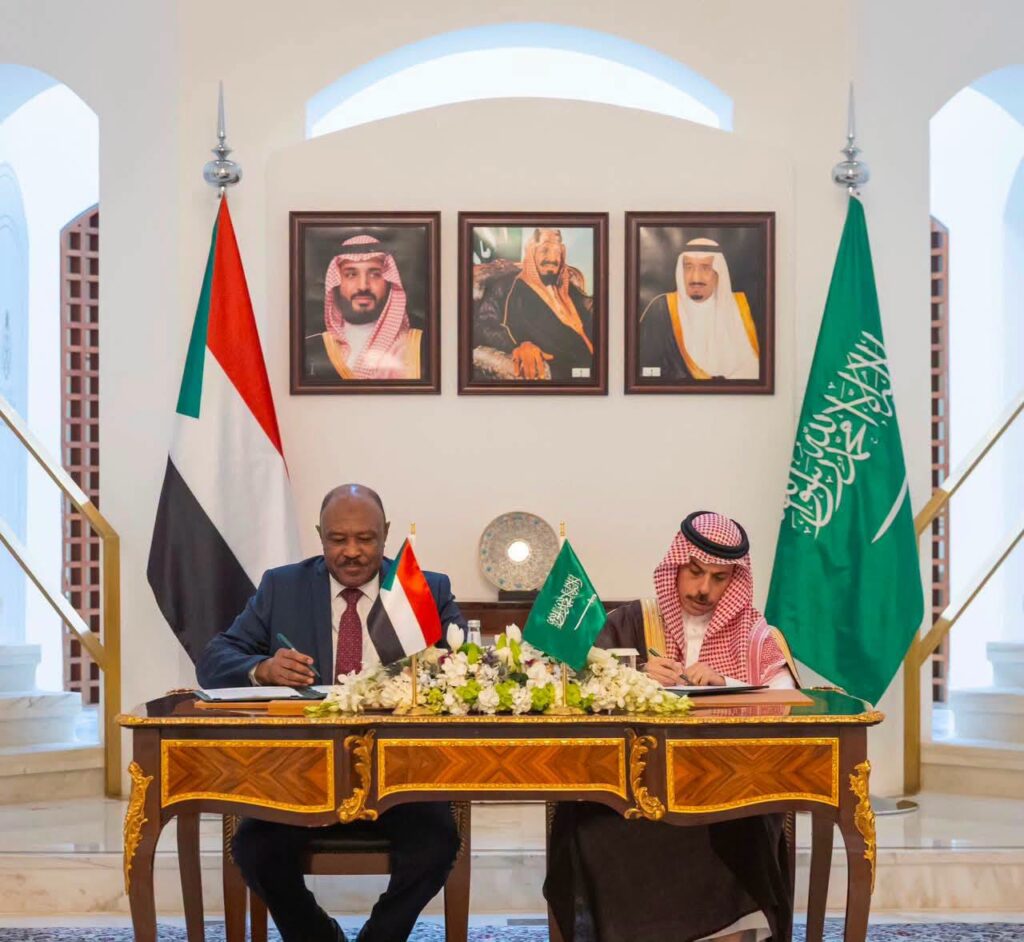
RIYADH – Sudan and Saudi Arabia signed an agreement on Sunday establishing a Higher Council for Cooperation and Strategic Coordination, creating a new institutional framework to manage and expand relations between the two countries.
The agreement was signed in Riyadh by Sudan’s Foreign Minister Mohieldin Salem Ahmed Ibrahim and Saudi Foreign Minister Prince Faisal bin Farhan, according to statements from both sides.
Sudan’s ambassador to Saudi Arabia, Dafaalla Al-Haj Ali Osman, and the director of the Arab Affairs Department at Sudan’s Foreign Ministry, Abdelazim Al-Karouri, attended the signing ceremony.
The council is designed to provide a broader and higher-level mechanism for developing bilateral relations and coordinating work across key files. According to Sudan’s Foreign Ministry, it will cover 10 main areas, including economic, investment, trade and political cooperation.
The Saudi Foreign Ministry said the council would serve as an effective institutional platform to strengthen bilateral ties and bring together relevant bodies from both countries to work on clear initiatives, projects and targets.
The agreement comes as Sudan seeks to reinforce regional partnerships amid the continuing war between the Sudanese Armed Forces (SAF) and the Rapid Support Forces (RSF), which has severely damaged the country’s economy, disrupted trade and increased the need for diplomatic, humanitarian and financial support.
Saudi Arabia has played a prominent diplomatic role since the outbreak of the war in April 2023, including hosting talks in Jeddah aimed at securing humanitarian access, ceasefire arrangements and a broader political process. Although those efforts have faced repeated setbacks, Riyadh has remained one of the key regional actors engaged in Sudan’s crisis.
The new council also reflects the long-standing strategic importance of relations between Sudan and Saudi Arabia. The two countries are linked by the Red Sea, labor migration, trade, investment, agriculture, livestock exports and security interests. Sudan has also traditionally viewed Saudi Arabia as one of its most important Arab partners.
For Khartoum, the agreement comes as the government works to restore official activity from the capital, expand regional recognition and attract support for reconstruction and economic stabilization. For Riyadh, stronger coordination with Sudan is tied to Red Sea security, regional stability and Saudi Arabia’s broader engagement in the Horn of Africa and the wider Arab-African region.
The council is expected to support joint projects and coordination mechanisms intended to promote development, economic stability and political cooperation between the two countries.