
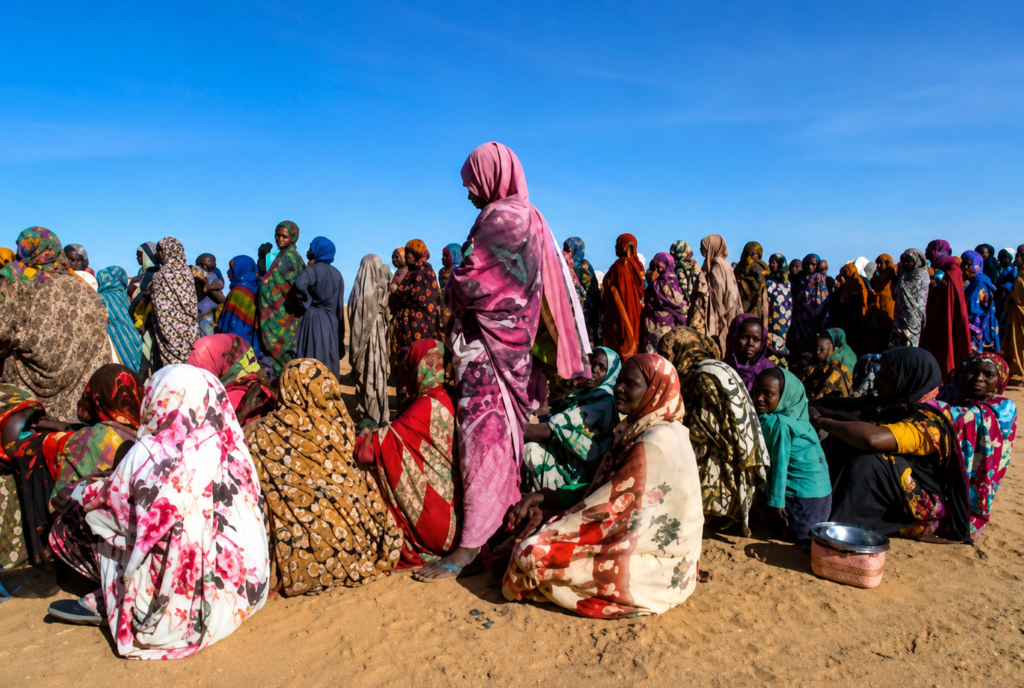
Introduction
Sudan is experiencing one of the largest displacement crises in the world. Millions of Sudanese have been forced to flee their homes because of armed conflict, violence, insecurity and humanitarian emergencies, creating a complex displacement crisis that affects both people who remain inside the country and those who have crossed international borders.
The current crisis accelerated dramatically after the outbreak of armed conflict between the Sudanese Armed Forces (SAF) and the Rapid Support Forces (RSF) on 15 April 2023. However, large-scale displacement in Sudan predates the current war and has been driven for decades by conflicts in Darfur, South Kordofan, Blue Nile and other regions.
Today, Sudan has millions of internally displaced persons (IDPs) living across all 18 states, while millions of Sudanese refugees have sought protection in neighbouring countries including Chad, South Sudan, Egypt, Ethiopia, Libya, the Central African Republic and Uganda. The crisis has placed enormous pressure on host communities, humanitarian organizations and neighbouring states, while creating urgent needs for food, shelter, healthcare, education and protection.
This guide explains Sudan’s displacement crisis, the difference between refugees and internally displaced persons, the causes of displacement, humanitarian conditions, international response and the long-term challenges facing displaced Sudanese communities.
Overview
Sudan’s displacement crisis consists of two closely related but legally distinct populations: refugees and internally displaced persons (IDPs).
Refugees are people who have crossed an internationally recognized border to seek protection because they cannot safely return to their country. Internally displaced persons, by contrast, have fled their homes for similar reasons but remain within Sudan’s borders. Under international law, refugees receive protection through the international refugee system, while IDPs remain under the primary responsibility of their own state.
Since April 2023, displacement has expanded rapidly across the country, making Sudan one of the world’s largest displacement emergencies. New displacement has occurred alongside long-standing displacement resulting from earlier conflicts, particularly in Darfur, creating overlapping humanitarian needs that continue to evolve. Recent UNHCR and IOM updates track millions of internally displaced people as well as millions of refugees and asylum seekers who have fled to neighbouring countries.
Why This Crisis Matters
Sudan’s displacement crisis extends far beyond the movement of people from one place to another. Displacement affects livelihoods, education, healthcare, food security, economic activity and social stability across the country and throughout the wider region.
A large proportion of displaced people are women and children, many of whom require sustained humanitarian assistance. Host communities also face increasing pressure on housing, schools, healthcare facilities, water resources and employment opportunities.
The scale and duration of displacement have made Sudan a central focus of humanitarian operations led by the United Nations, international organizations and national relief agencies. As the conflict continues, humanitarian needs remain closely linked to access constraints, funding shortages and security conditions in affected areas.
What is the Difference Between Refugees and Internally Displaced Persons (IDPs)?
Although the terms “refugee” and “internally displaced person (IDP)” are often used together, they describe two distinct categories of people under international frameworks.
Both refugees and IDPs are forced to flee their homes because of armed conflict, violence, persecution, human rights violations or disasters. The key difference is whether they cross an internationally recognized border.
A refugee leaves their country and seeks protection in another state because returning home would place their life, freedom or safety at risk. Refugees are protected under international refugee law, including the 1951 Refugee Convention, its 1967 Protocol and, in Africa, the 1969 OAU Refugee Convention, which expands the definition to include people fleeing events seriously disturbing public order.
An internally displaced person (IDP), by contrast, remains inside their own country after being forced to flee. IDPs do not lose their nationality or citizenship and remain under the primary responsibility of their own government, although humanitarian organizations may provide protection and assistance when needed. The internationally recognized definition of an IDP is contained in the UN Guiding Principles on Internal Displacement.
Legal Definitions
International refugee law defines a refugee as a person who is outside their country of nationality or habitual residence and cannot safely return because of persecution, armed conflict, violence or other serious threats requiring international protection.
Internally displaced persons are individuals or groups who have been forced to flee their homes for many of the same reasons but have not crossed an internationally recognized international border. Their displacement is internal rather than international, meaning they remain within the territory of their own country.
These legal distinctions determine which institutions are primarily responsible for providing protection and assistance and which international legal frameworks apply to each group.
Protection Under International Law
Refugees benefit from a specialized international legal protection regime. They cannot normally be returned to a country where they face persecution or serious threats to their lives, a principle known as non-refoulement. States hosting refugees also have obligations under international and regional refugee treaties.
IDPs, however, remain citizens or habitual residents of their own country. They retain all rights guaranteed under national and international law, and national authorities bear the primary responsibility for protecting them and helping them achieve durable solutions. International organizations such as UNHCR, IOM and other humanitarian agencies provide support when requested or mandated, particularly during humanitarian emergencies.
Why Sudan Has Both Refugees and IDPs
Sudan’s displacement crisis includes both refugees and internally displaced persons because conflict has affected nearly every region of the country.
Many families flee only a short distance to safer towns or neighbouring states within Sudan, becoming internally displaced persons. Others continue their journey across international borders into countries such as Chad, South Sudan, Egypt, Ethiopia, Libya, the Central African Republic and Uganda, where they become refugees under international law.
As security conditions change, some people move multiple times. A person may first become an IDP inside Sudan and later cross an international border to seek asylum, thereby becoming a refugee. Others may eventually return home or settle elsewhere depending on security, access to services and livelihood opportunities.
Patterns of Displacement in Sudan
Displacement in Sudan is highly dynamic and often occurs in several stages.
Some people flee active fighting and find temporary shelter with relatives or host communities. Others move to organized displacement sites or camps managed with humanitarian support. Refugees who cross into neighbouring countries may settle in refugee camps, urban areas or host communities depending on national policies and available assistance.
The pattern of displacement differs across Sudan. In Darfur, repeated cycles of violence have created long-term displacement lasting many years, while conflict since April 2023 has generated rapid and large-scale population movements across multiple states and international borders.
Understanding these different forms of displacement is essential for assessing humanitarian needs, planning assistance programmes and supporting long-term recovery and durable solutions for affected communities.
Historical Background
Large-scale displacement has been a recurring feature of Sudan’s modern history for decades. Civil wars, regional conflicts, political instability and environmental pressures have repeatedly forced communities to leave their homes.
The second Sudanese civil war (1983–2005) displaced millions of people across southern Sudan, the Nuba Mountains and Blue Nile. Although the Comprehensive Peace Agreement (CPA) in 2005 ended that conflict, new displacement crises soon emerged elsewhere in the country.
Beginning in 2003, the conflict in Darfur generated one of the world’s largest displacement emergencies. Hundreds of thousands of Sudanese crossed into neighbouring Chad, while millions became internally displaced within Darfur. Many remained in displacement camps for years because insecurity prevented their return.
Subsequent conflicts in South Kordofan and Blue Nile after 2011 created additional waves of displacement, adding to Sudan’s already large population of internally displaced people and refugees.
These successive crises meant that Sudan entered the 2023 conflict with millions of people already living in displacement, making the humanitarian consequences of the latest war even more severe.
The 2023 Sudan War and Mass Displacement
The outbreak of armed conflict between the Sudanese Armed Forces (SAF) and the Rapid Support Forces (RSF) on 15 April 2023 triggered one of the fastest-growing displacement crises in recent history.
Heavy fighting in Khartoum quickly spread to Darfur, Kordofan, Gezira, Sennar and other parts of the country, forcing millions of civilians to flee their homes.
Many families escaped with only a few personal belongings, leaving behind homes, businesses, farms, schools and livelihoods. Some sought safety in neighbouring towns, while others travelled hundreds of kilometres to safer states or crossed international borders.
The conflict also caused repeated secondary displacement. Families who had already fled once were often forced to move again as fighting expanded into areas that had initially been considered safe.
The scale, speed and geographic spread of displacement have placed enormous pressure on humanitarian organizations, host communities and neighbouring countries responding to the crisis.
Internal Displacement in Sudan
Most people displaced by the conflict have remained inside Sudan, making internally displaced persons (IDPs) the largest affected population.
IDPs are found across all regions of the country, with particularly high concentrations in Darfur, Northern State, River Nile, Kassala, Red Sea, White Nile and other areas considered relatively safer during different phases of the conflict.
Many displaced families live with relatives or host communities, while others reside in schools, public buildings, informal settlements or organized displacement sites established with humanitarian support.
Living conditions vary considerably depending on location, security conditions and humanitarian access. Many displaced households continue to face shortages of food, clean water, healthcare, education and shelter.
Cross-Border Refugee Movements
Millions of Sudanese have sought refuge in neighbouring countries since the conflict escalated.
Chad has received one of the largest refugee populations, particularly from Darfur, while Egypt has become a major destination for people fleeing northern and central Sudan. Significant numbers have also crossed into South Sudan, Ethiopia, Libya, the Central African Republic and Uganda.
Host governments, local communities and humanitarian organizations have worked to provide emergency assistance, registration, shelter, healthcare and protection services. However, the rapid arrival of large refugee populations has placed considerable strain on available resources and public services in many border areas.
The movement of refugees continues to evolve as security conditions inside Sudan change and humanitarian needs increase.
Repeated Displacement
For many Sudanese families, displacement has occurred more than once.
Communities displaced during earlier conflicts in Darfur, South Kordofan or Blue Nile were among those affected again after the outbreak of nationwide conflict in 2023.
Some households have moved several times within Sudan before eventually crossing an international border, while others continue to relocate between different towns depending on changing security conditions.
Repeated displacement increases humanitarian vulnerability by disrupting education, employment, healthcare and social support networks while making long-term recovery more difficult.
Displacement Trends
Sudan’s displacement patterns continue to change as frontlines shift and humanitarian access evolves.
New displacement often follows outbreaks of violence, while limited numbers of families return to their areas of origin when security conditions improve. At the same time, renewed fighting in previously stable locations can trigger additional waves of movement.
Humanitarian organizations therefore monitor displacement continuously in order to understand population movements, assess needs and plan assistance for both newly displaced and long-term displaced communities.
Women and Girls
Women and girls are among the groups most affected by Sudan’s displacement crisis. Many have experienced the loss of homes, livelihoods and community support networks while facing increased risks during displacement.
Displaced women often assume primary responsibility for caring for children, elderly relatives and other family members while also seeking food, water, healthcare and shelter under extremely difficult conditions.
Humanitarian organizations have repeatedly emphasized the importance of ensuring access to reproductive healthcare, maternal services, psychosocial support and protection programmes specifically designed for women and girls living in displacement.
Children
Children represent a large proportion of Sudan’s displaced population and have been disproportionately affected by the conflict.
Many have experienced interrupted education, family separation, psychological trauma and repeated displacement. Others have been exposed to malnutrition, disease outbreaks and limited access to healthcare.
International agencies continue to prioritize child protection, family reunification, education in emergencies, vaccination campaigns and nutritional support to reduce the long-term impact of displacement on Sudanese children.
Education
Displacement has severely disrupted education across Sudan.
Thousands of schools have been damaged, occupied, converted into shelters or closed because of insecurity, leaving millions of children without regular access to learning.
In displacement sites and refugee-hosting communities, humanitarian organizations have established temporary learning spaces and provided educational materials where possible. Despite these efforts, access to education remains limited for many displaced children because of overcrowding, teacher shortages, inadequate facilities and continuing insecurity.
Education is widely recognized as an essential component of humanitarian response because it helps protect children while supporting long-term recovery and community resilience.
Healthcare
Access to healthcare has become increasingly difficult for many displaced Sudanese.
Armed conflict has damaged health facilities, disrupted medical supply chains and reduced the availability of healthcare workers in many parts of the country.
Displaced families often face long travel distances to reach functioning health centres while shortages of medicines, medical equipment and qualified personnel continue to affect healthcare delivery.
Humanitarian organizations support emergency medical services, vaccination campaigns, maternal healthcare, nutrition programmes and disease surveillance in displacement-affected areas.
Food Security
Food insecurity is one of the most serious consequences of Sudan’s displacement crisis.
Families forced to flee frequently lose access to farms, livestock, businesses and other sources of income. At the same time, conflict disrupts agricultural production, transportation and local markets, reducing the availability of food and increasing prices.
Many displaced households rely on humanitarian food assistance, community support or informal coping mechanisms to meet their basic needs.
Food security conditions vary across Sudan and are influenced by conflict, seasonal factors, market access and humanitarian operations.
Shelter
Safe shelter remains one of the most urgent needs for displaced populations.
Many internally displaced people live in schools, unfinished buildings, collective shelters, informal settlements or with host families. Refugees in neighbouring countries may reside in organized camps or within local communities.
Overcrowding, limited privacy, inadequate protection from weather conditions and shortages of essential household items remain common challenges in many displacement sites.
Humanitarian agencies provide emergency shelter materials, tents, household supplies and support for camp management where access permits.
Water, Sanitation and Hygiene (WASH)
Access to clean water, sanitation facilities and hygiene services is essential for preventing disease outbreaks among displaced populations.
Large population movements place significant pressure on water systems and sanitation infrastructure, particularly in displacement sites and border reception areas.
Humanitarian organizations work to improve access to safe drinking water, construct emergency latrines, distribute hygiene supplies and promote disease prevention through community awareness campaigns.
Maintaining adequate WASH services is particularly important during outbreaks of cholera, acute watery diarrhoea and other communicable diseases.
Protection Risks
Displaced populations face a wide range of protection risks throughout their displacement.
These include family separation, loss of identity documents, restrictions on humanitarian access, exploitation, insecurity, forced displacement and limited access to legal services.
People with disabilities, older persons, women, children and unaccompanied minors often face additional protection challenges requiring specialized humanitarian support.
Protection activities seek to reduce these risks while promoting safety, dignity and respect for the rights of displaced people.
Gender-Based Violence
Humanitarian organizations have reported heightened risks of gender-based violence during displacement, particularly for women and girls.
Displacement can increase exposure to sexual violence, domestic violence, forced marriage and other forms of abuse, especially where security, shelter and access to services are limited.
Humanitarian responses include confidential survivor support, medical care, psychosocial services, legal assistance where available and community-based protection programmes aimed at reducing risks and strengthening prevention.
Human Trafficking and Exploitation
Large-scale displacement can increase the risk of trafficking in persons, forced labour and other forms of exploitation.
Families facing severe economic hardship may become more vulnerable to criminal networks operating along migration routes or in border areas.
Children travelling alone, separated families and individuals lacking legal documentation are particularly at risk.
Humanitarian organizations, governments and international partners work together to strengthen border protection, identify vulnerable individuals, provide legal assistance and raise awareness of trafficking risks among displaced communities.
International Humanitarian Response
Sudan’s displacement crisis has prompted one of the world’s largest humanitarian responses, involving United Nations agencies, the International Red Cross and Red Crescent Movement, international non-governmental organizations (INGOs), national organizations and local volunteer networks.
These organizations provide emergency assistance ranging from food, shelter and healthcare to education, water, sanitation, protection services and logistical support. Their operations are coordinated through humanitarian response plans led by the United Nations Office for the Coordination of Humanitarian Affairs (OCHA) in cooperation with the Government of Sudan, humanitarian partners and donor governments.
The scale of humanitarian needs continues to exceed available resources, making sustained international support essential for millions of displaced Sudanese.
United Nations High Commissioner for Refugees (UNHCR)
UNHCR is the lead United Nations agency responsible for protecting refugees, asylum seekers and stateless persons. In Sudan and neighbouring countries, the agency coordinates refugee registration, protection, emergency shelter, legal assistance and long-term solutions for displaced populations.
UNHCR also works with governments and humanitarian partners to support refugees who have fled Sudan while assisting internally displaced persons when requested within broader humanitarian operations.
The agency regularly publishes updated statistics on refugee movements, protection needs and humanitarian priorities related to the Sudan crisis.
International Organization for Migration (IOM)
The International Organization for Migration (IOM) plays a central role in monitoring internal displacement across Sudan.
Through its Displacement Tracking Matrix (DTM), IOM collects and publishes data on population movements, locations of displaced communities and changing humanitarian needs.
The organization also supports emergency shelter, camp coordination, transportation assistance, return assessments and community stabilization programmes where conditions permit.
United Nations Office for the Coordination of Humanitarian Affairs (OCHA)
OCHA coordinates the overall humanitarian response in Sudan by bringing together United Nations agencies, international organizations, national NGOs and donor governments.
It develops humanitarian response plans, coordinates emergency operations, identifies priority needs and monitors humanitarian access throughout the country.
OCHA also publishes regular situation reports, funding updates and assessments that guide humanitarian planning and international assistance.
World Food Programme (WFP)
The World Food Programme is the principal agency responsible for emergency food assistance in Sudan.
Its operations include food distributions, cash assistance where markets remain functional, nutritional support for vulnerable groups and logistics services supporting the wider humanitarian response.
WFP also operates large-scale transportation networks that help deliver humanitarian supplies to difficult-to-reach areas affected by conflict.
United Nations Children’s Fund (UNICEF)
UNICEF focuses on protecting children affected by displacement and conflict.
Its programmes include emergency education, vaccination campaigns, nutrition services, child protection, water and sanitation projects and psychosocial support.
UNICEF also works to reunite separated families, prevent disease outbreaks and improve access to safe learning environments for displaced children.
World Health Organization (WHO)
The World Health Organization supports Sudan’s health response by coordinating disease surveillance, emergency medical assistance and public health interventions.
WHO works with national health authorities and humanitarian partners to strengthen healthcare services, respond to disease outbreaks and supply essential medicines and medical equipment.
The organization has played a key role in responding to outbreaks of cholera, measles and other communicable diseases affecting displaced populations.
International Committee of the Red Cross (ICRC)
The International Committee of the Red Cross operates in Sudan under its humanitarian mandate to protect and assist people affected by armed conflict.
Its activities include emergency medical support, restoration of family links, protection of civilians, assistance to healthcare facilities and support for access to clean water.
The ICRC also engages confidentially with parties to the conflict regarding their obligations under international humanitarian law.
National and Local Organizations
Sudanese humanitarian organizations, community-based groups and volunteer networks play an essential role in responding to displacement.
Local organizations often provide the first emergency assistance to newly displaced families through community kitchens, emergency shelters, medical services, education initiatives and volunteer-led relief activities.
Their local knowledge and community connections make them indispensable partners in humanitarian operations, particularly in areas that are difficult for international organizations to access.
Humanitarian Funding
Meeting the needs of displaced Sudanese requires substantial financial support from donor governments, international financial institutions, United Nations agencies and humanitarian organizations.
Annual humanitarian response plans identify funding requirements based on assessments of food security, healthcare, shelter, education, protection and other essential services.
Funding levels directly influence the scale of humanitarian operations, with shortages often resulting in reduced assistance, delayed programmes and increased vulnerability among displaced communities.
Challenges to Humanitarian Access
Delivering humanitarian assistance in Sudan remains extremely challenging.
Active conflict, damaged infrastructure, insecurity, administrative procedures, telecommunications disruptions and seasonal flooding can all limit access to affected communities.
Humanitarian organizations frequently emphasize the importance of safe, rapid and unimpeded access to civilians in need, as well as the protection of humanitarian personnel, medical facilities and relief supplies.
Expanding humanitarian access remains one of the most important priorities for improving assistance to displaced populations across Sudan.
Durable Solutions
Humanitarian organizations recognize three principal durable solutions for refugees and internally displaced persons.
The first is voluntary return, where displaced people are able to return safely, voluntarily and with dignity to their homes or places of origin once conditions permit.
The second is local integration, whereby displaced people establish sustainable lives in the communities where they have taken refuge. For refugees, this may include obtaining long-term legal status in the host country. For internally displaced persons, it means integrating into the community where they have sought refuge within Sudan.
The third is settlement elsewhere. Refugees may be resettled to a third country or move through other legal pathways, while internally displaced persons may permanently settle in another part of Sudan if returning home is not possible.
A durable solution is achieved only when displacement-related protection and assistance needs have ended and people can enjoy their rights without discrimination linked to their displacement.
Returns and Reintegration
Some Sudanese families have returned to their areas of origin after improvements in local security conditions. Others have chosen to remain in displacement sites or host communities because homes, schools, health facilities and public infrastructure have been destroyed or essential services remain unavailable.
Successful return depends on several factors, including security, access to land and housing, restoration of public services, livelihood opportunities and the removal of explosive remnants of war where applicable.
Humanitarian organizations emphasize that all returns should be voluntary, safe, informed and dignified, while recognizing that some displaced people may choose other long-term solutions instead of returning to their original communities.
Future Challenges
Sudan’s displacement crisis is expected to remain one of the country’s most significant humanitarian challenges even after active conflict subsides.
Millions of displaced people will require support to rebuild homes, restore livelihoods, recover documentation, re-enrol children in school and regain access to healthcare and public services.
Long-term recovery will also depend on reconstruction, economic development, reconciliation between communities, strengthened public institutions and sustained humanitarian and development assistance.
Addressing displacement will therefore remain a central component of Sudan’s recovery for many years.
Latest Statistics
This section should be updated whenever UNHCR, IOM or OCHA publish new figures.
Suggested indicators include:
• Internally Displaced Persons (IDPs)
• Sudanese Refugees
• Refugees by Host Country
• People in Need of Humanitarian Assistance
• Children Affected
• Schools Closed or Disrupted
• Health Facilities Affected
• Humanitarian Funding Requirements
• Humanitarian Funding Received
• Date of Latest Update
Maintaining this section separately allows the guide to remain current without rewriting the rest of the article.
Timeline
1983–2005 – The second Sudanese civil war displaces millions of people across southern Sudan, Blue Nile and the Nuba Mountains.
2003 – Conflict in Darfur triggers one of Africa’s largest displacement crises.
2005 – The Comprehensive Peace Agreement ends the second civil war, enabling some voluntary returns while many communities remain displaced.
2011 – New conflict in Blue Nile and South Kordofan creates additional waves of internal displacement and refugee movements.
2020 – The Juba Peace Agreement seeks to address displacement, return and reconstruction in conflict-affected regions.
15 April 2023 – Armed conflict between the Sudanese Armed Forces (SAF) and the Rapid Support Forces (RSF) begins, causing mass displacement across Sudan.
2023–Present – Sudan experiences one of the world’s largest displacement crises, with millions of internally displaced persons and refugees requiring humanitarian assistance.
Frequently Asked Questions
What is the difference between a refugee and an internally displaced person (IDP)?
A refugee has crossed an international border to seek protection, while an internally displaced person has fled their home but remains within Sudan.
Why are so many Sudanese displaced?
The primary causes include armed conflict, violence, insecurity, human rights abuses and humanitarian emergencies.
Which countries host the largest numbers of Sudanese refugees?
Neighbouring countries including Chad, South Sudan, Egypt, Ethiopia, Libya, the Central African Republic and Uganda host the largest refugee populations from Sudan.
Who assists displaced Sudanese?
Assistance is provided by the Government of Sudan, host governments, UNHCR, IOM, OCHA, WFP, UNICEF, WHO, ICRC, international NGOs, national organizations and local volunteer groups.
Can displaced Sudanese return home?
Yes, but returns should be voluntary, safe and dignified. Many families are unable to return because of continuing insecurity, damaged infrastructure or the lack of essential services.
Why is Sudan’s displacement crisis important?
The crisis affects millions of people, places enormous pressure on neighbouring countries and humanitarian organizations and has significant humanitarian, economic and regional consequences.
Sources
• United Nations High Commissioner for Refugees (UNHCR)
• International Organization for Migration (IOM)
• United Nations Office for the Coordination of Humanitarian Affairs (OCHA)
• World Food Programme (WFP)
• United Nations Children’s Fund (UNICEF)
• World Health Organization (WHO)
• International Committee of the Red Cross (ICRC)
• International Federation of Red Cross and Red Crescent Societies (IFRC)
• ReliefWeb
• Government of Sudan
• Peer-reviewed academic publications on forced displacement and humanitarian response