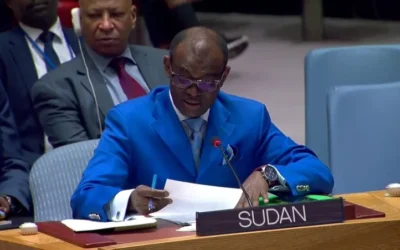

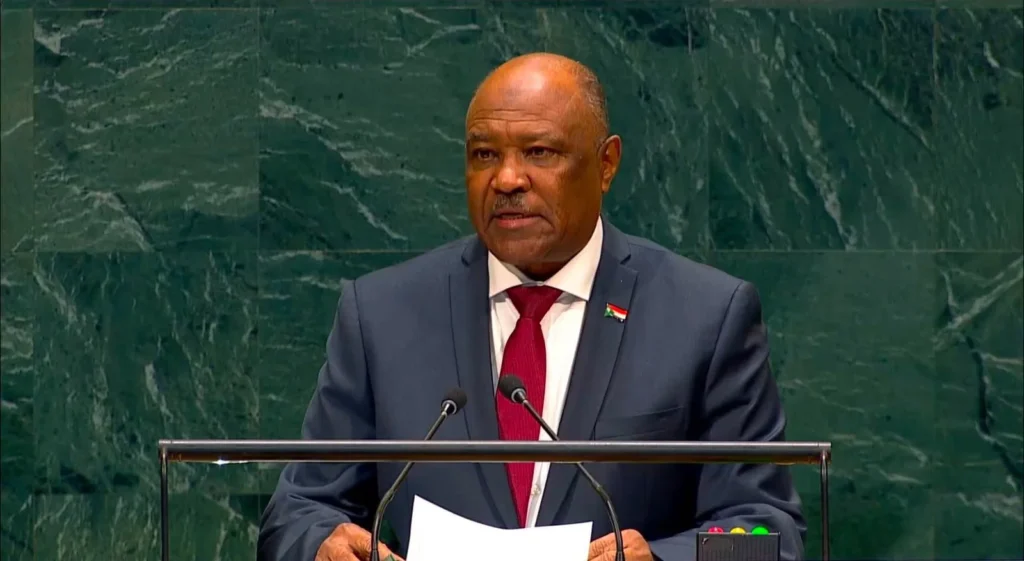
NEW YORK – Sudan called for an end to external interference, weapons flows and the movement of mercenaries into the country, while reaffirming its support for a broad Sudanese-Sudanese dialogue as the political path to ending the war.
Foreign Minister Mohieddin Salem outlined Khartoum’s position in an address to the 81st session of the U.N. General Assembly in New York, covering the war, international sanctions, reform of the United Nations and Sudan’s political and economic priorities for the post-war period.
Salem said Sudan had expected Sovereign Council Chairman Abdel Fattah al-Burhan to address the General Assembly, but his participation was prevented after he did not receive a U.S. entry visa.
Sudan called on the U.N. Secretary-General, the General Assembly and the Committee on Relations with the Host Country to take steps to uphold the U.N. headquarters agreement and address what it described as the denial of Sudan’s right to representation.
Salem also called for wider reform of the international system, arguing that developing countries need a more equitable global order.
He criticized the use of coercive sanctions for political or economic purposes and called for reform of the U.N. Security Council, including permanent African representation.
Sudan also called for changes to the international financial system to provide countries with more equitable access to financing.
Call to Halt Foreign Arms and Fighters
On the war, Salem said a durable peace required an end to external interference and the flow of weapons, ammunition and mercenaries into Sudan.
He accused the Rapid Support Forces (RSF) of attacks on civilians, civilian infrastructure and medical facilities and called for international action and accountability for violations.
The RSF has faced widespread accusations of abuses during the conflict, while the Sudanese army has also faced international allegations of violations. Both sides have rejected or disputed various accusations against them.
The war between the Sudanese Armed Forces (SAF) and the RSF began in April 2023 and has displaced millions of people, damaged infrastructure and severely disrupted public services.
Sudanese-Led Political Process
Salem said an inclusive Sudanese-Sudanese dialogue based on national ownership remained, in the government’s view, the best route to resolving the crisis.
He said the process required conditions that protect civilians, reduce escalation and build confidence among Sudanese parties.
The foreign minister also stressed implementation of commitments under the Jeddah Declaration, including civilian protection, humanitarian access and safe passage for people seeking to leave conflict areas voluntarily.
Salem said the government had begun preparing conditions for a broader national dialogue aimed at reaching common ground for an inclusive political transition ending in free and fair elections, with regional and international monitoring.
Government Road Map
The minister reaffirmed support for the government’s road map for ending the war, which includes security and political arrangements leading to a transitional period and elections.
He said Sudan remained open to initiatives genuinely aimed at ending the conflict but rejected what he described as externally imposed solutions or political dictates.
Salem stressed that decisions over Sudan’s political future should be made through a process owned by Sudanese themselves.
He also reaffirmed government cooperation with the United Nations, including the Secretary-General’s personal envoy, humanitarian agencies and human rights mechanisms.
Recovery and Reconstruction
On the economy, Salem said Sudan was seeking stronger engagement with international financial institutions and support for addressing debt, economic recovery and reconstruction.
He also highlighted Sudan’s participation in international initiatives involving borrowing countries and developing states, saying Khartoum wanted to expand cooperation with the Global South and international partners during the post-war recovery period.
Salem reiterated Sudan’s support for the Palestinian right to self-determination and an independent state with Jerusalem as its capital.
He also called for stability in the Red Sea, Bab al-Mandab and Gulf region, while emphasizing respect for the sovereignty of regional states.