
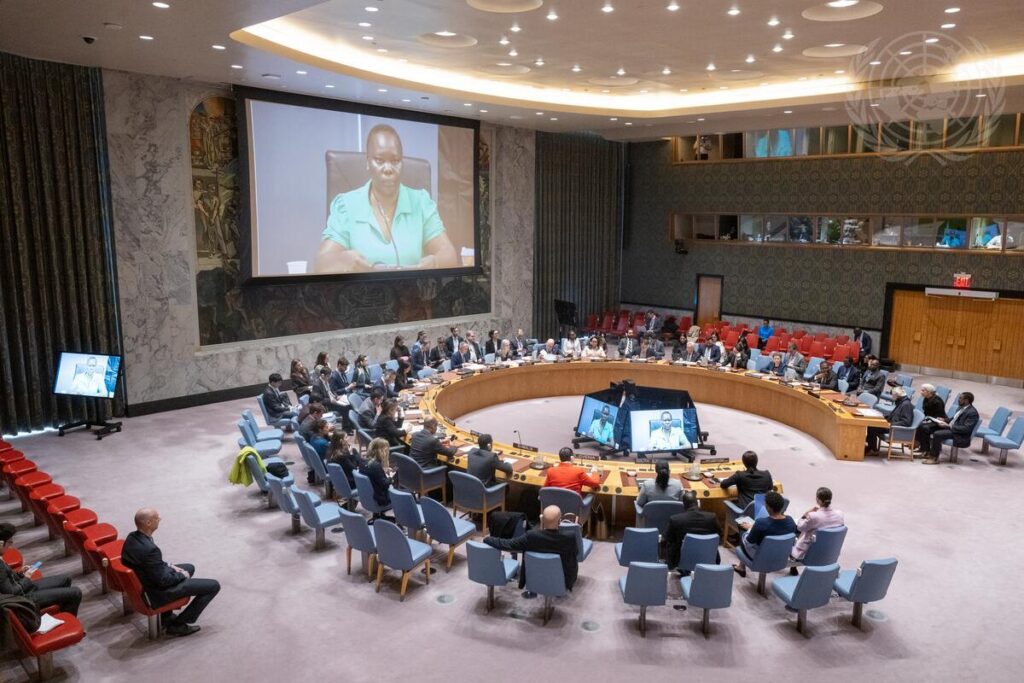
NEW YORK – The U.N. Security Council was sharply divided on Monday over a U.S. proposal to expand the arms embargo on Sudan from Darfur to the entire country, as members debated escalating fighting, drone attacks, foreign support to the warring parties and the future of sanctions.
The open briefing, held on August 24, did not produce a vote, a new resolution or any immediate enforcement measures, including a no-fly zone. But it exposed widening international disagreement over how to respond to Sudan’s war and whether the existing sanctions regime should be expanded.
The United States proposed widening the arms embargo under Resolution 1591 to cover all Sudanese territory, clarifying that the ban would include drones and related technologies, and increasing the number of experts monitoring sanctions.
Sudan rejected the proposal, while Western states including the United States, France, Britain, Denmark and Latvia supported expanding the embargo. Russia and China warned against broadening sanctions, while Egypt and Pakistan called for measures that distinguish between the Sudanese army and the Rapid Support Forces.
Sudan rejects wider arms embargo
Sudan’s ambassador to the Security Council, Al-Harith Idriss, rejected the U.S. proposal, saying expanding the arms embargo to the whole country would target Sudan’s sovereignty and weaken the Sudanese Armed Forces (SAF) as they fight the Rapid Support Forces (RSF).
Idriss said widening the embargo would amount to a “systematic destruction” of the Sudanese army, which he said is resisting an organized assault on the state. He argued that such a step would not build confidence or help end the war.
He also rejected any equation between the army and the RSF, saying Sudan’s national army could not be treated the same as what he described as an externally backed terrorist militia committing crimes.
At the same time, Idriss said Sudan supports accountability for violations of international law and international humanitarian law, including crimes he accused the RSF of committing against civilians, women and children.
He also referred to the U.N. Panel of Experts on Sudan, saying its report addressed what Khartoum describes as the role of the United Arab Emirates in fueling the war through support to the RSF. The UAE denies supporting any party in Sudan’s war.
U.S. pushes sanctions expansion
Massad Boulos, senior adviser to the U.S. president for African and Arab affairs, said Washington had submitted a proposal to expand the arms embargo across Sudan.
Boulos said the suffering of Sudanese civilians and the instability caused by more than three years of war had not received the international attention they deserved.
He accused both warring parties of choosing military escalation and territorial gains over a truce and peace, saying dialogue and a civilian-led transition remained the only path to lasting peace and the restoration of civilian rule.
The United States also voiced support for the Quint Mechanism, which includes the U.N., African Union, IGAD, Arab League and European Union, as part of efforts to advance a political and civilian track in Sudan.
Western states back wider ban
France supported expanding the arms embargo from Darfur to all of Sudan, saying the war could only end through dialogue. The French representative also pointed to severe funding gaps in Sudan’s humanitarian response plan.
Britain said it had provided £200 million in humanitarian assistance to Sudan this year, while Denmark described Sudan as the world’s largest humanitarian crisis and welcomed U.S. efforts to end the war.
The UAE also supported the U.S. draft proposal to expand the arms embargo nationwide, a position that highlighted one of the most sensitive disputes between Khartoum and Abu Dhabi inside the U.N. debate.
Russia and China object
Russia opposed the Western push, rejecting what it described as an attempt to place equal responsibility on the Sudanese army and the RSF.
The Russian representative accused the RSF of using drones indiscriminately and seeking to cause maximum harm to civilians and civilian infrastructure, while saying the Sudanese army works to identify military targets.
Moscow also criticized U.S. and European economic sanctions on Sudan, warning that what it called a policy of economic strangulation would increase pressure on Sudanese civilians.
China urged members to focus on implementing existing U.N. sanctions before considering expansion. Beijing said sanctions are not an end in themselves and warned that broad, poorly targeted measures could complicate the situation and worsen civilian suffering.
Egypt and Pakistan stress distinction between army and RSF
Egypt called for halting the flow of weapons and mercenaries to the RSF, saying this was essential to any serious effort to end the war. Cairo said the Darfur arms embargo had shown its limits after nearly two decades and needed to be improved.
At the same time, Egypt warned that ceasefire arrangements should not become a tool for drawing new lines of division or entrenching a de facto partition of Sudan.
Pakistan called for a return to the Jeddah platform, saying there was still an opportunity to revive negotiations. It also stressed the need to distinguish between the national army of a sovereign state and a militia accused of widespread crimes.
U.N. warns of expanding war
U.N. Under-Secretary-General for Political and Peacebuilding Affairs Rosemary DiCarlo warned that fighting is continuing on multiple fronts and that Sudan’s war is becoming more complex.
She said recent weeks had seen heavy use of drones, along with fighting in North Kordofan, West Darfur, North Darfur and Blue Nile. She also warned that fighting near the Sudan-Ethiopia border in Blue Nile was a matter of serious concern.
DiCarlo said advanced weapons used in the conflict indicate continued external support to both sides.
U.N. humanitarian chief Tom Fletcher said two-thirds of Sudan’s population urgently need life-saving assistance. He said U.N. teams are working across front lines, drone attacks, insecurity and bureaucratic obstacles, but warned that Sudan suffers not from a lack of analysis but from a lack of action.
Fletcher said the U.N. had reached nearly 11 million people by mid-year with at least one form of assistance, but the humanitarian response remained underfunded, with just over 40% received of the $2.87 billion required for the 2026 response plan.
Human rights concerns
Human rights briefers also raised concerns over sexual violence, forced marriage of underage girls and attacks on Sudan’s health sector.
Rights advocate Eva Kjer said sexual violence against women continues, including reports of forced marriages involving underage girls attributed to RSF elements. She also accused the RSF of deliberately targeting Sudan’s medical sector through artillery shelling and drone attacks.
Saudi Arabia said the RSF continues to commit grave violations against Sudanese civilians and praised the Sudanese government’s decision to open humanitarian crossings in line with the Jeddah Declaration.
No decision, but deeper division
The session ended without a vote or new sanctions decision, but it revealed a growing diplomatic battle over Sudan’s sanctions regime.
Western states pushed to expand the arms embargo nationwide, while Russia and China resisted broader sanctions. Egypt and Pakistan emphasized the need to stop weapons and mercenary flows while distinguishing between the army and the RSF.
The debate showed that Sudan’s war is now being fought not only on the ground in Kordofan, Darfur and Blue Nile, but also in international forums over arms flows, external support, accountability and the shape of any future peace process.