

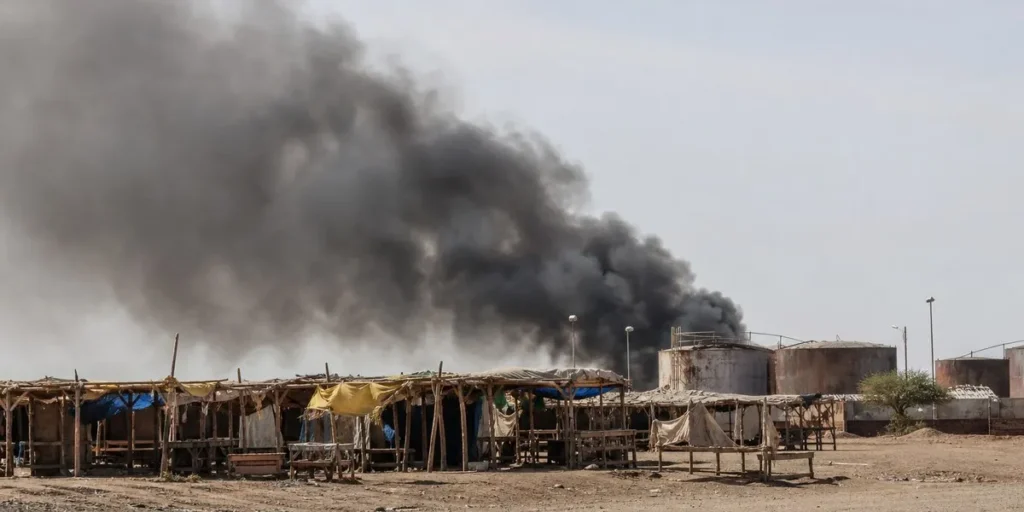
KHARTOUM – Sudan has denied that its armed forces carried out the deadly Oct. 19 drone attack on Amiet Market in the disputed Abyei region, expressing condolences to the victims as competing accounts continue over responsibility for one of the deadliest recent aerial attacks in the area.
The Ministry of Foreign Affairs and International Cooperation said in a statement issued Thursday that the Sudanese Armed Forces (SAF) had “no connection” to the attack and described the loss of civilian life as regrettable.
The ministry said the incident resembled attacks it has previously attributed to the Rapid Support Forces (RSF), including a December 2025 attack on a U.N. peacekeeping facility in Kadugli that killed members of the Bangladeshi contingent, as well as attacks on humanitarian convoys.
The Sudanese government did not present evidence identifying the party responsible for the Amiet strike.
Khartoum’s denial follows accusations from South Sudan, which blamed the SAF for the attack and summoned Sudan’s ambassador in Juba to lodge a formal protest.
South Sudan called on Sudan to prevent further attacks that could threaten civilian lives and property in Abyei, whose final status has remained unresolved since South Sudan gained independence in 2011.
The United Nations has not formally attributed responsibility for the attack.
U.N. figures released after the strike put the confirmed toll at at least 80 people killed and 27 injured, while Abyei authorities reported substantially higher casualty figures as recovery operations continued.
Earlier local estimates put the death toll at 153, although figures have continued to change as bodies were recovered from areas affected by fires following the attack.
The strikes hit Amiet Market and the nearby Todach area, about 15 kilometres from Abyei town. The United Nations Interim Security Force for Abyei (UNISFA) said dozens of people were killed or wounded and others were reported missing.
The attack also triggered large fires, with UNISFA peacekeepers providing emergency medical assistance, helping evacuate casualties and deploying firefighting teams.
Amiet is one of Abyei’s most important commercial centres, serving communities from Sudan and South Sudan and acting as a trading hub for food, fuel and other goods moving through the border region.
Its strategic commercial role has added to scrutiny of the attack amid reports that fuel and supplies passing through the area also move toward parts of Kordofan and Darfur affected by Sudan’s war.
The Sudanese government’s denial comes as drone warfare expands across the conflict between the SAF and RSF, with aerial attacks increasingly reaching civilian markets, residential areas and locations far from conventional front lines.
The International Committee of the Red Cross warned this week that recent aerial attacks across Sudan, many likely carried out by armed drones, had reportedly killed hundreds of civilians and particularly affected residential areas, markets and locations sheltering displaced people.
Abyei remains particularly sensitive because it is claimed by both Sudan and South Sudan and is intended to remain demilitarized under existing arrangements.
The United Nations has urged both governments to prevent further escalation, protect civilians and preserve Abyei’s demilitarized status.


