
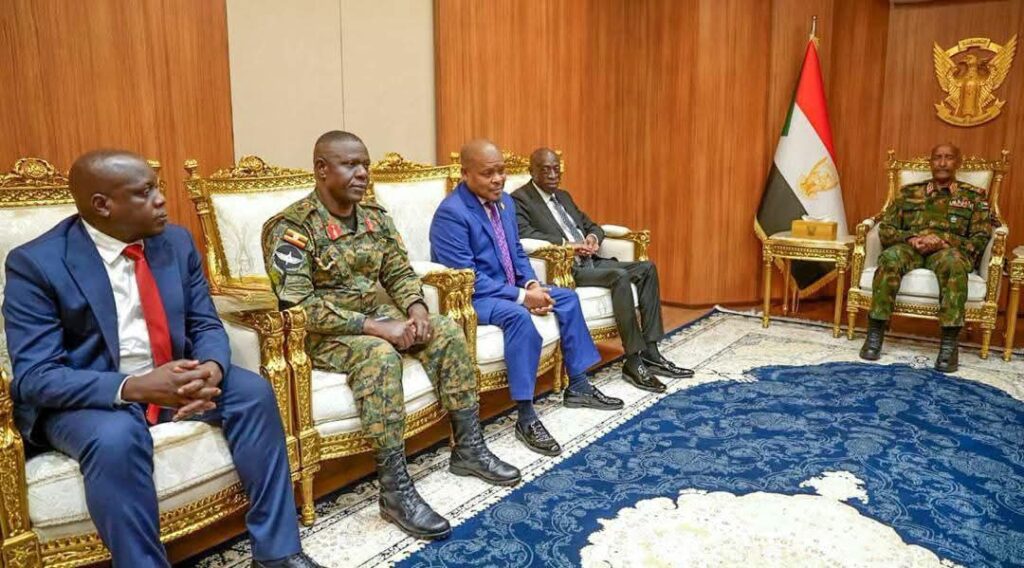
KHARTOUM – Uganda reaffirmed its support for Sudan’s sovereignty and territorial integrity on Friday during talks between Transitiona Sovereignty Council Chairman General Abdel Fattah al-Burhan and Ugandan President Yoweri Museveni’s Special Envoy for Peace in Sudan, Joseph Akuot, who also conveyed a message from the Ugandan leader.
According to Sudan’s Sovereignty Council, Akuot reiterated Uganda’s rejection of any arrangements that could lead to the establishment of a parallel government in Sudan and reaffirmed Kampala’s support for the country’s unity, sovereignty and stability, describing peace in Sudan as important for regional security.
Burhan said Sudan was committed to strengthening bilateral relations with Uganda in ways that serve the interests of both countries, the council said.
Earlier on Friday, the Ugandan delegation held separate talks with Sudanese Prime Minister Kamil Idris, focusing on recent developments in the conflict, Khartoum’s peace initiative and prospects for expanding bilateral cooperation.
According to Sudan’s government, Idris briefed the delegation on the latest military developments, including what he described as gains by the Sudanese Armed Forces (SAF) and allied forces, as well as the impact of the conflict on civilian infrastructure and public institutions. He also outlined the government’s peace initiative, which Khartoum says has received domestic, regional and international support.
Uganda has maintained diplomatic engagement with Sudan throughout the conflict and has repeatedly expressed support for preserving Sudan’s sovereignty and territorial integrity while encouraging efforts to restore peace and stability.
The meetings come as Sudan’s government seeks broader regional backing for its peace initiative amid continued fighting between the SAF and the Rapid Support Forces (RSF), a conflict that has displaced millions of people and triggered one of the world’s largest humanitarian crises.
Regional governments and international organizations continue to call for a negotiated settlement to the conflict, while Sudanese authorities maintain that any political process must preserve the country’s sovereignty, unity and state institutions.