
KHARTOUM – Médecins Sans Frontières (MSF) said Sudanese people are best placed to tell the world the reality of the war in their country, stressing that the conflict, now in its fourth year, cannot be understood through headlines alone but through the experiences of millions of civilians living it every day.
In an article published on its website, MSF said one of its Sudanese staff members responded to the question, “Who tells Sudan’s story?” by saying: “We, the Sudanese, are the ones who can tell the world our story.”
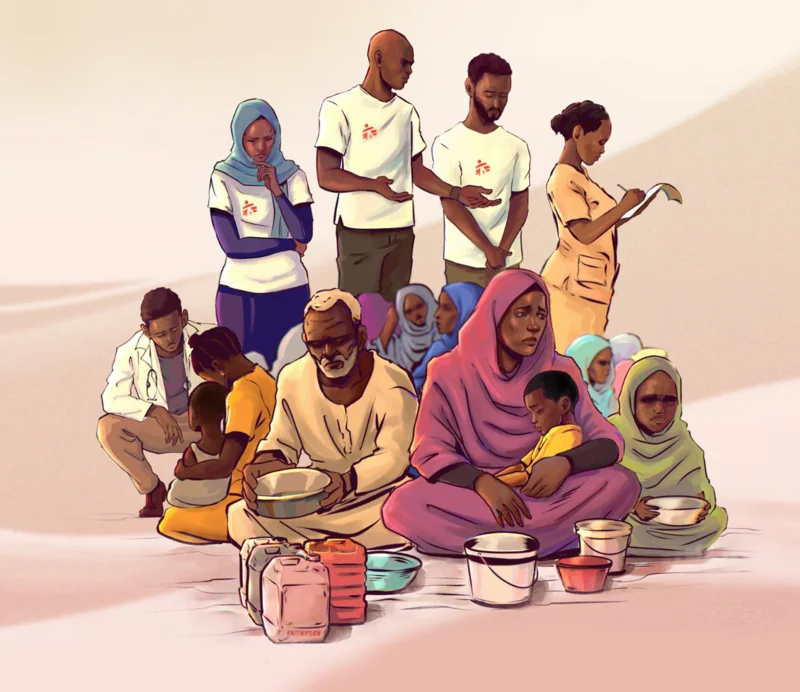
The organization highlighted the experience of Narin Vandoglu, an MSF operations adviser who visited Sudan twice last year and used illustrations to document what she witnessed in Khartoum and Darfur. She described art as a way to understand and communicate everyday life amid conflict.
Her drawings depict scenes from local markets, coffee stalls, damaged homes, shared water containers and Sudan’s ancient pyramids, reflecting the country’s history, culture and daily life beyond images of war.
The initiative comes as Sudan’s conflict, which began in April 2023, has evolved into one of the world’s largest humanitarian crises, displacing millions of people and severely disrupting access to healthcare and basic services across much of the country.
MSF said the war has deprived many Sudanese artists of opportunities to tell their own stories, adding that its collaboration with cartoonists from Khartoon Magazine aims to give Sudanese voices greater space instead of relying solely on external narratives that portray people primarily as victims.
According to the organization, the conflict has now lasted for more than 1,200 days. Citing UNHCR, it said nearly 12 million people have been displaced inside Sudan and across its borders, while about 33.7 million people require humanitarian assistance. It also cited World Health Organization data indicating that 37% of Sudan’s health facilities remain out of service because of the conflict.