
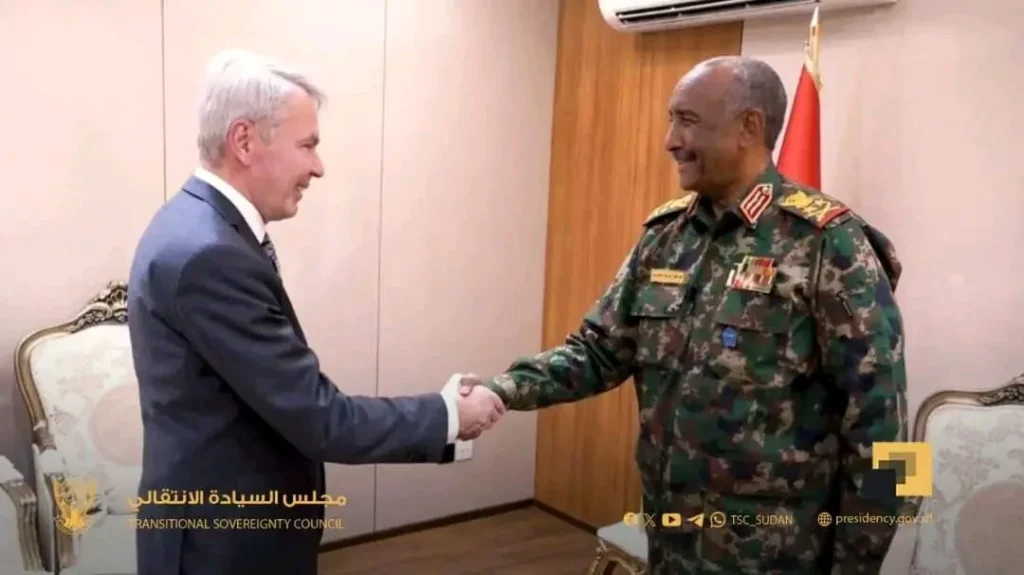
KHARTOUM – The UN Secretary-General’s personal envoy for Sudan, Pekka Haavisto, arrived in Khartoum on Friday for consultations with key Sudanese actors on de-escalation, civilian protection and possible steps toward a political process.
UN spokesperson Stéphane Dujarric said Haavisto held a phone call on Thursday with Rapid Support Forces (RSF) commander Mohamed Hamdan Dagalo, known as Hemedti, to discuss issues related to de-escalation and the protection of civilians.
Dujarric said the UN envoy would join partners from the Quint Mechanism in Khartoum for a series of meetings with Sudanese stakeholders.
The Quint Mechanism brings together the African Union, European Union, Intergovernmental Authority on Development (IGAD), League of Arab States and the United Nations.
The meetings are expected to address Sudan’s current political landscape, including recent initiatives and proposals aimed at advancing a Sudanese-Sudanese dialogue.
The UN continues to call for a negotiated settlement to the conflict that reflects the democratic aspirations of the Sudanese people, Dujarric said.
He added that Haavisto would continue engaging with a wide range of Sudanese actors inside and outside the country to support an inclusive, sustainable and Sudanese-owned political process.
Previous Consultations
Haavisto’s visit to Khartoum follows recent meetings with Sudanese political and civil forces outside the country, including consultations in Nairobi with the Sudan Liberation Movement/Army led by Abdel Wahid Mohamed Nour and the Sudanese Declaration of Principles group.
Those meetings focused on efforts to end the war, the humanitarian crisis, political initiatives and proposals for a credible peace process.
The groups that met Haavisto in Nairobi expressed support for ending the war through a comprehensive political process, but raised reservations about any dialogue framework they said could legitimize military rule, entrench the realities created by the war or exclude key civilian forces.
Sudanese anti-war groups have also held consultations in Addis Ababa in recent weeks to discuss army chief Abdel Fattah al-Burhan’s call for an internal Sudanese dialogue and broader proposals for a comprehensive peace process.
Those discussions reflected deep divisions among Sudanese civilian and political forces over the timing, venue and guarantees of any political process, especially while fighting continues and large parts of the country remain under the control of armed actors.
War and Mediation Efforts
Sudan’s war erupted in April 2023 between the Sudanese Armed Forces (SAF) and the RSF after tensions over security arrangements and the integration of the paramilitary force into the army.
The conflict has since spread across much of the country, causing one of the world’s worst humanitarian crises, mass displacement, widespread hunger and the collapse of basic services in several regions.
Regional and international mediation efforts have struggled to secure a durable ceasefire, while Sudanese political forces remain divided over how to structure a civilian-led process capable of ending the war and rebuilding state institutions.
Haavisto’s latest visit comes as the UN and regional partners seek to coordinate diplomatic efforts around de-escalation, civilian protection, humanitarian access and a political track owned by Sudanese actors.