
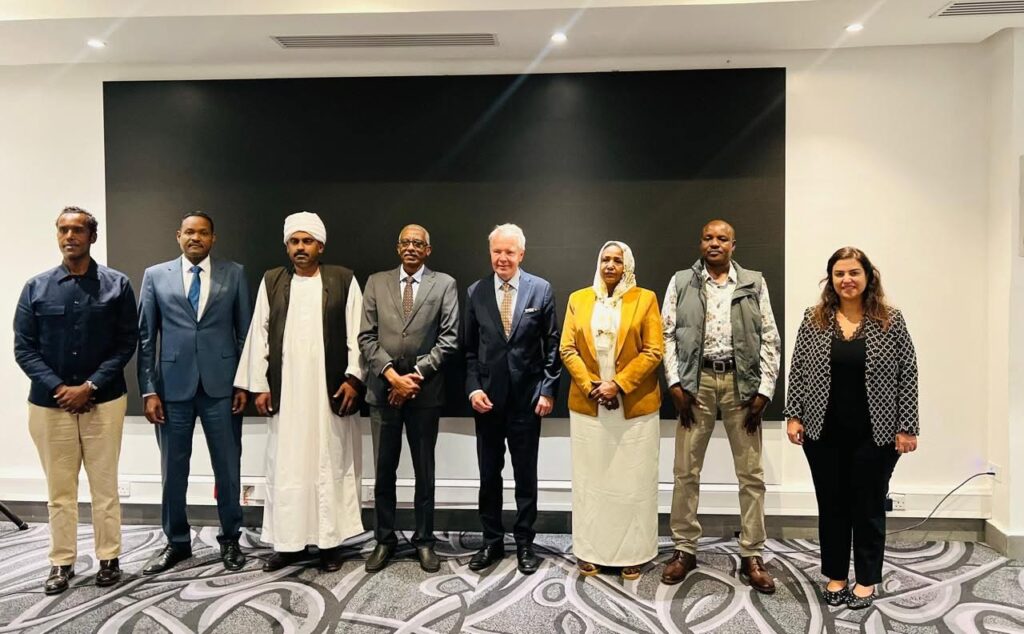
NAIROBI – Sudanese anti-war political forces, including the Sudan Liberation Movement/Army led by Abdel Wahid Mohamed Nour and representatives of the Sudanese Declaration of Principles, met UN envoy Pekka Haavisto in Nairobi to discuss efforts to end the war and launch a credible peace process.
The meetings, held in the Kenyan capital on August 28 and 29, focused on Sudan’s humanitarian crisis, political initiatives, regional and international mediation efforts, and the call for an internal dialogue announced by army chief and Sovereign Council Chairman Abdel Fattah al-Burhan.
The Sudan Liberation Movement/Army said its delegation met Haavisto, the personal envoy of the UN secretary-general for Sudan, as part of its local, regional and international efforts to stop and end the war.
The movement said it briefed the UN envoy on its vision for addressing the roots of Sudan’s crisis and ending the war, adding that its position aligns with the Sudanese Declaration of Principles and the outcomes of the anti-war forces’ consultative meeting held in Addis Ababa on August 22 and 23.
The delegation warned of Sudan’s worsening humanitarian situation, citing shortages of food, medicine and shelter, and what it described as weak international relief efforts. It called for urgent international action before famine and a wider humanitarian catastrophe occur, particularly amid poor rainfall this year.
On peace initiatives, the movement said it welcomed the Quad initiative, saying it had laid out sound foundations for addressing Sudan’s crisis. It also said there were reservations over the work of the Quint Mechanism, adding that the Sudanese Declaration of Principles had sent the mechanism a letter outlining its concerns and proposals.
The movement rejected Al-Burhan’s proposed dialogue, saying it was aimed at seeking legitimacy for his rule and was similar to former President Omar al-Bashir’s “National Dialogue.” It said Sudan needs a genuine and comprehensive dialogue after the war is stopped, excluding only the dissolved National Congress Party, the Islamist movement and their political fronts, or those who refuse to participate.
The SLMA delegation invited Haavisto to visit Darfur and areas under the movement’s control. It also urged him to meet Sudanese people in cities, rural areas, displacement camps and refugee camps, rather than listening only to political and civil forces.
The delegation included Abdel Wahid Mohamed Nour, founder and chairman of the Sudan Liberation Movement/Army; Mohamed Abdelrahman Al-Nayer, member of the Higher Leadership Council and spokesperson; Abdel Latif Abdelrahman Abkar, known as Tibo; and Nimiri Issa Musa, the movement’s humanitarian and organizations official.
In a separate meeting on August 29, representatives of the Sudanese Declaration of Principles also met Haavisto in Nairobi to discuss political developments, efforts to stop the war and the conditions required for a credible peace process.
The group said it told the UN envoy that its rejection of Al-Burhan’s dialogue was not a rejection of dialogue itself, but of the proposed framework, which it said risks entrenching the political and geographic realities produced by the war.
The group said any political process launched from one of the warring centers of power, or managed through arrangements that reproduce one-sided control over the state, would not provide a real path to ending the crisis. Instead, it said, such a process could legitimize existing divisions and consolidate parallel authorities.
The Sudanese Declaration of Principles said the required dialogue must be part of a broader process aimed at stopping the war, protecting civilians, addressing the humanitarian crisis, restoring unified state institutions and leading to a democratic civilian authority.
The meetings come after anti-war forces in Addis Ababa issued a joint position document titled “The Peace Process We Want,” rejecting Al-Burhan’s internal dialogue call and calling for a structured peace process built on humanitarian access, a cessation of hostilities and a civilian-led political track.
Sudan’s war, which erupted in April 2023 between the Sudanese Armed Forces (SAF) and the Rapid Support Forces (RSF), has fragmented the political landscape. Some civilian and armed actors have aligned with the army, others with RSF-linked structures, while a third current presents itself as anti-war and independent from both sides.
The anti-war forces also discussed the Quint Mechanism, saying their reservations relate to its working method, the selection of participants and representation within the political process. They stressed that those concerns do not mean rejecting engagement with the mechanism, but require prior agreement on the nature of the political process, its participants, its references and guarantees for independent civilian decision-making.
They said no party should monopolize representation of the anti-war camp.
The Sudanese Declaration of Principles said it remains ready to engage with regional and international efforts to end the war, provided they preserve Sudan’s unity, prevent the consolidation of de facto authorities and lead to a sustainable democratic civilian transition.