

KHARTOUM – Sudan says it has documented 70 drone attacks launched from Ethiopian territory between February and late October 2026, including strikes that killed or wounded 484 civilians, according to a new government report presenting forensic, geospatial and operational evidence.
The report, titled Launched From Ethiopia, was issued by the Transitional Sovereignty Council’s Advisory Board and consolidates findings presented by Sudan’s Foreign Ministry, Military Intelligence Authority and General Intelligence Service on Oct. 28.
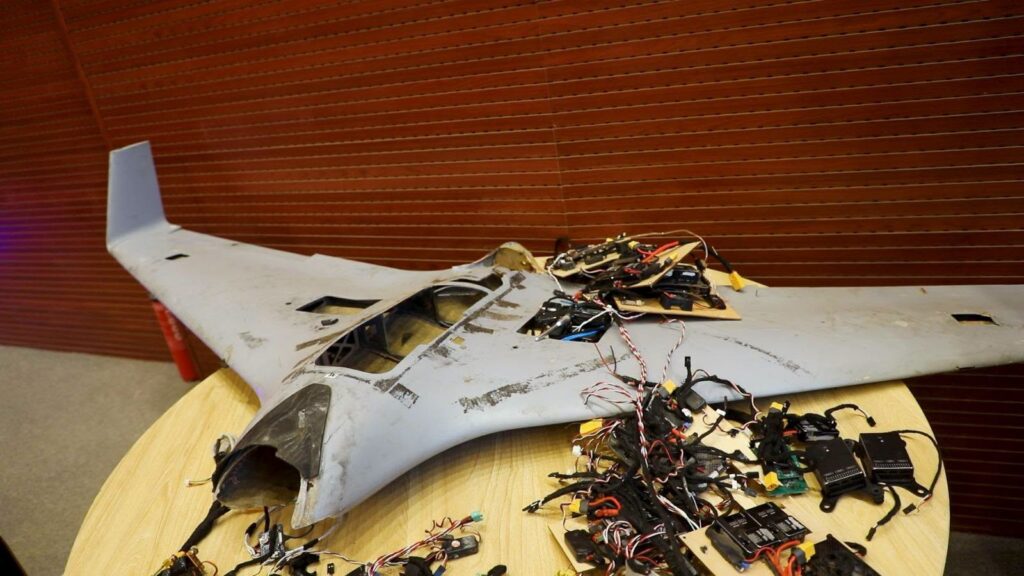
Sudanese authorities say the evidence includes recovered drone wreckage, flight-control hardware, programmed mission data, reconstructed flight paths and manufacturer serial numbers.
The claims have not been independently verified.
According to the report, the 70 incidents recorded between Feb. 15 and Oct. 27 involved 187 one-way attack drones and 82 munitions fired by strategic drones.
October alone accounted for 28 incidents and 97 of the one-way attack drones, suggesting a sharp escalation during the month.
The government report records 484 civilians killed or wounded during the campaign. It also says 176 Sudanese soldiers were killed and another 200 wounded.
Flight Data Points to Ethiopian Territory
One of the central exhibits concerns a flight-control computer recovered from a long-range drone brought down near Ed Damazin on Sept. 20.
Sudanese investigators said the device contained a programmed 12-point mission beginning near Gizen, along the Sudan-Ethiopia border.
The report says analysis of the coordinates placed the programmed take-off point about 1.7 kilometres inside Ethiopia.
It reconstructs a 134-kilometre flight route and says the initial climb and roughly the first 10 kilometres of the programmed mission remained on the Ethiopian side of the border.
Sudan says the recovered mission commands, coordinates and altitude profile allow the flight path to be independently examined.
Bahir Dar and Asosa Named
A second set of evidence concerns Bayraktar Akinci drones that Sudanese authorities say were involved in operations originating from Bahir Dar Air Base in Ethiopia.
The report says investigators recovered wreckage, reconstructed flight tracks and identified manufacturer plates containing component serial numbers.
Sudan has called for the aircraft’s supply history and end users to be independently verified against manufacturer and export records.
The report also identifies Asosa, Bahir Dar and the Kurmuk-Gizen border sector as areas linked to alleged drone operations.
It distinguishes between three types of drones recovered on the Blue Nile front: fibre-optic FPV drones, long-range fixed-wing one-way attack aircraft and short-range electric flying-wing drones.
Sudanese authorities say examination of their control systems, payloads and operational ranges helped determine possible launch areas.
Hundreds of Civilian Casualties
The report lists individual attacks to illustrate the human impact of the drone campaign.
It says a strike in Abu Shendi in Wad Al-Mahi on Oct. 9 killed 30 civilians — 26 women and four children — and wounded 100 others.
Another attack in Khartoum on Oct. 19 killed three young children inside their home, according to the report.
Other incidents damaged hospitals, schools, residential buildings, fuel facilities and electricity infrastructure.
The report says six power stations were knocked out of service on Oct. 26 and 27 alone.
Sudan has repeatedly accused the Rapid Support Forces of carrying out long-range drone attacks against electricity stations and other critical infrastructure.
It has also increasingly accused Ethiopia of allowing its territory to be used to support those operations.
Report Cites External Investigations
The Sudanese report cites outside reporting and research that it says provides additional context for its findings.
It refers to a Reuters investigation into a training camp at Menge and developments at Asosa Airport, as well as findings by Yale University’s Humanitarian Research Lab concerning activity at an Ethiopian military facility that it said was consistent with military support to the RSF.
It also cites satellite monitoring of cargo movements.
The report describes those sources as supporting context, while saying recovered hardware, mission data and incident records form the core of Sudan’s case.
Sudan Seeks International Action
Sudan says it holds Ethiopia internationally responsible for what it describes as cross-border military operations and support networks documented in the report.
Khartoum is demanding an immediate halt to launches from Ethiopian territory, closure of facilities allegedly used by the RSF and other actors, and dismantling of what it describes as the Menge training camp.
The government also says it will seek accountability and reparations for casualties and infrastructure damage.
Sudan called on the U.N. Security Council and the African Union Peace and Security Council to urgently examine the allegations.
It said it intends to pursue formal complaints against states it believes are implicated and reserved its rights under international law, including any applicable right of self-defence under Article 51 of the U.N. Charter.
The government said it was prepared to submit recovered wreckage, flight-control hardware, original data files and chain-of-custody records for independent technical examination under U.N. or African Union auspices.
Ethiopia’s response to the detailed allegations contained in the report was not included in the material reviewed.


