

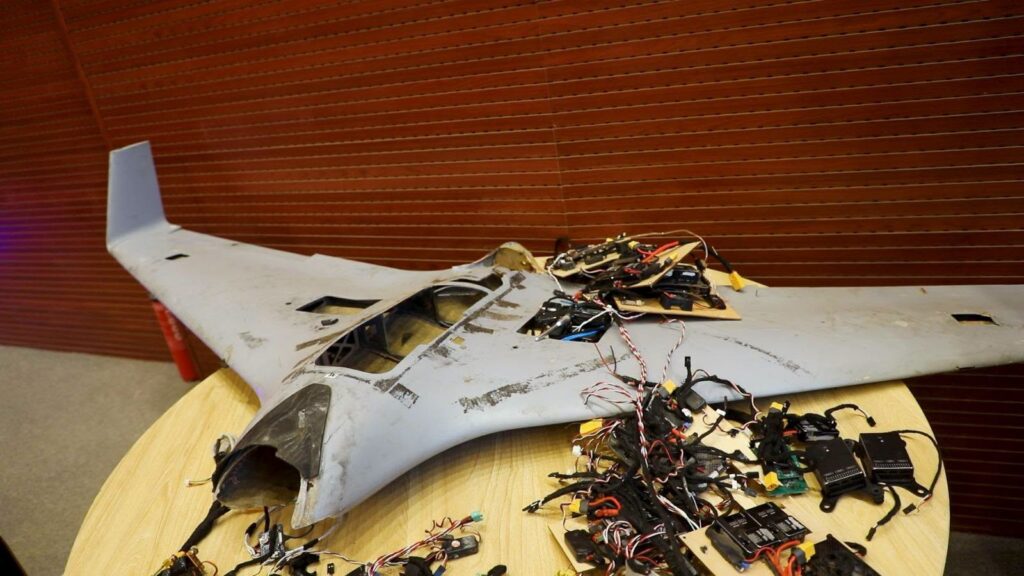
KHARTOUM – Sudan’s government said it has evidence that long-range and suicide drones used in recent attacks on electricity facilities and other civilian sites were launched from inside Ethiopia, including from the area of Bahir Dar airport.
The allegations were presented at a joint news conference involving Sudan’s ministries of defence, foreign affairs and international cooperation, culture and information, as well as the General Intelligence Service.
Officials said data extracted from drones shot down by Sudanese air defences indicated that their flight paths originated inside Ethiopian territory.
They said satellite imagery provided additional evidence and specifically identified Bahir Dar as one of the alleged launch locations.
Sudan Now could not independently verify the data, satellite imagery or the claimed points of origin.
The latest alleged attack struck an electricity facility in Al-Managil in Gezira State on Wednesday, according to Sudanese authorities, following several days of drone strikes on the country’s power network.
The government displayed models and wreckage of drones it said had been intercepted, along with information on flight routes, targeted locations and damage caused by the attacks.
The account carried by Sudan’s state news agency did not include a response from Ethiopia to the latest allegations.
Power Stations Hit Across Several States
The accusations come after a concentrated series of attacks on Sudan’s electricity infrastructure.
On Oct. 26, drones struck substations in Singa, Al-Hawata, Al-Faw, Mashkour and Al-Junaid, damaging equipment and causing widespread outages across Sennar, Gedaref, White Nile and Gezira states.
Sudan Electricity Holding Company attributed those attacks to the Rapid Support Forces (RSF).
A day later, a drone struck the Al-Markhiyat electricity substation in Omdurman, knocking the facility out of service and disrupting power supplies across large parts of Khartoum, River Nile State and other areas.
On Wednesday, drones also targeted the Al-Managil electricity station and fuel facilities in the city, causing further outages in Gezira State and surrounding areas.
Sudanese authorities have blamed the RSF for the attacks on electricity facilities while now alleging that drones used in the recent strikes were launched from Ethiopian territory.
The government did not say whether it believed Ethiopian authorities themselves were directly involved in launching or facilitating the attacks.
Civilian Infrastructure Under Growing Pressure
Sudanese officials said the facilities targeted in the recent strikes were civilian installations and argued that the attacks were intended to disrupt essential services and discourage displaced people from returning to their homes.
Electricity infrastructure has become an increasingly prominent target as drone warfare expands across Sudan.
Repeated strikes on substations and transmission facilities can have consequences beyond electricity outages because hospitals, dialysis centres, water pumping stations, bakeries, telecommunications systems and food-storage facilities depend on reliable power.
The United Nations has warned that attacks on electricity and water infrastructure threaten essential civilian services and has called on all parties to comply with international humanitarian law.
The U.N. Human Rights Office has also documented a sharp increase in drone attacks during October, with strikes attributed to both the Sudanese Armed Forces and RSF hitting homes, markets, hospitals, displacement sites and other civilian infrastructure.
Sudan’s government said the evidence presented at Wednesday’s briefing would form part of its case concerning what it describes as external support for attacks inside the country.
The latest allegations could add another layer of tension to relations between Sudan and Ethiopia, neighboring countries that share a long border and have faced periodic disputes over security, territory and regional political alignments.