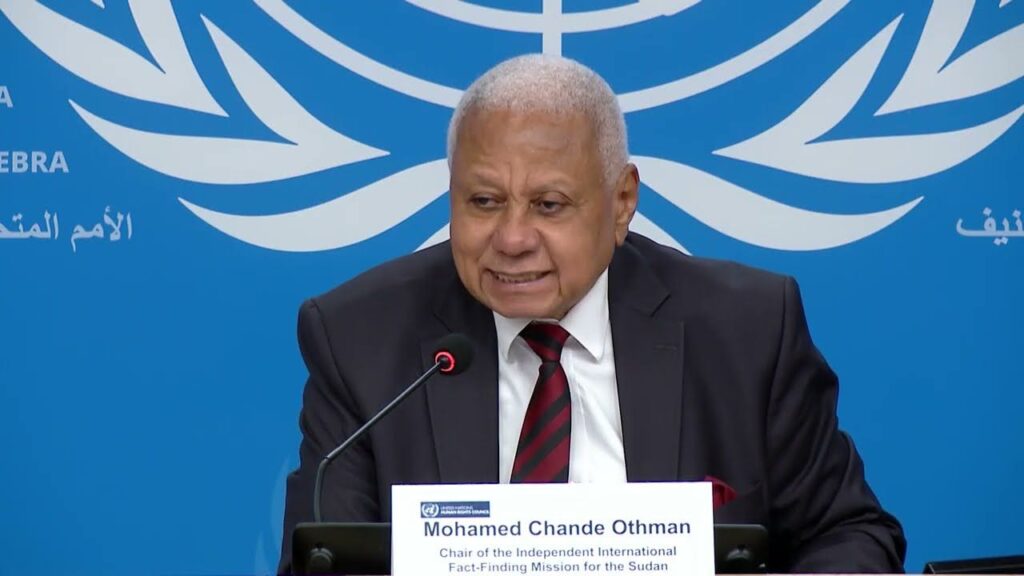
GENEVA – A U.N. fact-finding mission said Rapid Support Forces drone attacks on populated areas of El Obeid and detention practices attributed to the Sudanese Armed Forces may amount to war crimes, warning that civilians in the North Kordofan capital remain exposed to aerial attacks, torture, arbitrary detention and shrinking civic space.
In a report dated Oct. 28, the Independent International Fact-Finding Mission for Sudan said it had reasonable grounds to believe that RSF drones repeatedly struck residential neighbourhoods, educational facilities, gathering places and civilian infrastructure in El Obeid, causing deaths and injuries.
The mission said the manner in which the attacks were carried out violated obligations governing distinction, proportionality and precautions in attack and “may amount to war crimes.”
It separately found that detention practices applied by the SAF in El Obeid involved serious violations of international humanitarian and human rights law, including allegations of torture, cruel treatment and outrages upon personal dignity that may also constitute war crimes.
The findings present a broader picture of civilian risk in a city that remains under army control but is increasingly exposed to long-range drone warfare and internal security measures targeting people suspected of links to the RSF.
The mission said it shared its findings with Sudan on Oct. 26 but had received no response by the time the report was published.
RSF Drone Campaign Hits Civilian Areas
The fact-finding mission said RSF drone attacks intensified sharply in El Obeid in June and continued through September and October despite changes in surrounding front lines.
The attacks affected residential neighbourhoods, schools, displacement sites, fuel and electricity infrastructure and other locations used by civilians.
On Sept. 9, a drone strike damaged the College of Developmental and Technological Sciences and reportedly killed a security guard.
On Sept. 20, strikes on two warehouses in Shikan locality destroyed more than 330,000 educational materials intended for distribution at the start of the school year.
A Sept. 30 strike on the Al Mina Al Bari displacement site reportedly killed a child and injured 12 others.
The following day, a drone strike on a University of Kordofan dormitory reportedly killed five civilians and injured 47.
The mission also documented attacks in June on residential neighbourhoods including Al-Muwazzafeen, Al-Amir and Al-Matar.
In one incident, a witness said a strike destroyed his sister’s home and killed at least three civilians in a neighbouring property.
The mission said some attacks struck locations where civilians had gathered after earlier explosions, including one incident involving a funeral for victims of a previous drone strike.
SAF Deployments Increased Civilian Risk
The report also raised concerns over the Sudanese army’s deployment of personnel and military vehicles inside or close to residential neighbourhoods, civilian homes and markets.
Witnesses described army and allied personnel operating from rented houses and other civilian buildings.
The mission said such deployments appeared to have increased the foreseeable risk to civilians from RSF drone strikes.
It found that the SAF appeared to have failed to take all feasible precautions to protect civilians under its control from the effects of attacks by locating military personnel and equipment in or near densely populated areas.
The report stressed, however, that the presence of military objectives near civilians does not remove the RSF’s independent obligations to distinguish between civilians and military targets and to avoid disproportionate attacks.
Hospitals, Water and Electricity Disrupted
The mission said drone attacks on electricity, fuel and other infrastructure had consequences extending far beyond the immediate strike sites.
Damage to electricity and fuel facilities disrupted water supplies and critical hospital services, including surgery, oxygen provision and dialysis.
Medical services were already struggling with shortages of blood, medicines and other supplies.
One expert told the mission that only around 30% of hospitals in El Obeid remained operational after attacks affecting health facilities.
A June 16 drone strike near the maternity hospital damaged operating rooms and the pharmacy, forcing operations to be suspended.
Medical workers described women giving birth amid shortages of medicines, medical personnel and specialist care, while electricity outages complicated emergency obstetric surgery.
The mission said the same drone attacks producing severe blast and fragmentation injuries were simultaneously damaging the services needed to keep survivors alive.
Arbitrary Detention and Torture
The report also documented what it described as an expanding system of surveillance, arbitrary detention and intimidation in areas of El Obeid controlled by the SAF.
The mission said SAF-affiliated security actors and allied forces targeted civilians over actual or perceived links to the RSF and for participation in humanitarian work, peace initiatives, civil society activities and efforts to document violations.
Journalists, activists, lawyers, trade union representatives, academics, humanitarian workers and community figures were among those described as facing increased scrutiny.
Some civilians were detained on broadly framed national security accusations without being told the reasons for their arrest or given prompt judicial review.
Former detainees said people were sometimes held for prolonged periods in unofficial Security Cell facilities without access to lawyers or relatives before being transferred to El Obeid Central Prison.
The mission said interrogations included death threats, beatings, verbal abuse and pressure to sign confessions.
Some detainees reported being struck with hands, feet, whips and hoses.
The mission also received reports of deaths in custody linked to torture, inadequate healthcare and poor detention conditions.
Prison Holding Far Beyond Capacity
Multiple sources estimated that El Obeid Central Prison was holding around 2,000 detainees and convicted prisoners despite a reported capacity of approximately 450.
The mission said the estimate still required verification but that accounts consistently described extreme overcrowding.
Former detainees reported poor ventilation, extreme heat, inadequate sanitation, lack of electricity and shortages of safe drinking water.
In some detention facilities, detainees were forced to urinate in bottles or buckets inside their cells.
One account described around 200 detainees sharing a single toilet.
Access to healthcare was also described as severely restricted, including for people suffering from chronic illnesses.
Allegations of Sexual Abuse in Detention
Women, including pregnant women, were also detained in Security Cell facilities, some together with infants or young children.
The mission received what it described as credible allegations of sexual violence, sexual harassment and coercion against women in detention.
Some women were allegedly subjected to demands for sexual acts in exchange for release, preferential treatment or permission to receive family visits.
The report said the full scale of the alleged abuse remained unknown because access to survivors was limited and victims feared reprisals.
The mission concluded that detention and the threat of detention were increasingly being used to intimidate civilians, encourage self-censorship and discourage criticism of authorities.
‘No Credible Dialogue’ Under Current Conditions
The mission warned that civic space in El Obeid was shrinking as civilians feared arrest or retaliation for criticizing authorities, documenting abuses or participating in peace and human rights activities.
Some witnesses who had initially agreed to speak to investigators later withdrew because they feared detention or reprisals against themselves or their families.
Human rights defenders also reported avoiding photographing drone wreckage or documenting attack locations because authorities could interpret such activity as assisting the RSF.
The mission said these pressures undermine accountability and prevent civilians from freely discussing ways to end the conflict.
“No credible Sudanese dialogue can take place under such circumstances,” the report said.
The mission called on the SAF and RSF to cease hostilities and protect civilians.
It also urged the U.N. Security Council to expand the existing arms embargo from Darfur to the whole of Sudan and called on foreign states to stop material support to the warring parties.
The mission recommended an end to arbitrary detention and intimidation, access for independent monitors to detention facilities and stronger accountability mechanisms, including a specialized independent court for Sudan working alongside the International Criminal Court.