
KHARTOUM –Italy has provided €3.5 million to support emergency health operations in Sudan, funding disease prevention, surveillance and childhood vaccination efforts at a time when severe financing shortages are constraining the wider humanitarian response, the World Health Organization said.
WHO said the Italian grant would support emergency health interventions and strengthen public health activities carried out with Sudan’s Federal Ministry of Health.
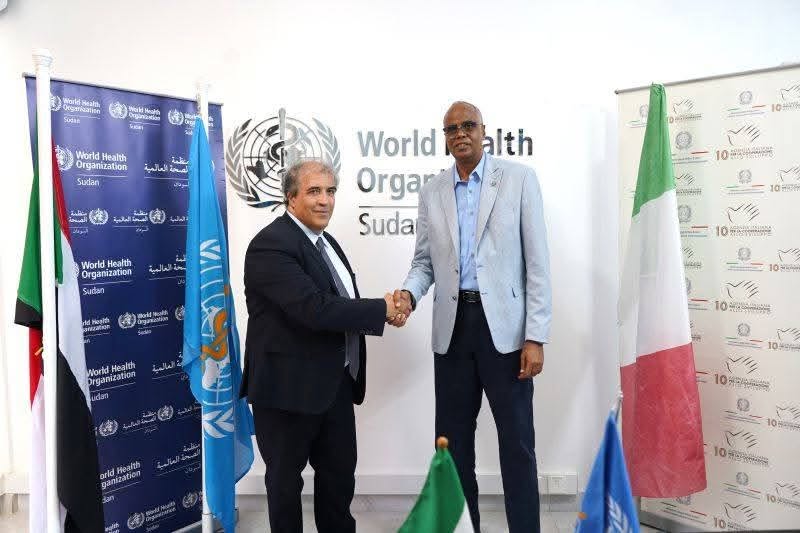
WHO Representative in Sudan Dr. Abdel Nasser Abu Bakr welcomed Italian Ambassador to Sudan Silvio Mignano and Michele Morana, head of the Italian Agency for Development Cooperation (AICS) office, on the occasion of the contribution.
The funding will support efforts to prevent and control disease outbreaks, strengthen surveillance and response capacity and expand vaccination campaigns for children who missed routine immunizations during the war.
More than 3 million people are expected to benefit from the contribution, including over 730,000 children who will receive catch-up vaccinations aimed at closing immunization gaps caused by disruptions to health services.
Sudan’s health system has come under increasing pressure from the war, mass displacement, disease outbreaks and damage to health infrastructure, while humanitarian agencies have repeatedly warned that limited funding is restricting their ability to respond.
WHO said in July that its humanitarian appeal for Sudan remained severely underfunded more than halfway through the year. The agency had sought about $167 million for its emergency health response but had received only a small proportion of the amount required.
Health needs include responses to outbreaks of cholera, malaria, dengue fever, measles, meningitis and hepatitis E, alongside essential health care, nutrition services and vaccination campaigns.
WHO has warned that Sudan’s health system cannot keep pace with the scale of humanitarian needs without additional financial support.
Humanitarian Response Faces Wider Funding Shortfall
The financing crisis extends beyond the health sector.
Sudan’s 2026 humanitarian response plan sought about $2.87 billion to assist 20.4 million people out of an estimated 33.7 million people requiring humanitarian assistance.
By June, about $1.18 billion, or roughly 41% of requirements, had been provided, forcing some humanitarian programmes to reduce or suspend activities.
Funding levels varied sharply between sectors. Health had received about 36.1% of its requirements by June, while water, sanitation and hygiene stood at about 22.6% and education at 18.8%.
UNICEF reported in July that it had mobilized $352.2 million of the $962.9 million required for its Sudan humanitarian appeal, leaving a funding gap of about 63%.
The agency said the shortage of resources was limiting its ability to provide life-saving assistance.
The World Food Programme said in September that its Sudan budget had fallen to about $206 million in 2026, compared with roughly $645 million the previous year, and that it needed around $300 million more to maintain current operations.
The International Organization for Migration also warned in September that stocks of shelter materials and other essential humanitarian supplies could run out within weeks without new funding, threatening a common humanitarian supply pipeline used by more than 100 organizations operating in Sudan.
The shortages come as an estimated 33.7 million people in Sudan require humanitarian assistance in 2026, while about 19.1 million people are facing acute food insecurity.
Italy Expands Sudan Assistance
Italy has continued providing humanitarian assistance to Sudan through its “Italy for Sudan” initiative, including food and health support, supplies for displaced communities and funding for international organizations.
Italy’s Foreign Ministry said in May that contributions under the initiative had exceeded €6 million, alongside more than 130 metric tons of humanitarian assistance delivered since its launch.
WHO said it welcomed the support from the Italian government and people, describing Italy as a longstanding supporter of Sudan’s health sector.
The organization said the new funding would help maintain essential health services and strengthen Sudan’s capacity to respond to disease outbreaks and vaccination needs as the humanitarian crisis continues.