

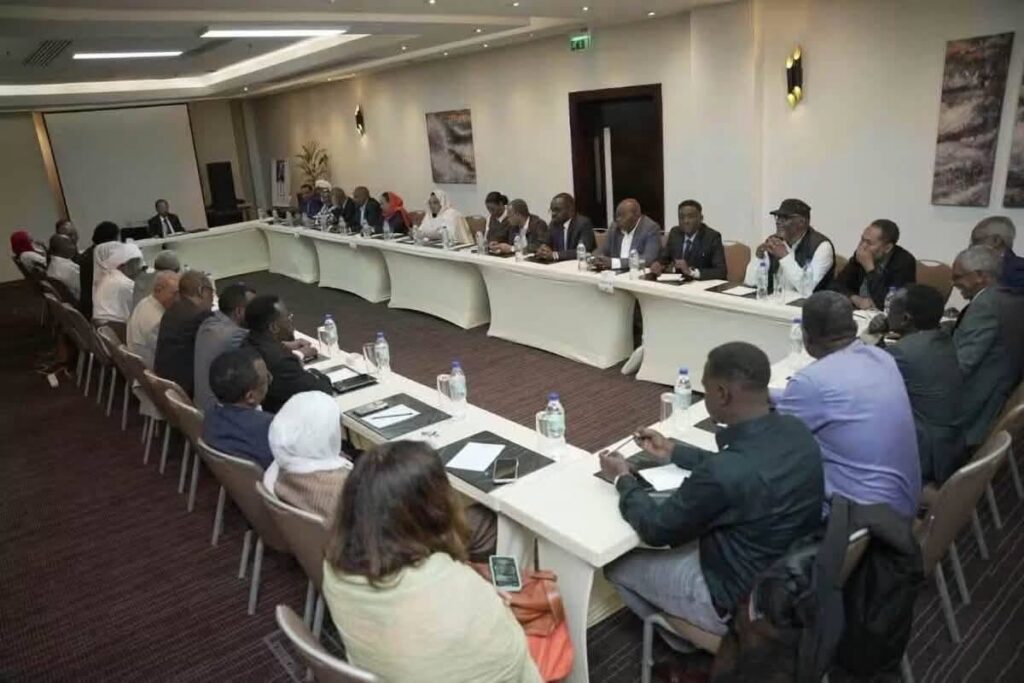
KHARTOUM – The African Union Commission’s welcome for a proposed Sudanese-Sudanese dialogue inside Sudan has drawn criticism from several political groups, which said endorsing the initiative at this stage was premature and warned that the process could be used to legitimize one side of the war.
The AUC said in a statement issued on August 31 that it welcomed the launch of an initiative to prepare for an internal Sudanese dialogue overseen by an independent committee of Sudanese figures.
It called for consultations to include a broad range of civil, political and community groups, based on inclusivity, Sudanese ownership and Sudanese leadership of the political process.
The commission said the initiative could advance the African Union’s roadmap and the Five-Mechanism process as part of a Sudanese-led strategy aimed at achieving a united, sovereign and stable Sudan.
But the statement triggered sharp reactions from political forces opposed to the initiative in its current form, exposing deep divisions over whether dialogue should begin inside Sudan before a ceasefire and humanitarian guarantees are secured.
Abdel Wahid Mohamed Ahmed Al-Nur, chairman and founder of the Sudan Liberation Movement/Army (SLM/A), criticized the AUC statement, saying its welcome for what he described as the “coup leader’s dialogue” represented a “dangerous setback” from the African Union’s position after Sudan’s October 25, 2021 military takeover.
Abdel Wahid said welcoming a dialogue controlled, in his view, by one of the parties to the conflict amounted to a “green light” for deepening Sudan’s geographical divisions. He also warned that linking the initiative to the Five-Mechanism process could undermine the mechanism’s neutrality and credibility.
The SLM/A leader accused the dialogue proposed by what he called the “Burhan authority” of seeking to confer “false legitimacy” on the military leadership and pave the way for the return of the Islamist movement to power.
He said any genuine dialogue should begin with a ceasefire and an end to the war, followed by a free Sudanese-led and Sudanese-owned process that addresses the root causes of the national crisis and leads to a civilian democratic transition.
Abdel Wahid called on the African Union and the Five-Mechanism to respect the will of the Sudanese people and avoid legitimizing political arrangements that could restore military rule.
The National Umma Party took a more cautious position, saying it did not oppose the principle of a Sudanese-Sudanese dialogue but considered the AUC’s welcome premature before the initiative’s nature, objectives and operating mechanisms are clarified.
The party said it appreciated the commission’s emphasis on Sudanese ownership, preserving Sudan’s unity and sovereignty, restoring civilian rule and ensuring broad participation by political, civil and community groups.
However, it said more clarity was needed on who would prepare and manage the process, the criteria for participation, decision-making mechanisms and how the initiative would relate to efforts to end the war.
The party said any credible political process must include clear safeguards to prevent any existing authority or party to the conflict from dominating it or using it to transform military realities created by the war into political legitimacy.
It said the central question was not whether dialogue was needed, but how it would be structured, who would own and manage it, under what conditions it would take place and whether it could genuinely help end the war and rebuild the state on civilian and democratic foundations.
The Sudanese Congress Party also criticized the AUC statement, saying it served a political process controlled by one of the parties to the war.
The party described the AUC position as “shameful,” saying the commission should not help legitimize what it called a “sham political process.” It said the priority should be stopping the war and ending the humanitarian catastrophe affecting millions of Sudanese.
The party said the AUC statement came days after a meeting of Sudanese anti-war forces, which it said had produced broad agreement on rejecting the initiative in its current form.
It warned that the dialogue could be used by one party to restore its authority, impose its will on Sudanese people and pave the way for the return of the dissolved National Congress Party and the Islamist movement.
The Sudanese Congress Party said the proposed dialogue was unlikely to lead to peace and could instead threaten Sudan’s unity and undermine aspirations for a civilian democratic state.
The criticism comes as Sudan’s war, which erupted in April 2023 between the Sudanese Armed Forces (SAF) and the Rapid Support Forces (RSF), continues to divide the political landscape. Some forces have aligned with the army, others with RSF-linked political structures, while a third bloc presents itself as anti-war and independent from both sides.
In contrast, the committee preparing the Sudanese-Sudanese dialogue said its role is not to manage the talks or determine participants and agendas, but to help create a conducive environment, build trust and facilitate preliminary consultations among political, civil and community groups inside and outside Sudan.
The committee said it does not claim any representation or mandate beyond what Sudanese themselves agree upon. It said its task is to listen to concerns and expectations, gather proposals and help narrow differences between positions.
It added that the consultations are intended to produce a consensus-based agenda shaped by stakeholders, rather than impose a predetermined process.
The initiative called on all political, civil and community groups to take part in preliminary consultations on conditions and guarantees for dialogue, as well as criteria for participation and representation.
It said national consensus does not begin with a pre-arranged dialogue, but with listening, consultation and building a minimum level of trust among parties.
The AUC also said the state’s role should be limited to providing necessary guarantees, facilitation and protection, while preserving the dialogue’s independence and Sudanese ownership of its outcomes, without intervening in determining participants, agenda or results.
The proposed initiative aims to foster what its committee describes as a serious, independent, safe and inclusive national dialogue that could lay the foundations for a stable transitional period based on national consensus and lead to free and fair elections.
The differing positions of the SLM/A, the National Umma Party and the Sudanese Congress Party highlight continuing divisions among Sudanese political forces over the proposed internal dialogue.
While some forces reject the initiative outright, viewing it as an attempt to confer political legitimacy on one side of the war, the National Umma Party said its objection is not to dialogue itself, but to the lack of clear guarantees for independence, inclusivity and Sudanese ownership.
The debate comes amid increased political efforts to find a path toward ending Sudan’s war, with major disagreements persisting over whether fighting should stop first, where dialogue should take place, who should oversee it, which groups should participate and what safeguards are needed to prevent any party from dominating the outcome.


