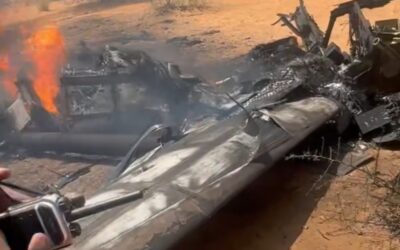
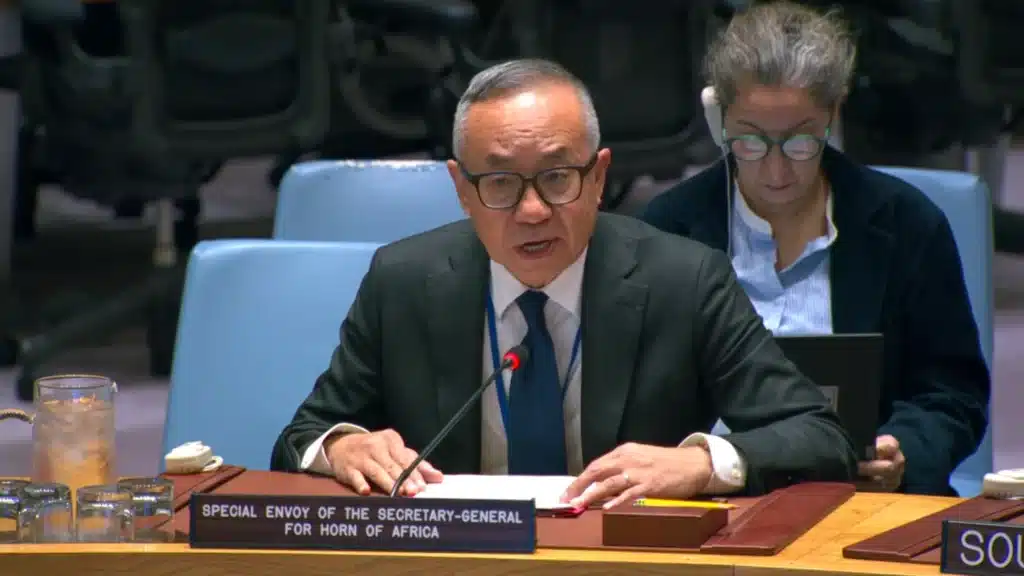
NEW YORK – The U.N. Secretary-General’s Special Envoy for the Horn of Africa warned that Sudan’s war risks drawing the disputed Abyei region deeper into the conflict, calling for an independent investigation into a deadly drone attack on Amiet market and renewed dialogue between Khartoum and Juba.
Briefing the U.N. Security Council on Nov. 5, Guang Cong described the Oct. 19 drone attack on Amiet market as one of the deadliest incidents in Abyei’s history.
He condemned the attack and called for a prompt and independent investigation to establish the facts and hold those responsible accountable. He did not attribute responsibility for the strike.
Cong urged Sudan and South Sudan to preserve Abyei’s demilitarised status, prevent further attacks and respect international humanitarian law.
He said movements by the Rapid Support Forces, South Sudan People’s Defence Forces and other armed groups inside the Abyei area were threatening efforts by the U.N. Interim Security Force for Abyei, or UNISFA, and local authorities to maintain the territory as a weapons-free zone.
Political Tensions Raise Risk of Violence
Cong said disagreements over plans for Abyei to participate in South Sudan’s upcoming elections had increased tensions between Ngok Dinka and Twic Dinka communities.
Misinformation, hate speech, alleged mobilisation of proxy armed groups and fears of cross-border insecurity had further aggravated the situation, he said.
U.N. engagement had helped prevent further deterioration, but Cong warned that the underlying disputes remained unresolved and the risk of renewed violence was still high.
He also cited September clashes involving Misseriya, Nuba and Ngok Dinka groups around Amiet market.
Sudan-South Sudan Dialogue
The envoy said protecting recently revived dialogue between Sudan and South Sudan from the effects of Sudan’s war and domestic political pressures in South Sudan was essential to resolving Abyei’s final status.
A meeting of the Joint Political and Security Mechanism resumed in Juba in August after a pause since 2023. A follow-up meeting originally scheduled for Oct. 20 was postponed to Nov. 8-10.
Cong said broader institutional progress remained limited, noting that the Abyei Joint Oversight Committee had been inactive since 2017.
He said a parallel appointment of an AJOC co-chair by the RSF in August fell outside the framework of agreements between Sudan and South Sudan.
Abyei’s final status remains one of the major unresolved issues dating from Sudan’s 2005 Comprehensive Peace Agreement and South Sudan’s subsequent independence.
Fighting Intensifies in Kordofan and Blue Nile
Cong also warned of worsening conditions in South Kordofan and Blue Nile, where control of territory, border areas and supply routes has become increasingly contested.
He said the wider Kordofan region had become an epicentre of fighting between the Sudanese army and the RSF.
In South Kordofan, fighting around Kadugli and Dilling and the opening of eastern fronts had disrupted basic supplies and humanitarian access. Two bridges on the Kadugli-Dilling road had also been destroyed, restricting civilian movement.
In Blue Nile, fighting around Al-Kurmuk, Geisan and Baw had intensified amid shifting territorial control.
Cong warned that hostilities could expand further along South Kordofan’s eastern fronts and around the Al-Kurmuk border area.
The U.N. figures cited in his briefing put displacement in Blue Nile at 99,277 people between January and September and at about 308,000 across Kordofan since October 2025.
A later IOM assessment estimated that displacement in Blue Nile had risen to 119,782 people by Oct. 15.
Oil Infrastructure Under Threat
Cong said security arrangements involving the Sudanese army, RSF and South Sudanese forces around Heglig oil infrastructure were still holding.
However, a September drone attack on a pipeline in South Kordofan carrying South Sudanese oil demonstrated the vulnerability of energy infrastructure to Sudan’s war.
More than 50,000 South Sudanese returnees, Sudanese refugees and asylum seekers have crossed into South Sudan through Abyei, he said.
Food shortages, attacks on civilians and limited humanitarian funding were further worsening conditions in the area.
Cong called for intensified diplomatic efforts to prevent Abyei from being fully drawn into Sudan’s conflict and said he would continue supporting U.N. efforts toward a cessation of hostilities and a broader political settlement.