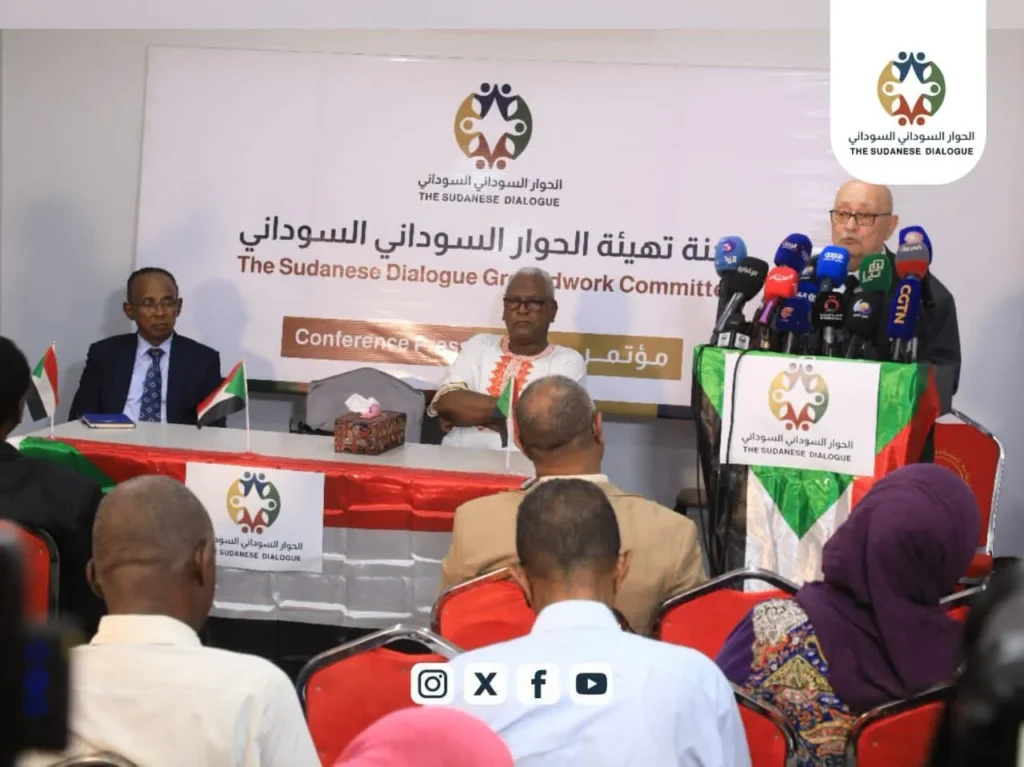
KHARTOUM – The committee preparing a Sudanese-Sudanese dialogue said on Tuesday it had begun inviting political forces without exception to consultations aimed at paving the way for a broader national dialogue conference.
Committee spokesman Osman Mirghani said at a press conference in Khartoum that meetings with political groups would begin in the coming period, with talks planned next week with the Democratic Bloc, followed by consultations with other political forces.
He said the consultations were intended to build the widest possible agreement on the conditions and issues surrounding the dialogue before the committee summarizes the outcomes and develops a platform for the proposed national conference.
Mirghani said the committee hoped the dialogue conference could be held before the end of 2026.
The committee is also maintaining contacts with regional and international actors. Mirghani said members were expected to meet representatives of European countries and other parties concerned with Sudan outside the country this week.
The Sudanese-Sudanese dialogue initiative emerged in August after consultations with political, civil and community figures as Sudan’s war entered its fourth year.
Sovereign Council Chairman and army chief Abdel Fattah al-Burhan subsequently said the state would provide legal, political and security guarantees for participants while leaving decisions over participation, the agenda and outcomes to the dialogue mechanism.
The preparatory committee formally launched its initiative in Khartoum on Aug. 30, describing its role as creating conditions for an internally led political process focused on ending the war and rebuilding the state on a nationally agreed basis.
On Sept. 1, Sudanese authorities announced legal guarantees for participants, including the dismissal of some state-filed complaints linked to political positions and temporary procedural protection for Sudanese returning from abroad to participate in the consultations.
The initiative, however, remains contested among Sudanese political forces.
The Democratic Bloc has welcomed the principle of a Sudanese-Sudanese dialogue and called for a broad process addressing the roots of the conflict and leading to sustainable peace.
Other anti-war political and civil groups have rejected or expressed reservations about the initiative, questioning whether a dialogue held in army-controlled areas while fighting continues could operate independently.
Several such groups held consultations in Addis Ababa in August and proposed alternative approaches to the political process, including linking negotiations more closely to efforts to end the fighting.
The disagreement reflects a broader debate over sequencing: whether a ceasefire should precede political negotiations or whether political consultations can proceed in parallel with efforts to stop the war.
The domestic initiative is also unfolding alongside regional and international mediation efforts involving the African Union, the United Nations, IGAD, the European Union and the Arab League.
Those mechanisms have held consultations with Sudanese political actors over ceasefire arrangements, humanitarian access and the shape of a future political process.
The preparatory committee said its consultations were intended to bridge political divisions before moving toward a comprehensive conference involving political and community forces.
Sudan’s war between the Sudanese Armed Forces (SAF) and the Rapid Support Forces (RSF) began in April 2023 and continues to drive displacement, humanitarian needs and political fragmentation across the country.