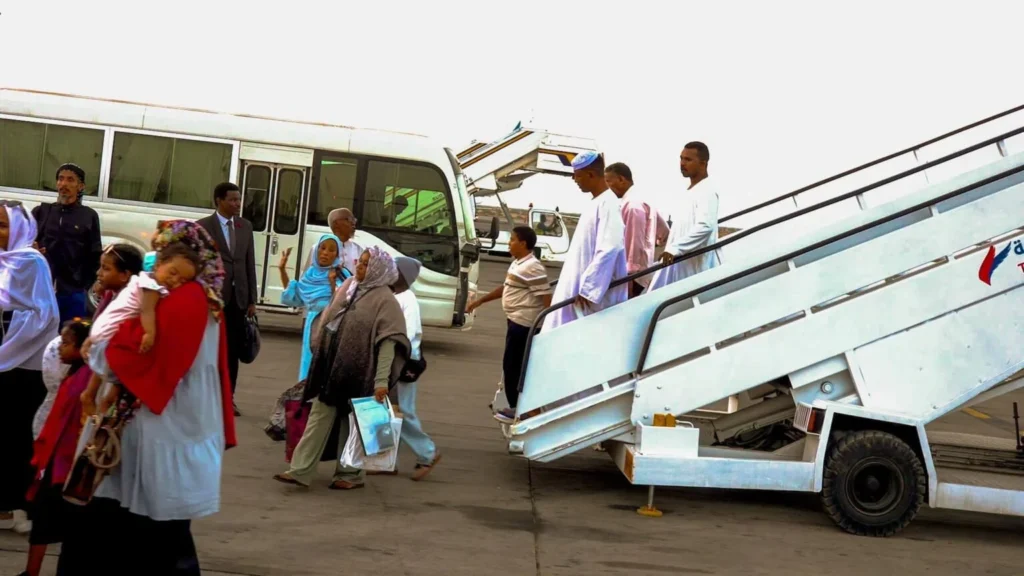
PORT SUDAN – Fifty Sudanese nationals, including families and children, have voluntarily returned from Mauritania as the number of Sudanese recorded returning from abroad approaches one million, according to Sudanese authorities and U.N. data.
The group travelled aboard a Turkish Airlines flight and was received by officials from Sudan’s Ministry of Foreign Affairs and the government body responsible for expatriate affairs in Red Sea State.
Idris Salem Idris, head of the Expatriates Affairs Regulatory Authority in Red Sea State, said the flight was organized as part of government efforts to assist Sudanese nationals abroad who wish to return home.
He said coordination between the Foreign Ministry, the expatriates authority and Sudan’s embassy in Nouakchott helped arrange the return.
Authorities said they were prepared to receive additional Sudanese returnees and provide assistance after arrival.
The movement comes as increasing numbers of Sudanese return from neighboring countries and other destinations after more than three years of war between the Sudanese Armed Forces (SAF) and the Rapid Support Forces (RSF).
The conflict, which began in April 2023, forced millions of people from their homes, with many crossing into Egypt, Chad, South Sudan, Ethiopia, Libya and other countries.
The U.N. refugee agency recorded 942,113 Sudanese returning from abroad as of Oct. 5, 2026.
That figure refers specifically to people returning to Sudan from other countries and should not be confused with the much larger number of people returning to their places of origin after being displaced within Sudan.
The International Organization for Migration had recorded about 4.65 million return movements to areas of origin, from both internal displacement and abroad, by the end of June 2026.
According to those figures, around 82% of the returnees had previously been displaced inside Sudan, while 18% had returned from other countries.
Large numbers of returnees have headed to Khartoum and Al Jazirah states, where fighting had previously forced millions to flee.
The growing number of returns does not necessarily indicate that conditions have fully stabilized.
Many families returning to Sudan continue to face damaged or looted homes, limited healthcare and education services, shortages of water and electricity and difficulties restoring jobs and livelihoods.
The U.N. refugee agency has stressed that refugee returns should be voluntary, informed, safe and dignified, particularly as fighting and insecurity continue in several parts of Sudan and access to basic services varies widely.