

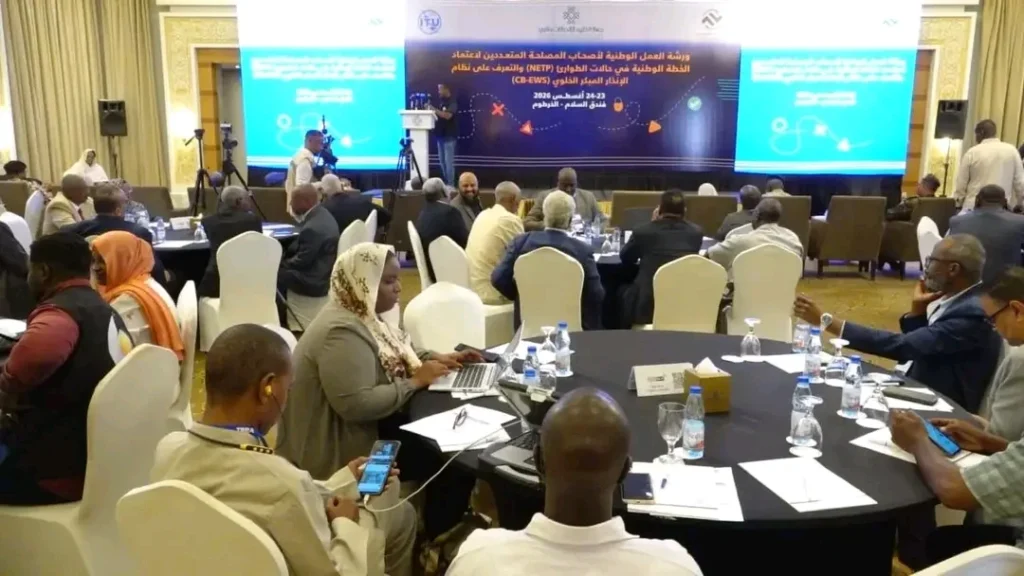
KHARTOUM – Sudanese authorities are moving to strengthen the role of the telecommunications sector in disaster and emergency response by adopting a national emergency telecommunications plan and introducing a cell broadcast early warning system.
The workshop, held at Al Salam Rotana Hotel in Khartoum, was organized by the National Telecommunications and Post Regulatory Authority in cooperation with the International Telecommunication Union (ITU) to approve the National Emergency Telecommunications Plan (NETP) and introduce the Cell Broadcast Early Warning System (CB-EWS).
MTN Sudan said it participated in the national multi-stakeholder workshop, along with technical sessions, detailed working groups and a training-of-trainers programme involving relevant national institutions.
The opening session was attended by several officials, including Interior Minister Babikir Samra, representing the prime minister; Digital Transformation and Communications Minister Ahmed Dardiri Ghandour; Health Minister Haitham Mohamed Ibrahim; Infrastructure and Transport Minister Saif Al-Nasr Al-Tijani; and Social Development Minister Mutasim Ahmed.
The initiative comes as Sudan faces repeated emergencies caused by war, displacement, floods, disease outbreaks and infrastructure damage, all of which have highlighted the need for reliable communications and rapid public alerts.
Since the outbreak of the war between the Sudanese Armed Forces (SAF) and the Rapid Support Forces (RSF) in April 2023, telecommunications services have been repeatedly disrupted in several states, affecting civilians’ ability to communicate, receive information, report emergencies and access humanitarian assistance.
A national emergency telecommunications plan is intended to help ensure the continuity of communications services during crises, while a cell broadcast early warning system can allow authorities to send urgent alerts directly to mobile phones in affected areas without requiring internet access.
MTN Sudan said its participation comes as part of efforts to support the readiness and resilience of the telecommunications sector during emergencies and to use network infrastructure to deliver timely warnings and information to citizens.
Ghandour said continuity of telecommunications services is essential for supporting the state and society during crises. He stressed the need to improve sector readiness and strengthen its ability to withstand and respond to emergencies.
He also called for stronger cooperation between government bodies, regulators and telecom operators to improve the ability of networks to reach and support citizens during disasters and other emergency situations.
The development of early warning systems has become increasingly important in Sudan as floods, conflict-related displacement, disease outbreaks and insecurity continue to affect large parts of the country. Timely alerts can help reduce risks to civilians by providing information on evacuation, public health threats, weather hazards and service disruptions.
MTN Sudan said it would continue cooperating with relevant authorities to support network readiness, maintain service continuity and strengthen the role of telecommunications in delivering alerts and information to citizens at the right time.


