DAKAR – Sudan has invited the African Commission on Human and Peoples’ Rights to visit the country and assess humanitarian conditions, while accusing unnamed foreign actors of supplying weapons, financing and fighters to the Rapid Support Forces (RSF).
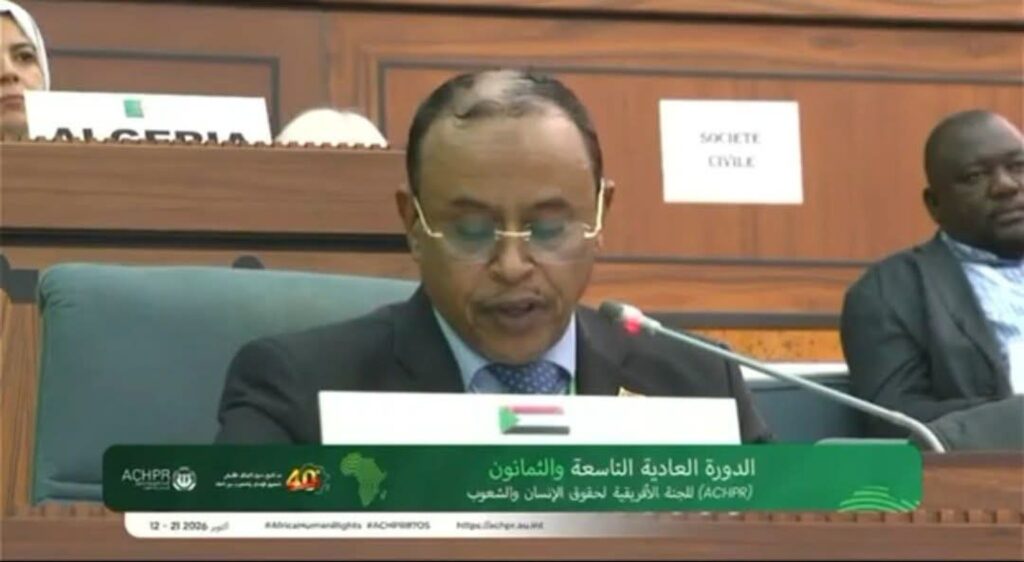
Sudan’s delegation chief, Ambassador Abdel Ghani Al-Naim, told a session of the commission in Senegal that external support for the RSF included strategic weapons, drones and other military equipment, as well as financing and the recruitment of fighters from outside Africa.
Al-Naim did not identify the country outside Africa or the neighboring states he accused of facilitating the support, but said they bore responsibility for contributing to violations against Sudanese civilians.
The Sudanese Armed Forces (SAF) and RSF have been at war since April 15, 2023, in a conflict that has displaced millions of people, devastated infrastructure and left large parts of the population dependent on humanitarian assistance.
Al-Naim accused the RSF of genocide, war crimes and crimes against humanity, as well as attacks on civilians, state institutions and civilian infrastructure. The allegations were presented as the Sudanese government’s position.
He also referred to a decree by Sovereignty Council Chairman Abdel Fattah al-Burhan designating the RSF a rebel terrorist group, and rejected descriptions of the war as simply a conflict between two rival military forces.
Sudan’s government has increasingly argued that foreign military and financial support has prolonged the war, while calling for restrictions on weapons flows and the removal of foreign fighters as part of any ceasefire arrangement.
Al-Naim warned that continued external involvement could threaten regional security because of Sudan’s geographic position and its links with neighboring states.
Peace and Political Transition
Turning to efforts to end the war, Al-Naim cited peace initiatives presented by Burhan and Prime Minister Kamil Idris.
He said the prime minister’s proposal submitted to the U.N. Security Council included disarmament, demobilization and reintegration arrangements, accountability measures and a transitional period leading to what the government described as free and transparent elections.
Sudan has also approved a separate national initiative led by a civilian committee tasked with preparing a Sudanese-Sudanese dialogue.
The committee has been holding consultations with political and community groups aimed at establishing common ground for addressing the political crisis and developing a framework for ending the conflict.
The government says any political settlement should allow Sudanese citizens to determine the country’s future through an internal national process.
Accountability and Human Rights
Al-Naim said Sudan’s national committee investigating violations of domestic law and international humanitarian law had issued its fifth interim report, covering the period from Aug. 11, 2025, to August 2026.
He also said the government had completed a national human rights implementation plan covering 2026-2030.
Sudanese authorities have cited the reopening of the Adré border crossing with Chad, reconstruction efforts and the restoration of basic services as part of measures aimed at improving humanitarian conditions and facilitating returns.
Al-Naim renewed Sudan’s invitation for the African Commission on Human and Peoples’ Rights to visit the country and assess conditions facing civilians, displaced people and refugees.
He said Sudan remained willing to cooperate with African and international human rights mechanisms.