NEW YORK – Sudan has renewed its rejection of U.S. allegations that its forces used chemical weapons, accusing Washington of pursuing political pressure while declining Sudanese requests for a technical investigation or the submission of evidence to the international chemical weapons watchdog.
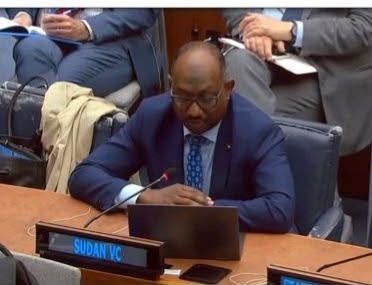
Minister Plenipotentiary Faisal Abdel Azim Salem told a United Nations meeting in New York that Sudan rejected allegations raised by the United States and several other delegations over the alleged use of chemical weapons.
Salem said Sudan had proposed sending a technical delegation to conduct a joint investigation and had asked that any evidence held by the United States be submitted to the Organisation for the Prohibition of Chemical Weapons (OPCW).
He said Washington had rejected those proposals, arguing that the refusal reflected an attempt to exert political pressure on the Sudanese government.
The United States determined in April 2025 that the Government of Sudan had used chemical weapons in violation of international law and later imposed sanctions under U.S. legislation governing the use of chemical and biological weapons.
The measures included restrictions on arms sales, military financing, U.S. government credit and certain exports, although some provisions were partially waived on national security grounds.
Sudan has consistently rejected the U.S. determination and has maintained that allegations of chemical weapons use should be addressed through mechanisms established under the Chemical Weapons Convention rather than unilateral findings.
The issue has also been raised within the OPCW. Its Executive Council has considered requests for clarification concerning Sudan under Article IX of the Chemical Weapons Convention, while Sudan has provided responses through the organisation’s procedures.
Earlier this month, the OPCW said its Technical Secretariat continued to monitor reports of possible chemical weapons use in Sudan and encouraged member states to provide any relevant information.
The United States has separately urged Sudan to work with the OPCW, declare any chemical weapons-related production facilities or munitions and allow their verification and destruction if they exist.
Sudan, however, maintains that no independently established evidence has confirmed the allegations and says claims should not be treated as proven until they are subjected to an internationally recognised technical process.
Salem reaffirmed Sudan’s commitment to the Chemical Weapons Convention and pointed to the country’s current membership of the OPCW Executive Council as part of what he described as its commitment to the treaty.
Sudan is one of nine African countries serving on the 41-member Executive Council for the current term.
The controversy comes as Sudan’s war between the Sudanese Armed Forces (SAF) and the Rapid Support Forces (RSF), which began in April 2023, remains under growing international scrutiny over alleged violations of international humanitarian law by the warring parties.
Salem urged other countries not to repeat chemical weapons allegations against Sudan until their accuracy had been established through recognised international mechanisms.