

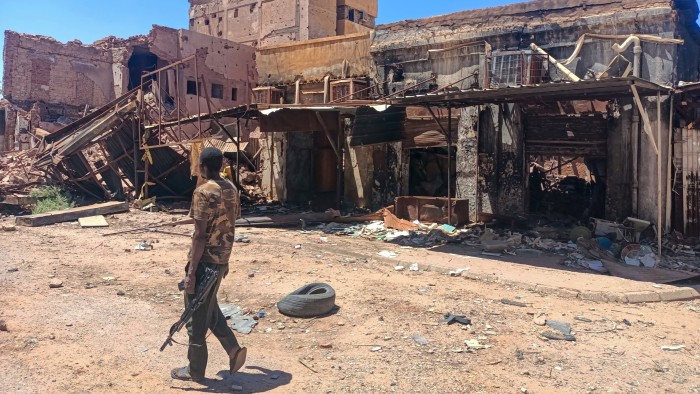
MOSCOW – Sudan’s war has caused economic and social losses exceeding $200 billion, Finance Minister Gibril Ibrahim said, warning that continued fighting and destruction have made the current cost of the conflict increasingly difficult to calculate.
Speaking in an interview with Russia Today on the sidelines of the Russia-Africa Summit in Moscow, Ibrahim said the estimate came from a government committee established in December 2023 to assess the damage caused by the war.
The committee completed its assessment about a year later and put losses at more than $200 billion, he said.
Ibrahim cautioned that the figure no longer reflected the full scale of destruction because fighting and damage to infrastructure, businesses and productive sectors had continued since the assessment was completed.
He said Sudan had asked the World Bank, the United Nations Development Programme and the African Development Bank to establish a joint mechanism to conduct a more comprehensive assessment of the economic and social damage.
The war between the Sudanese Armed Forces and the Rapid Support Forces began in April 2023 and has devastated infrastructure, disrupted production and trade and displaced millions of people.
IMF Projects 7% Growth
Despite the damage, Ibrahim said Sudan’s economy had moved from contraction to positive growth.
He said the International Monetary Fund’s latest projection put Sudan’s real economic growth in 2026 at around 7%, rather than the 0.7% contained in earlier projections.
The government hopes to achieve double-digit growth during reconstruction, Ibrahim said, while acknowledging that any recovery would begin from an economy severely weakened by more than three years of war.
The minister said reconstruction spending would increasingly focus on restoring electricity, water, sanitation, hospitals, schools and markets in areas where fighting has subsided.
Sudan has operated under flexible emergency budgets during the war because the government has been unable to reliably forecast revenues and expenditures, he said.
Inflation Could Reach 77%
Ibrahim said inflation could reach between 76% and 77%, citing declining production and exports, increased demand for foreign currency and rising fuel, transport and insurance costs.
He also acknowledged that government borrowing from the banking system and central bank to cover expenditure amid falling revenues increases the money supply and adds pressure on both inflation and the Sudanese pound.
The government is seeking to direct more public spending toward agriculture, livestock and mining while expanding the tax base and using digital systems to improve revenue collection, Ibrahim said.
He said the approach was intended to increase government revenue without simply raising tax rates.
Most Gold Produced Outside Large-Scale Mining
Gold remains one of Sudan’s most important sources of foreign currency, but Ibrahim said about 80% of production comes from artisanal mining.
The dispersed nature of the sector makes monitoring production and exports difficult, he said.
A significant share of Sudanese gold does not pass through official export channels, according to Ibrahim, depriving the government of foreign currency and public revenue.
He said authorities were seeking to organize mining markets, processing sites and the sale of mining inputs while introducing electronic registration systems for producers.
Rather than relying primarily on security operations along Sudan’s extensive borders, the government wants to encourage miners to sell through official markets by making formal channels more attractive, he said.
Ibrahim said gold resources were found in 14 of Sudan’s 18 states.
Government Rejects Famine Assessment
The finance minister also rejected claims that Sudan was experiencing famine, citing Agriculture Ministry estimates that this year’s grain production would broadly cover national requirements.
He acknowledged that reduced rainfall, climate pressures and El Niño could result in a limited food-production deficit.
Ibrahim did not provide detailed production or reserve figures during the interview.
His comments follow international warnings that Sudan’s food security situation is deteriorating, with millions of people facing acute hunger and several areas considered at risk of famine.
UAE Accused of Supplying RSF Drones
Ibrahim also accused the United Arab Emirates of supplying drones to the RSF that he said had been launched from Ethiopian territory.
His remarks followed Sudanese military claims that technical data recovered from intercepted drones showed flight routes originating inside Ethiopia.
Ibrahim said the military possessed evidence tracing those routes but did not provide details during the interview.
The UAE has repeatedly denied accusations that it provides military support to the RSF.
Sudanese authorities have also accused Ethiopia of allowing its territory to be used for drone operations, while the evidence presented publicly has not been independently verified.
Bashir Remains in Sudan
Ibrahim also said former Sudanese President Omar al-Bashir remains inside the country under house arrest.
He said the former president was receiving medical treatment because of health problems related to his age.
The finance minister’s comments came as Sudanese officials attending the Russia-Africa Summit sought investment and international partnerships for reconstruction.
Sudan has offered Russian companies investment opportunities in gold, copper and other minerals and proposed establishing a Russian free economic zone on the Red Sea coast.
The scale of reconstruction needs remains uncertain, however, as fighting continues in parts of Kordofan, Darfur and Blue Nile and repeated drone attacks damage infrastructure in other regions.


