

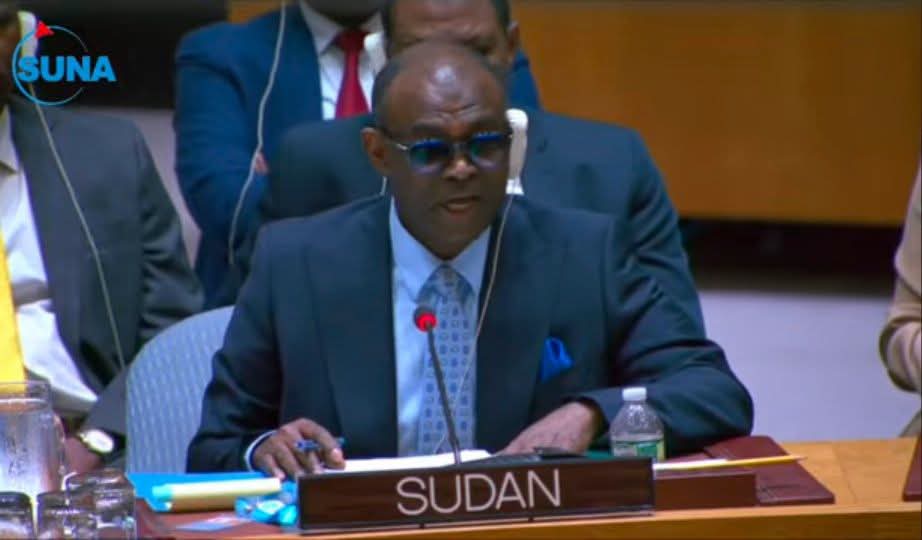
New York – Sudan has called on the UN Security Council to take firm measures to expel foreign mercenaries from the Darfur and Kordofan regions, urging the activation of regional and international anti-mercenarism agreements, the establishment of a border-monitoring mechanism to prevent arms smuggling, and investigations into the activities of security companies allegedly involved in recruiting and transporting foreign fighters. It also called for an end to what it described as foreign interference in support of the RSF.
Sudan’s Permanent Representative to the United Nations, Ambassador Al-Harith Idriss, told a UN Security Council session on Sudan that the government had submitted a list of foreign mercenaries to the Council. He called for measures to remove them from Darfur and Kordofan, hold accountable the entities and companies found to be involved in their recruitment and transportation, and support investigations into war crimes and crimes against humanity.
Idriss accused the United Arab Emirates of providing military, logistical, and financial support to the RSF alleging that this included the transfer of weapons, military equipment, drones and air defense systems, the establishment of supply routes through neighboring countries, and the facilitation of the movement of foreign fighters into areas under RSF control.
He added that the government had identified networks involved in transporting mercenaries, including Colombian nationals, along routes passing through the United Arab Emirates, Libya, and Chad into Darfur. He said Nyala Airport had been transformed into a key supply hub, with makeshift airstrips prepared to facilitate military transport operations, while the borders with the Central African Republic and Chad were being used as corridors for moving fighters and military equipment.
The allegations come as reports by the UN Panel of Experts on Sudan, as well as findings by international organizations, have documented the presence of foreign fighters in the Sudanese conflict. In recent months, the U.S. Department of the Treasury has also imposed sanctions on individuals and companies accused of recruiting former Colombian military personnel to fight alongside the RSF.
Idriss urged the UN Security Council to investigate the activities of security companies that he said were involved in recruiting and transporting mercenaries to Sudan, support regional, international, and national investigations into war crimes and other violations, and establish a compensation fund for victims, survivors and communities affected by the war.
In a separate matter, Sudan’s representative rejected allegations that the Sudanese Armed Forces had used chemical weapons. He said a U.S. team had visited the sites referenced in the allegations and collected samples, but maintained that no evidence had been presented to prove that the army had used such weapons. He stressed that the Organisation for the Prohibition of Chemical Weapons (OPCW) is the competent body responsible for examining the issue.
He also called for bridging the gaps between the various mediation tracks and supporting the Jeddah Agreement as the primary platform for resuming negotiations. He emphasized the principle of national ownership of the political process and rejected proposals to expand the sanctions imposed under UN Security Council Resolution 1591 to cover the entire territory of Sudan.
Idriss stated that the government had registered thousands of criminal cases involving killings, rape, and enforced disappearances allegedly committed by members of the RSF, and had referred a number of them to the courts, reaffirming Sudan’s commitment to the principle of accountability and the fight against impunity. He added that the government had opened the airports of Wad Madani, Kadugli, El Obeid, and Ad Damazin to facilitate the delivery of humanitarian aid, but said humanitarian operations continued to face a funding shortfall, noting that the UN humanitarian response plan had received only 37.2 percent of the required funding.
The Sudanese representative’s remarks came during a UN Security Council session dedicated to discussing the latest political and humanitarian developments in the country, as fighting continues in Darfur and Kordofan and international warnings intensify over the widening conflict and the deepening humanitarian crisis.


