
KHARTOUM – Sudan’s five Darfur states are hosting about 5.59 million internally displaced people, or roughly 65% of all IDPs in the country, as continued fighting and funding shortages place growing pressure on food, water and health services.
A European Commission emergency-response map issued on Oct. 5 shows 8.58 million internally displaced people across Sudan, based on International Organization for Migration data as of Aug. 26, 2026.
South Darfur hosts the largest number, with about 1.77 million displaced people, followed by North Darfur with 1.67 million, Central Darfur with nearly 995,000, East Darfur with about 809,000 and West Darfur with roughly 352,000.
Together, the five Darfur states account for about 5.59 million displaced people.
South and North Darfur alone host about 3.44 million people, equivalent to roughly 40% of Sudan’s total internally displaced population, highlighting the scale of pressure on communities and basic services in the two states.
Darfur had already experienced repeated waves of displacement before the current war, which began in April 2023. The figures on the map therefore should not be read as representing only people displaced for the first time during the current conflict.
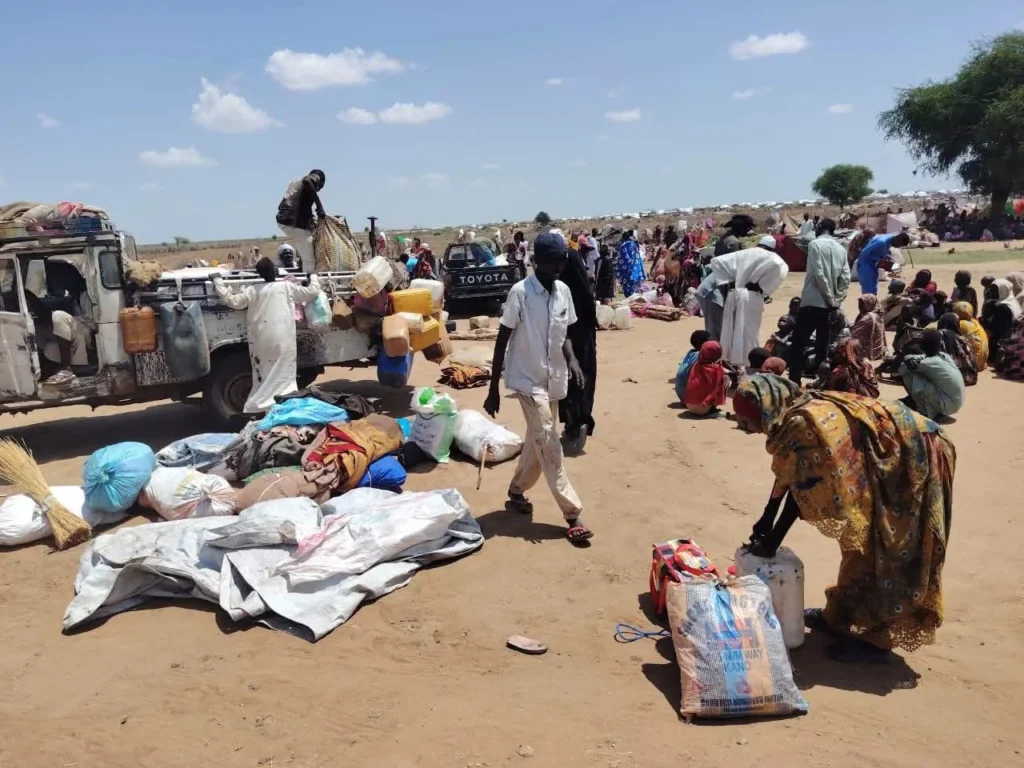
In North Darfur, Tawila has become one of the main destinations for civilians fleeing El Fasher and surrounding areas. The U.N. humanitarian office previously estimated that Tawila was hosting about 625,000 displaced people, while warning that water-trucking services for around 150,000 people could decline because of funding shortages.
The strain has intensified as humanitarian organizations scale back programmes. On Oct. 1, the International Rescue Committee said about 473,700 people in Sudan had lost access to health, nutrition, clean water and protection services after U.S. funding ended in July and temporary financing provided by the organization was exhausted.
The organization said the impact would be particularly severe in Darfur, where 14 health facilities and mobile clinics had been providing care each month to about 16,900 patients and 6,381 young children.
It also said cash assistance for families in Tawila had ended, removing support that households had used to pay for food, shelter and water.
The European map combines displacement locations with reported violent events and areas classified as being at risk of famine. The shaded areas indicate famine risk and should not be interpreted as confirmation that famine conditions exist throughout all highlighted locations.
The three Kordofan states host nearly 1 million displaced people, including about 421,000 in West Kordofan, 330,000 in South Kordofan and 248,000 in North Kordofan. Blue Nile hosts another 381,000.
Humanitarian operations in Kordofan are also facing direct security risks. The World Food Programme said one driver was killed when an aerial attack struck two trucks carrying food assistance from Dilling to Kadugli on Oct. 3, a day after another WFP truck hit an explosive device in Dilling.
WFP said the trucks were clearly marked as humanitarian vehicles and called for a prompt and impartial investigation, without identifying who carried out the attack.
Alongside continued displacement, the map records about 5.15 million people returning to their areas of origin since April 2023, including 4.21 million returning from displacement within Sudan and 936,208 returning from abroad.
The data also show a 26% decline in the total number of internally displaced people compared with January 2025, although return does not necessarily mean humanitarian needs have ended, particularly in areas where health facilities, water networks, homes and livelihoods have been damaged.
Khartoum continues to host about 421,000 displaced people, while Northern State hosts about 333,000, River Nile about 269,000 and White Nile around 220,000.
The displacement crisis is unfolding amid a major funding shortfall. The International Rescue Committee said Sudan’s 2026 humanitarian response plan had received only 42.8% of required funding by the beginning of October.
The European Commission map also warns that continued fighting has left many areas largely inaccessible to humanitarian workers, meaning some of the available displacement data remain partial.
The map draws on datasets collected on different dates and therefore does not represent a single nationwide count taken on the day it was published.