

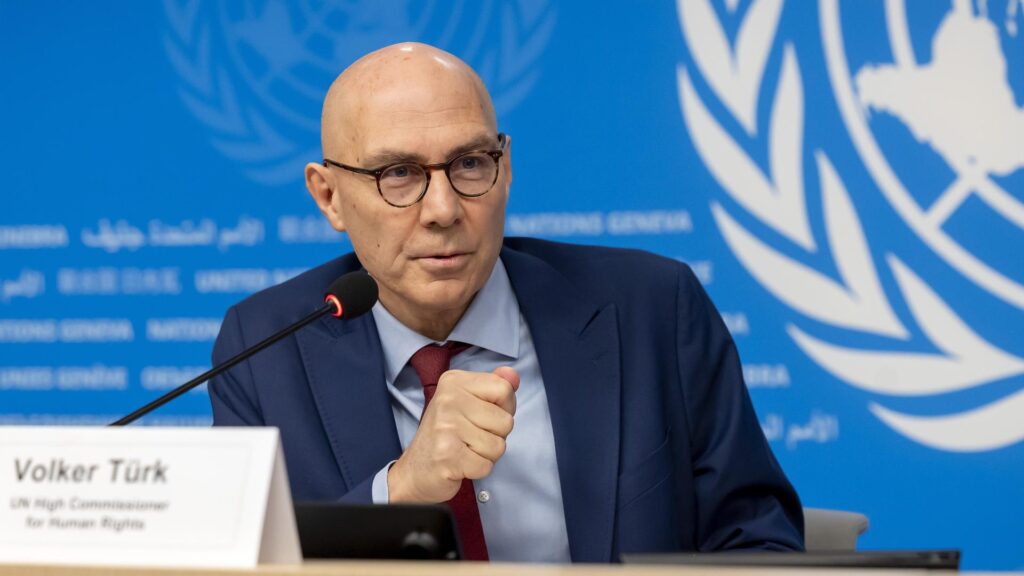
GENEVA – UN High Commissioner for Human Rights Volker Türk called for an immediate ceasefire in Sudan and an end to foreign involvement in the war, warning that civilians remain at imminent risk as attacks increasingly strike markets, hospitals, fuel stations and other civilian areas.
Speaking before the UN Human Rights Council on Monday, Türk said the conflict between the Sudanese Armed Forces (SAF) and the Rapid Support Forces (RSF) has created a massive humanitarian emergency, with more than 6 million people displaced inside Sudan and another 4.5 million forced to flee across the country’s borders.
“There needs to be an immediate ceasefire, an end to foreign involvement, and a return to inclusive civilian rule,” Türk said.
His remarks came after the publication of a new report by the Independent International Fact-Finding Mission for the Sudan, which warned that the growing use of long-range drones by both sides has expanded the reach of attacks far beyond traditional front lines.
Drone Warfare and Civilian Harm
Mohamed Othman, chair of the fact-finding mission, said both the SAF and RSF are increasingly using long-range drones, allowing attacks to reach areas previously distant from active combat zones.
Othman said drone strikes had killed and injured civilians in homes, schools, hospitals, markets, displacement sites and places of refuge, as well as during weddings, funerals and other community gatherings.
The mission warned that the spread of drone warfare has deepened the danger facing civilians in Kordofan, Blue Nile, North Darfur and West Darfur, where fighting, siege conditions and restricted humanitarian access have already weakened essential services.
In El Obeid, North Kordofan, Othman said repeated RSF drone attacks had damaged or disrupted water, energy and other vital civilian infrastructure in a city under partial siege.
“These attacks underscore that these risks remain acute, as civilians continue to face repeated aerial threats, displacement and pressure on already strained essential services,” he said.
War Crimes Concerns
The fact-finding mission said both parties to the conflict carried out attacks affecting civilians and civilian infrastructure.
It cited successive RSF drone strikes on a kindergarten and a hospital in Kalogi, South Kordofan, that killed 114 people, including 60 children.
The mission also cited SAF attacks on Ad-Da’ein Teaching Hospital in East Darfur that killed at least 70 people.
“Based on the evidence gathered, we found reasonable grounds to believe that both the SAF and the RSF committed serious violations of human rights and international humanitarian law which may amount to war crimes,” Othman told the Council.
The report also pointed to significant external support allegedly provided to RSF fighters by individuals and entities in the United Arab Emirates, Chad, southeastern Libya and Puntland in Somalia.
Healthcare System Devastated
In a separate update from Khartoum, the World Health Organization (WHO) said three major hospitals in the capital had suffered extensive damage, reflecting the broader collapse of Sudan’s healthcare system.
Before the war, Khartoum Teaching Hospital, the Ophthalmology Hospital and the Dental Hospital served as major referral and teaching hospitals. WHO said their buildings and medical equipment have now sustained severe damage.
“Operating theatres have been destroyed, imaging equipment lost and several wards have collapsed,” said Dr. Abdinasir Abubakar, WHO representative in Sudan.
He said entire blocks and departments are out of service, adding that the buildings need urgent structural repairs before patients can be safely admitted.
Despite the destruction, hospital staff continue to treat patients in parts of the buildings that remain usable, WHO said.
Background
Sudan’s war erupted in April 2023 after a power struggle between army chief Gen. Abdel Fattah al-Burhan and RSF commander Mohamed Hamdan Dagalo, known as Hemedti, over plans to integrate the paramilitary force into the army during the country’s political transition.
The conflict has since spread across much of Sudan, triggering one of the world’s worst humanitarian crises, destroying health facilities, disrupting aid routes and exposing civilians to repeated attacks by ground forces, artillery and drones.
International and regional efforts have so far failed to secure a lasting ceasefire, while rights investigators continue to warn that foreign weapons, fighters, financing and logistical support are helping prolong the war.
Türk’s latest appeal adds to growing pressure on Sudan’s warring parties and their external backers to stop attacks on civilians, allow humanitarian access and return the country to a civilian-led political process.


