

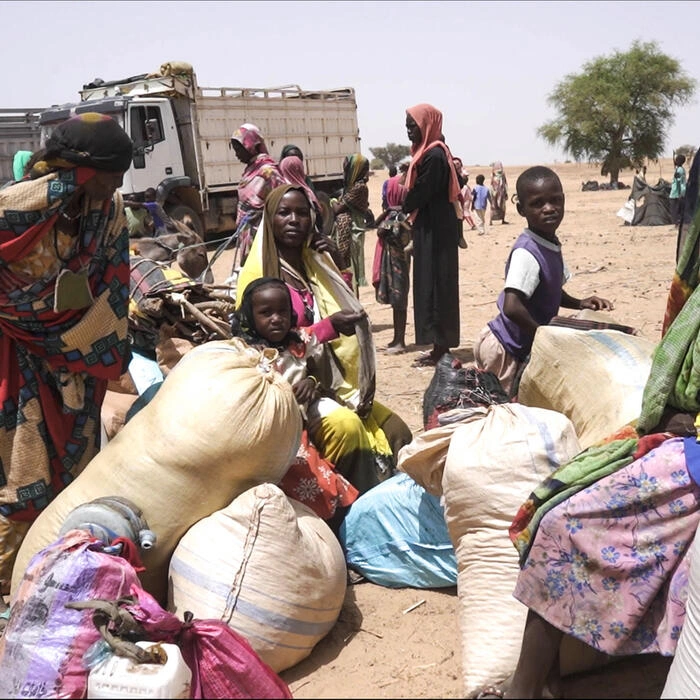
KHARTOUM – About 1.44 million internally displaced Sudanese intend to return to their areas of origin within the next year if movements take place in line with current plans, according to a new International Organization for Migration assessment that found insecurity remains the biggest obstacle to return.
The IOM Displacement Tracking Matrix estimated that 761,435 people intend to return within six months, with another 681,285 expecting to return during the following six to 12 months.
IOM cautioned that the figures reflect stated intentions at the time of the survey and should not be interpreted as a forecast of actual population movements.
The findings come from surveys conducted in August with 11,594 displaced and returnee households across all 18 Sudanese states.
Nearly half — 46% — of internally displaced households said they were likely or very likely to return to their places of origin.
Among those considering return, 36% expected to do so within 12 months, while 51% had no defined timeframe.
Security Remains Main Barrier
Among the 54% of displaced households that were uncertain, unlikely or very unlikely to return, 75% cited insecurity as a barrier.
Lack of livelihood opportunities was reported by 66%, housing problems by 50% and inadequate access to services by 33%.
When asked what could enable their return, 79% identified improved security, followed by livelihood support at 52%, reconstruction of shelter at 38% and cash assistance at 30%.
The findings underline the gap between growing interest in returning home and conditions in many areas affected by more than three years of war.
IOM said perceptions of conditions varied sharply across Sudan and warned that favourable perceptions did not necessarily mean conditions were suitable for safe, dignified and sustainable returns.
Women-Led Households Less Likely to Return
The survey identified a significant difference between male- and female-headed households.
About 40% of female-headed displaced households said they intended to return, compared with 52% of male-headed households.
Female-headed households were also more uncertain about timing, with 63% reporting no defined timeframe compared with 43% of male-headed households.
The report did not attribute the difference to a single cause, but broader findings showed that security, livelihoods, housing and access to services were central considerations affecting return decisions.
West Kordofan, Sennar and Gezira Show High Return Intentions
Return intentions also differed substantially by state.
West Kordofan recorded the highest proportion of displaced households saying they were likely or very likely to return, at 83%, followed by Sennar at 81% and Gezira at 80%.
In Gezira, more than half of surveyed displaced households — 54% — said they were very likely to return.
North Darfur showed a markedly different pattern, with only 31% reporting that they were likely or very likely to return and 64% remaining uncertain.
Among households already planning to return, Red Sea State recorded the strongest near-term intentions, with 68% expecting to return within six months.
South Kordofan followed at 42% and Blue Nile at 37%.
Most Expect Permanent Return
Among displaced households likely to return, 71% said they expected the move to be permanent.
About 78% expected the entire household to return together, while 10% anticipated adult men returning first.
Permanent return was the dominant expectation across all states surveyed, although uncertainty remained high in several conflict-affected areas.
North Darfur had the highest proportion of households with no defined return timeframe at 72%, followed by West Darfur at 64%, and Central and South Darfur at 60% each.
IOM linked the uncertainty in Darfur and Kordofan to continuing conflict, shifting front lines and restrictions on movement and humanitarian access.
Khartoum Emerges as Major Intended Destination
Khartoum was among the most prominent intended return destinations for displaced households currently living in several other states.
Nearly half — 48% — of displaced households surveyed in Gedaref who intended to return identified Khartoum as their destination.
Households displaced in Northern, River Nile, Kassala and North Darfur also reported Khartoum among intended destinations.
In Blue Nile, 77% of households intending to return planned to remain within the state.
The report found that return patterns could involve significant movement across state boundaries rather than simply reversing displacement along the same routes.
Some Returnees Plan to Leave Again
IOM also found that return does not necessarily mark the end of displacement-related movement.
About 10% of surveyed returnee households said they intended to relocate again within the next 12 months, while another 5% were uncertain.
The highest proportions planning to relocate were recorded in Gezira and West Darfur, both at 16%, followed by North Darfur at 15% and Sennar at 11%.
Among returnee households considering relocation and identifying a country of destination, Egypt was the most frequently reported foreign destination at 27%, followed by South Sudan at 8%.
Female-headed returnee households considering another move were more likely than male-headed households to report a destination outside Sudan.
IOM said financial constraints, limited livelihood opportunities and housing problems were among the main obstacles facing households considering further movement.
The organization stressed that the survey measures intentions and perceptions rather than confirmed future movements or actual conditions on the ground.


