

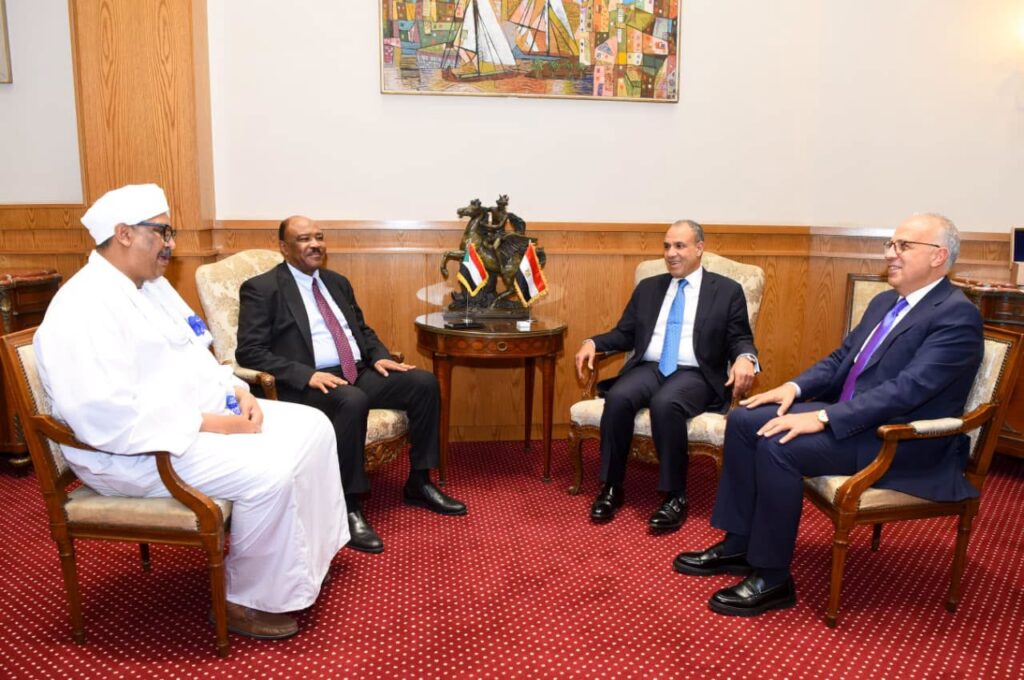
CAIRO – Egypt and Sudan on Monday reaffirmed their security and water alliance, with Cairo saying it was prepared to act under a joint defense agreement to protect Sudan’s unity while both countries rejected what they described as unilateral Ethiopian actions over a major Nile dam.
The positions were set out in a joint statement following the third round of the Egypt-Sudan “2+2” consultation mechanism between the two countries’ foreign and irrigation ministers in Cairo on Nov. 2.
Egypt said Sudan’s unity, territorial integrity and national institutions were directly linked to Egyptian national security and reaffirmed its readiness to take measures permitted under international law and the bilateral Joint Defense Agreement if what it described as red lines were threatened.
The statement did not specify what measures could be taken.
Egypt also rejected the establishment or recognition of parallel entities in Sudan and reiterated its support for Sudanese state institutions.
The talks brought together Egyptian Foreign Minister Badr Abdelatty and Water Resources and Irrigation Minister Hani Sewilam with Sudanese Foreign Minister Mohi El-Din Salem and Agriculture and Irrigation Minister Ismat Qurashi.
Egypt and Sudan Reject Ethiopian Dam Policy
The two countries said their water security was “a single indivisible entity” and reaffirmed what they described as their existing water rights and uses under the 1959 Nile Waters Agreement.
They categorically rejected unilateral actions in the Eastern Nile Basin and said Ethiopia’s unilateral management of its dam posed a continuing threat to downstream countries in the absence of a binding legal framework governing its operation.
Egypt and Sudan called on Ethiopia to return to cooperation based on international law, including prior notification, consultation, consensus and the principle of avoiding significant harm.
They also said the dispute over the Ethiopian dam concerned only Egypt, Sudan and Ethiopia and rejected attempts to broaden the issue to other Nile Basin countries.
At the same time, the statement emphasized what the two governments described as historic relations with the Ethiopian people.
Cairo and Khartoum Back Joint Nile Position
Egypt and Sudan agreed to strengthen the role of the Permanent Joint Technical Commission for Nile Waters, established under the 1959 agreement, in developing common positions on Nile-related issues.
They also reaffirmed support for the Nile Basin Initiative and called for restoration of consensus among basin states.
The statement welcomed a consultation process aimed at addressing concerns over the Cooperative Framework Agreement and restoring what the two countries described as an inclusive regional mechanism representing all Nile Basin states.
Both sides said they support development projects in the southern Nile Basin provided they follow required technical studies and principles of prior notification, consultation and consensus.
Red Sea Access and Militarization Rejected
The two governments also adopted a joint position on Red Sea security.
They said governance of the Red Sea should remain the responsibility of littoral states and rejected maritime access for non-littoral countries if such arrangements came at the expense of the sovereignty, territorial integrity or port security of Red Sea states.
Egypt and Sudan also opposed what they described as attempts to exploit regional instability to militarize the Red Sea or impose unilateral arrangements affecting states in the region.
The statement did not identify any specific country or agreement in this section.
Drone Attacks Condemned
The two countries condemned drone attacks on Sudanese infrastructure, particularly electricity and water facilities, which they said had been launched from a neighbouring country.
The statement referred to attacks carried out by what it described as rebel militias and reiterated the need to respect Sudan’s sovereignty and territorial integrity.
Egypt also expressed support for Sudan’s national institutions, including the Sudanese Armed Forces, in carrying out their constitutional responsibilities to protect national security.
Sudan has separately accused the Rapid Support Forces of launching drone attacks from Ethiopian territory against electricity facilities and other civilian infrastructure.
Ethiopia has previously denied Sudanese accusations that its territory is being used to support attacks inside Sudan.
Reconstruction and Jebel Aulia Dam
The talks also addressed Sudan’s recovery and reconstruction.
Sudan said it wanted to deepen cooperation with Egypt across reconstruction sectors and welcomed an Egyptian initiative to assess damage to the Jebel Aulia Dam.
The statement said Egyptian technical experts were carrying out maintenance work in cooperation with Sudan’s Ministry of Agriculture and Irrigation.
Egypt said it was prepared to support Sudanese government reconstruction efforts across multiple sectors.
The two sides also agreed to expand training for Sudanese irrigation officials as part of efforts to rebuild the country’s water institutions.
Broader Bilateral Coordination
The ministers reviewed implementation of commitments from their previous “2+2” meeting in September 2025 and directives issued during consultations between the two prime ministers in February 2026.
They agreed to intensify official visits and coordination across political, economic, water, cultural, social and humanitarian issues.
The joint statement places Sudan’s war, Nile water disputes, Red Sea security and regional drone attacks within a broader framework of increasingly close political and security coordination between Cairo and Khartoum.


