

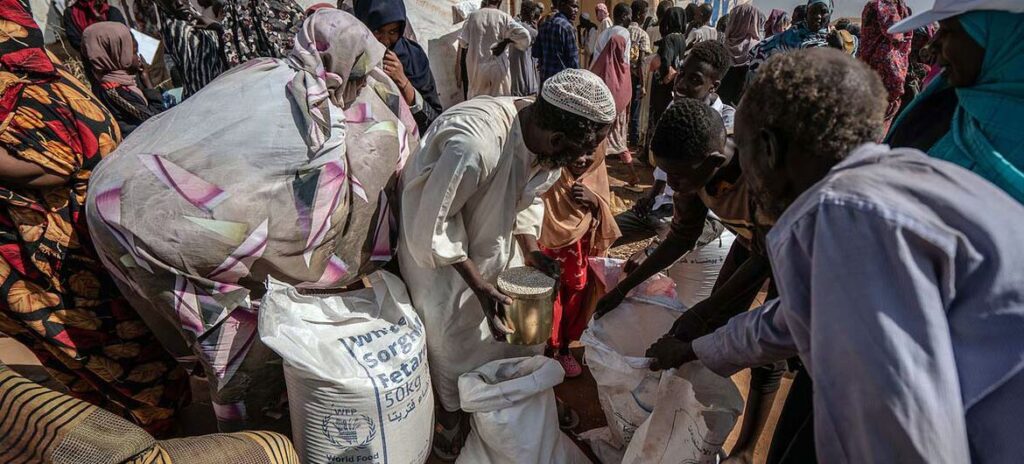
PORT SUDAN – The World Food Programme (WFP) warned that around 20 million people in Sudan are facing acute hunger, while the International Organization for Migration (IOM) cautioned that critical emergency relief supplies could run out by the end of September unless new funding is secured.
WFP Acting Executive Director Carl Skau, speaking at the end of an eight-day visit to Sudan that included Khartoum, Darfur and Kordofan, described the situation as “the world’s largest hunger and displacement crisis.”
Skau said about 5 million people are facing emergency levels of hunger, while around 200,000 people are experiencing famine-level hunger, or IPC Phase 5, the highest level of the international food insecurity scale.
WFP also estimated that around 14 million people have been displaced by Sudan’s war.
Severe Conditions in El Fasher and Tawila
Skau described conditions in El Fasher as extremely severe after about 18 months of siege, with widespread destruction and sharply reduced economic activity.
WFP is providing food assistance to about 20,000 people who remain in the city.
In Tawila, North Darfur, Skau said around 250,000 additional displaced people had arrived since his previous visit in April, bringing the population there to nearly 1 million.
WFP has expanded operations to reach around 950,000 people each month, but families are receiving only about half of their normal food rations because of funding constraints.
Drought Adds Pressure in Darfur
Skau also warned of severe drought conditions in Darfur, saying the region had not experienced conditions of this scale since 1984.
The drought is placing additional pressure on communities already affected by war, displacement and hunger, while threatening agriculture and livestock on which many families depend.
The combination of conflict, food shortages, displacement and deteriorating livelihoods has pushed parts of Sudan deeper into humanitarian crisis.
WFP Warns of Major Funding Cuts
Skau warned that funding shortages could force WFP to significantly reduce operations in the coming weeks.
He urged donors to provide additional resources and said ending Sudan’s crisis also requires urgent “political investment” to stop the war.
The warning comes as other humanitarian agencies report similar financial pressures across Sudan.
IOM: Humanitarian System Could Collapse Within Weeks
The International Organization for Migration warned that emergency relief supplies delivered through its Common Humanitarian Pipeline are close to running out.
IOM Director General Amy Pope said the humanitarian system could face collapse within weeks if additional funding is not secured.
“We cannot turn our backs on the people of Sudan when they need us most,” Pope said, pointing to continued fighting, increasing displacement and the impact of heavy rains.
She warned that without new funding, humanitarian agencies would be unable to deliver assistance to some of the areas where needs are most severe.
IOM said displacement continues to rise across communities affected by conflict and other crises, leaving vulnerable families exposed to further risks.
According to the organization’s Displacement Tracking Matrix, around 8.6 million people remain internally displaced, while approximately 4.9 million returnees have been recorded.
About 70% of internally displaced people are living with host families or in informal settlements.
Violence, flooding and heavy rains continue to damage shelters and force some families to move repeatedly, IOM said.
Emergency Supplies Expected to Run Out
IOM said current stocks of shelter materials, sanitation supplies and emergency household relief items are expected to be depleted by the end of September 2026 without immediate donor support.
The organization said the Common Humanitarian Pipeline has reached around 2.84 million people since July 2023, but its reach has steadily declined despite growing humanitarian needs.
More than 1 million people received assistance through the system in 2024, falling to 804,000 in 2025.
So far in 2026, IOM said it has provided shelter materials and emergency support kits to around 330,000 people.
The pipeline supplies emergency relief materials through a network of more than 100 registered humanitarian partners, allowing agencies to rapidly distribute assistance where it is needed.
IOM warned that disruption of the system would significantly weaken humanitarian agencies’ ability to mobilize and deliver life-saving aid.
Rebuilding the pipeline after any collapse would be complex, expensive and time-consuming, requiring the restoration of supply chains, operational systems and coordination networks.
$15 Million Needed to Keep Pipeline Operating
IOM said it needs at least $15 million to maintain the pipeline at minimum operating capacity for 12 months, which would allow it to support about 305,000 people.
Around $27 million would restore assistance to levels close to those seen in 2025 and allow aid to reach approximately 570,000 people.
With $42 million, IOM said the humanitarian response could be expanded to provide immediate life-saving support to as many as 1 million people.
The warnings from WFP and IOM highlight mounting pressure on Sudan’s humanitarian response as hunger, displacement, drought, heavy rains and continued fighting drive needs higher while international funding falls short.
Sudan’s war, which began in April 2023 between the Sudanese Armed Forces (SAF) and the Rapid Support Forces (RSF), has devastated food production, disrupted markets and aid routes, displaced millions of people and severely weakened public services across large parts of the country.


